[AINews] Much ado about Open Weights
- Source
- latent.space
- Author
- Latent.Space
- Date
Context
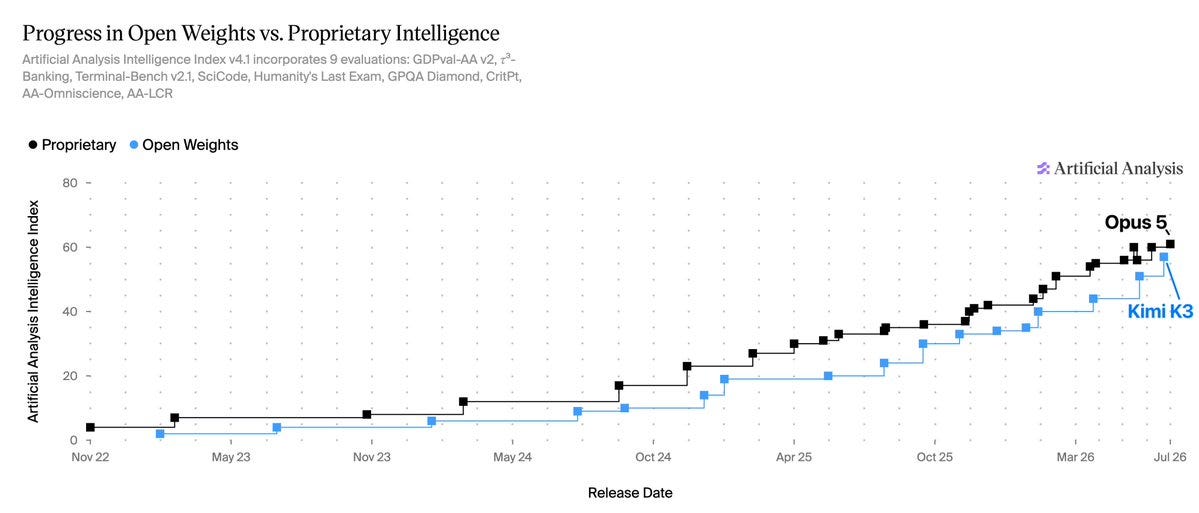
Moonshot AI's Kimi K3 release gives organizations downloadable model weights they can deploy themselves. Its model card documents that access, while its license determines which commercial uses require additional permission.
For companies operating a model-as-a-service business, the license requires a separate commercial agreement when combined revenue with affiliates exceeds $20 million over any consecutive twelve months. Internal use and access through official products or certified inference partners are exempt from that requirement. The release therefore expands control over deployment, while preserving conditions that depend on how a business uses the model.
- Kimi K3 is a 2.8T-parameter with 104B active, 896 experts of which 16 fire per token, a 1M-token , and native vision, with a reported ~2.5x scaling-efficiency gain over K2 from work on numerical stability at scale.
- Moonshot shipped the surrounding machinery too: FlashKDA kernels, the MoonEP library for MoE communication, and AgentENV for distributed agent environments. That is closer to a full recipe than a weights drop.
- "" is not OSI open source here. Hosting providers above $20M a year need a separate agreement, and products above 100M monthly users or $20M monthly revenue must display "Kimi K3" in the UI.
- Agent skills carry a regression tax. Across nearly 6,000 paired runs, adding skills produced real gains but also broke tasks the agent had previously solved without them, so stuffing more procedures into context is not free.
- End-to-end RL over a multi-module pipeline causes role drift: overall accuracy rises while modules quietly abandon their assigned jobs, such as a decomposer that embeds the answer instead of structuring the problem.
- open weights — A model whose trained parameters are published for anyone to download and run — unlike API-only models you can access but never possess.
- mixture-of-experts — A model built from many specialist sub-networks where only a few activate per token, giving big-model capability at small-model running cost.
- context window — The maximum amount of text a model can consider at once — its working memory for the current conversation or task.
- attention — The mechanism that lets a model weigh which earlier words matter for the word it's currently processing — the core operation of a transformer.
“This is more than a model drop; it is a fairly complete recipe for large-scale agentic post-training and serving.”
“That breadth underscores that open-weight frontier launches are now supply-chain events, not just research announcements.”
“As usual, public eval gains and harness-specific production utility are diverging.”



Checking sign-in…
Loading comments…