The State Of LLMs 2025
- Source
- magazine.sebastianraschka.com
- Author
- Sebastian Raschka, PhD
- Date
Context
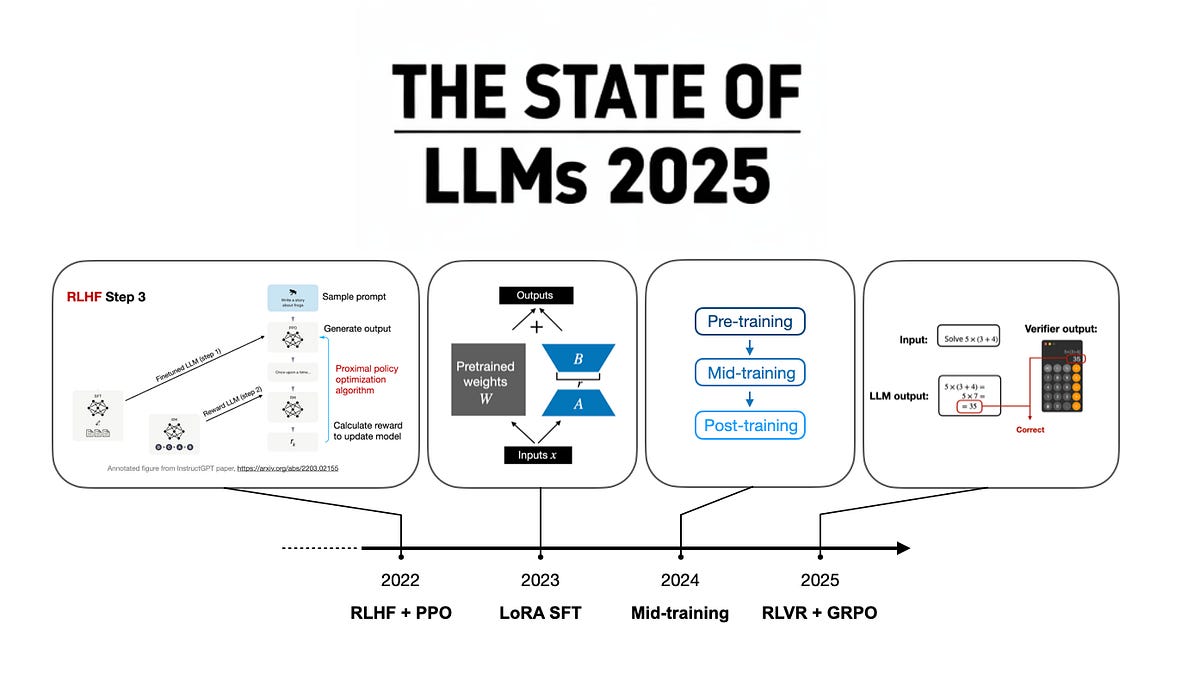
Automatic answer checks made reinforcement learning a more scalable way to improve language models, argues researcher Sebastian Raschka in a 2025 review. In reinforcement learning with verifiable rewards, a model generates responses and receives a training signal from whether its answers pass a check. For suitable mathematical problems, correctness can be checked automatically, reducing the need for people to label every response.
That changes where developers can spend additional computing resources: they can improve a pretrained model through repeated attempts and feedback. The approach is especially useful where reliable checks exist. Extending it to questions without an easily verified answer requires a way to judge success.
- DeepSeek reset cost intuitions: roughly $5M of compute for the V3 base run and another $294K to train R1 on top. The caveat is that this covers the final run only, excluding salaries, failed experiments, and hyperparameter search.
- RLVR works because a deterministic program can check correctness, so post-training stops being bottlenecked by hand-written responses or human preference labels and starts scaling with compute the way does.
- The dominant technique rotates roughly yearly: with PPO in 2022, fine-tuning in 2023, mid-training (synthetic data, data mixes, long-context stages) in 2024, RLVR with GRPO in 2025. Each stays in use, it just stops being the frontier.
- Process reward models, which grade each reasoning step rather than only the answer, were tried and dropped in DeepSeek R1 because the gain didn't justify the compute overhead at RL scale. DeepSeekMath-V2 suggests scored explanations are returning.
- Continual learning is blocked by catastrophic forgetting: continued pretraining shows a model absorbing new knowledge loses some old knowledge, which is why the topic stayed hot all year without a breakthrough.
- test-time compute — Spending more computation when the model answers — thinking longer, trying multiple attempts — to buy accuracy without training a bigger model.
- pretraining — The first, biggest phase of building a model: training it on enormous amounts of text so it learns language, facts, and reasoning in general.
- RLHF — Reinforcement learning from human feedback — training a model to prefer answers humans rate as better, which turns a raw text predictor into a usable assistant.
- LoRA — A cheap way to fine-tune a model by training a small add-on layer instead of changing all of the model's weights.
“If I had to pick a word or trend that describes LLM development this year, it would be ",”

Checking sign-in…
Loading comments…