- Category
- Developer Tools
- Rank
- No. 3721Tools index
Previous survey · No. 3511 ·
- Pricing
- Open Source
- Type
- TOOL
- Use case
- Data Processing
- Builder
- vercel-labs
- GitHub
- 67 stars
- Date
About
Visualizer for npm download trends across packages — see which libraries are winning.
What it does
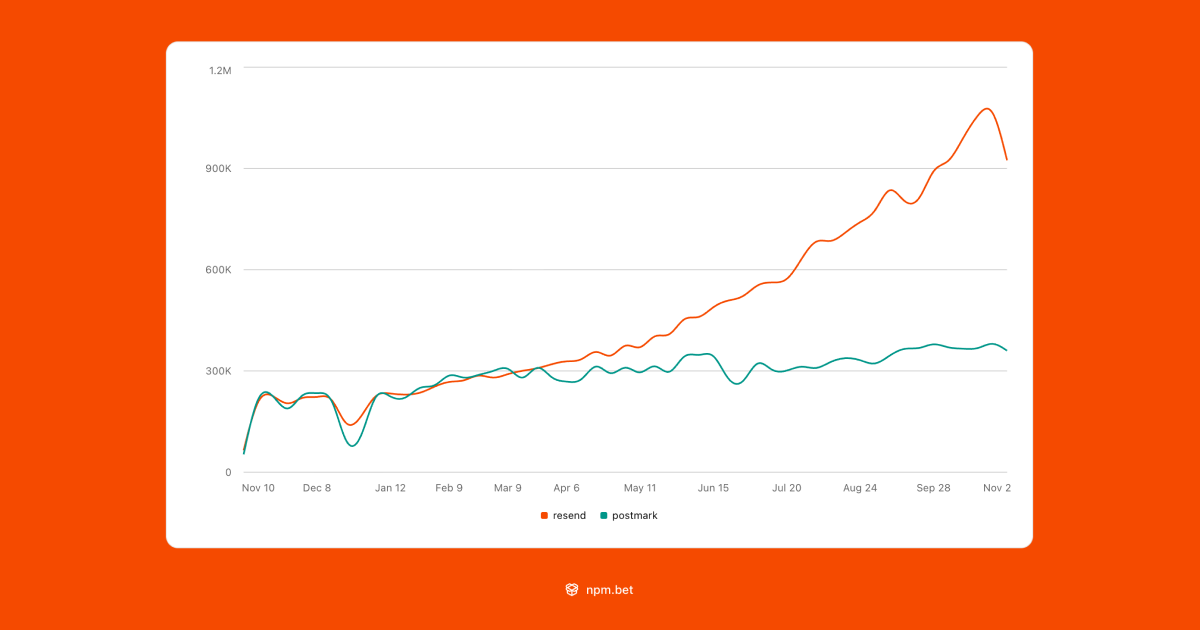
npm.bet turns npm download history into interactive line charts. Search for several packages, choose a time window and daily, weekly, or monthly grouping, then compare raw totals or relative share. Charts can be saved as PNG images or embedded as SVG.
Why it's ranked here
The focused scope is persuasive: package search, multi-package comparison, flexible aggregation, share calculations, and export all support one practical question. URL-backed filters and generated social images also make comparisons easy to revisit and circulate. It is useful evidence of adoption, but not a complete package evaluation.
What's good
The chart drops the current incomplete day, week, or month, avoiding misleading partial-period comparisons. Share mode calculates each package’s percentage of the selected set. Export supports both high-resolution PNG files and SVG snippets for Markdown, HTML, or direct links. Download data is cached for one hour to reduce upstream load.
Tradeoffs
Download counts measure usage volume, not code quality, maintenance, security, compatibility, or developer satisfaction. Relative share only works with multiple selected packages and describes that chosen set, not the whole npm ecosystem. One-hour caching means results need not reflect the newest upstream response. Current incomplete periods are intentionally omitted.
How to use it well
Use it when comparing candidate libraries, tracking adoption patterns, or preparing a chart for documentation and discussion. Start with raw downloads, adjust grouping to reduce noise, then use share mode to inspect movement within the selected group. Pair it with separate source, security, compatibility, and maintenance checks before choosing a dependency.
Technical notes+
package.json defines a private Next.js 16 application using React 19, TypeScript, SWR, Recharts, Tailwind CSS 4, Radix UI, date-fns, nuqs, and html-to-image, with pnpm scripts for development, builds, Ultracite checks, and fixes. components/main.tsx fetches each selected package through a server action and handles empty, loading, and error states. components/chart.tsx merges grouped series by date, removes incomplete periods, computes relative share, and renders Recharts lines. lib/chart-utils.ts performs Sunday-based weekly grouping, monthly grouping, XML escaping, and compact number formatting. app/page.tsx builds comparison-specific Open Graph metadata, while next.config.ts enables AVIF, WebP, and Turbopack’s development filesystem cache.
Observed
- License
- MIT
- Primary language
- TypeScript
- Packaging
- Private Next.js web application managed with pnpm; not published as an npm library
- Interface
- Responsive browser interface with package search, interactive charts, PNG export, and SVG embed output
- Data source
- Official npm Registry search and download statistics APIs
- Runtime requirement
- Node.js 20 or higher
Read from README.md, package.json, lib/utils.ts, lib/chart-utils.ts, next.config.ts, postcss.config.mjs, app/page.tsx, app/layout.tsx, components/main.tsx, components/logo.tsx, hooks/use-mobile.ts, components/chart.tsx, components/footer.tsx, components/github.tsx, components/header.tsx.
What it can do
Visualize npm package download trends
npm package names → Interactive charts showing download statistics over time
Compare download performance between packages
Multiple npm package names → Comparative visualization showing relative popularity
Track package adoption trends
npm package name and time period → Trend analysis showing growth or decline patterns
Identify winning libraries in categories
Related npm packages or library categories → Rankings and metrics showing market leaders
Generate download statistics reports
npm package names and date ranges → Statistical data on package download volumes
Tags
Tech Stack
Media
Comments (0)
No comments yet
Editorially curated, with community endorsements as a secondary signal. Corrections welcome.