Sauron
sauron.splimter.com- Category
- Developer Tools
- Rank
- No. 2564Tools index
- Pricing
- Open Source
- Type
- TOOL
- Use case
- Deployment & Operations · Data Processing
- Interfaces
- Client SDK · MCP · Web
- Date
About
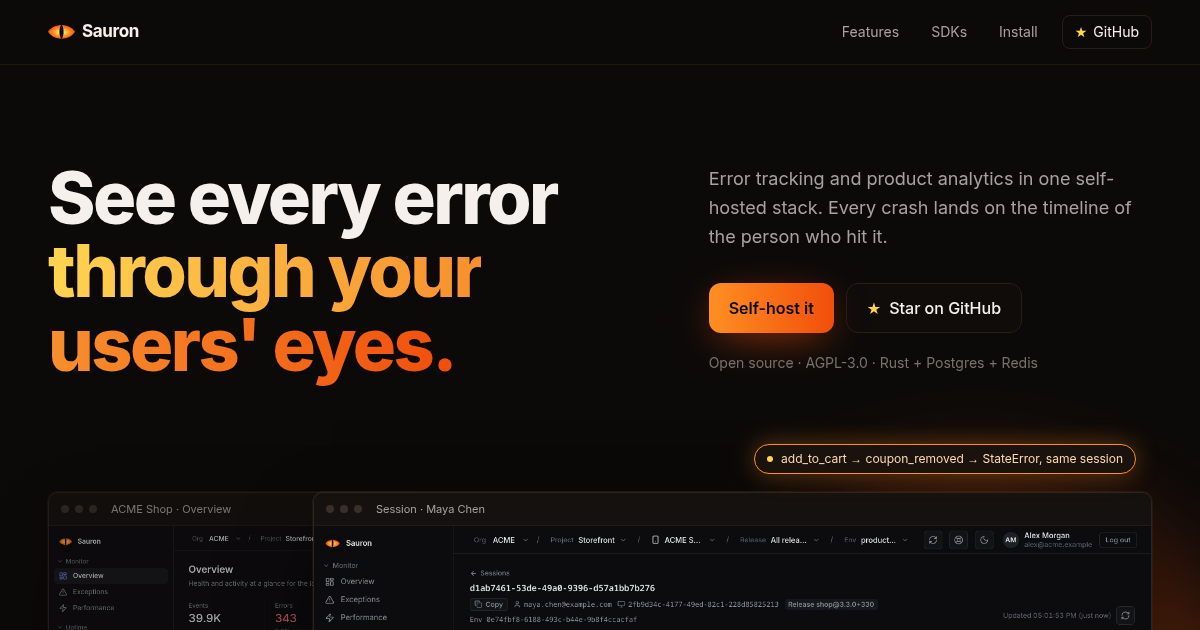
A self-hosted platform that combines error tracking and product analytics so each crash appears on the timeline of the user who hit it. It offers SDKs for browser, Flutter, Node, Python and C#, plus alerts, uptime monitors, performance data, release tracking and an MCP endpoint for AI assistants. The server is built with Rust, Postgres and Redis.
At a glance
Sauron is an open-source error tracker and product analytics server that you host yourself. One SDK call ties every event and crash to a person, so an issue shows who hit it, on which release, and what they did first. It suits teams that want both signals on their own servers. Expect to run Postgres and Redis and to adopt a young, small project.
Good fit
Teams shipping web, Flutter, Node, Python or C# apps who run one tool for crashes and another for analytics, and want to ask "did this bug cost us customers?" without exporting data between them. Retention can be split by whether people hit an error. It also fits groups that must keep event data on their own infrastructure, or want AI agents to query issues through scoped MCP keys.
Consider something else when
Skip it if you want a hosted service or nobody on your team can operate a server. Sauron is open source you run yourself, alongside Postgres and Redis. Also skip it if you need session replay or SSO, which the project lists as out of scope, an SDK beyond browser, Flutter, Node, Python and C#, or if AGPL-3.0 terms on a modified server are a problem.
Start here
Run git clone https://github.com/edraj/sauron.git, then cp .env.example .env and replace JWT_SECRET and NOTIFY_SECRET_KEY with values of at least 32 characters (openssl rand -hex 32). Run docker compose up --build; the first build compiles the Rust workspace seven times. Open the dashboard at localhost:10002, register, create a project and an app, copy the dev environment's DSN from Settings, Environments into @edraj/sauron-browser, and watch the first event land.
Cost and requirements
There is no software price: the server is AGPL-3.0, and the SDKs are LGPL-3.0, so they can ship inside closed-source apps. Billing is outside the project's scope. Your cost is hosting Sauron, Postgres and Redis through Docker Compose or native packages for Fedora/RHEL and Debian 12 or Ubuntu 22.04. Building the packages needs Rust and Node. Alerts go to Email, Slack, Discord, Matrix, Telegram or a webhook.
Limits to know
The project is young: the GitHub repository shows one star and one fork, and its SDK feature matrix is at v0.3.0. Operation carries sharp edges. Losing NOTIFY_SECRET_KEY means deleting and re-creating every alert channel, one upgrade cannot be downgraded for notification channels, and personal-data masking skips older data moved to Parquet. Unindexed searches cover only the last 30 days by default.
Related work
- Sentry: hosted error tracking and performance monitoring (alternative)
- Amplitude: dedicated product analytics (alternative)
Still unclear
- How much Postgres storage and server capacity does a production deployment need at a given monthly event volume?
- Can existing Sentry or PostHog SDK instrumentation send data to Sauron, or does switching require re-instrumenting with Sauron's own SDKs?
Sources checked 2026-11-14. Source-based assessment.
Tags
Media
Comments (0)
No comments yet
Editorially curated, with community endorsements as a secondary signal. Corrections welcome.