Gpt 6 1 Terra Pushes The Cost Efficiency Frontier
- Source
- artificialanalysis.ai
- Author
- Artificial Analysis articles
- Date
Context
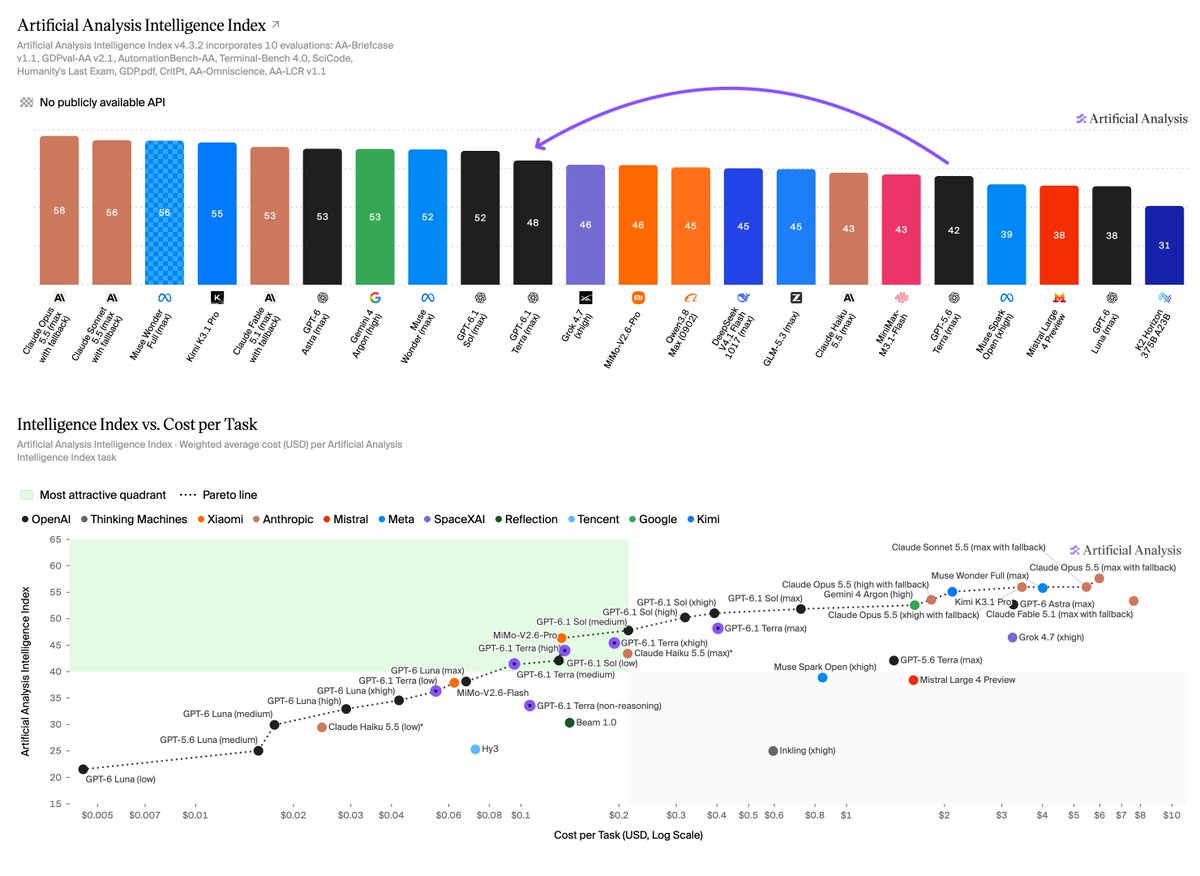
Artificial Analysis, an independent firm that benchmarks AI models, finds that OpenAI's GPT-6.1 Terra has something its predecessor lacked: settings where it is the efficient choice. Terra is the model family that scores between OpenAI's Sol and Luna. When Artificial Analysis charted the previous generation, GPT-5.6 Terra trailed both siblings at every effort setting, meaning a Luna or Sol setting was always smarter at no extra cost or as smart for less. Effort settings control how much the model reasons before answering, which changes both quality and cost. In its GPT-6.1 Terra results, Artificial Analysis places the low and medium settings on its cost-efficiency frontier: no option it tested beat them on both its Intelligence Index score and cost per task.
Two things moved at once. Per- prices fell to $1 per million input tokens and $5 per million output tokens, against $2 and $12 for GPT-5.6 Terra, and cached input fell from $0.20 to $0.05 per million. Scores also rose. At max effort GPT-6.1 Terra gains 6 points on the Intelligence Index over GPT-5.6 Terra while costing $0.40 per task against $1.40, and at lower effort settings the gain is 7 to 13 points.
The clearest behavioral change is in guessing. On AA-Omniscience, Artificial Analysis's private test of knowledge and , GPT-6.1 Terra guesses 38% of the time when it does not know the answer, down from 88% for GPT-5.6 Terra, and its accuracy also rose 2 points, so the drop did not come at the cost of fewer correct answers. On Terminal-Bench 4.0, an agentic benchmark where the model works in a command-line terminal, it gained about 20 points, which Artificial Analysis says now rivals GPT-6.1 Sol at max effort. Most other evaluations improved less, such as 5 points on GDP.pdf.
The case for Terra is cost, not ceiling. At max effort it scores 4 points below GPT-6.1 Sol and 10 above GPT-6 Luna on the Intelligence Index, and 48 on Artificial Analysis's Coding Index against 54 for Sol and 31 for Luna, with its low and xhigh settings on that index's cost frontier. These are one evaluator's measurements, so a team picking a model would still want to test it on its own work.
- Artificial Analysis reports GPT-6.1 Terra costs $1/$5 per million input/output tokens versus $2/$12 for GPT-5.6 Terra, with cached input down from $0.20 to $0.05 and cache writes halved to $1.25.
- At max effort, GPT-6.1 Terra gained 6 Intelligence Index points over GPT-5.6 Terra at $0.40 per task versus $1.40. Lower effort settings gained 7 to 13 points, and only low and medium effort sit on the cost-efficiency frontier.
- On AA-Omniscience, GPT-6.1 Terra guessed on 38% of questions it could not answer, down from 88% for GPT-5.6 Terra, while accuracy rose 2 points, meaning it also answered more questions correctly.
- GPT-6.1 Terra scored 48 on the new Coding Agent Index v2.0, between GPT-6.1 Sol (54) and GPT-6 Luna (31), and gained about 20 points on Terminal-Bench 4.0, rivaling Sol at max effort. Most other moved less, such as 5 points on GDP.pdf.
- token — The chunk of text a model reads and writes in — roughly three-quarters of a word — and the unit AI usage is billed in.
- hallucination — When a model states something false with full confidence — inventing facts, citations, or APIs that don't exist.
- AI agent — An AI system that doesn't just answer once but works toward a goal in a loop — taking actions, reading the results, and deciding what to do next.
- eval — A repeatable test for AI quality — a set of tasks plus scoring — used the way software teams use test suites, because model output is too variable to judge by eyeballing.
 articleVials Aa
 articleThinking Machines Releases Inkling 2 Small Highest Scoring Open Weights Model Outside Of Chinia Upon Weights Release It
 articleNanbeige Has Released Nanbeige4 3 33b Scoring 20 On The Intelligence Index
 articleGithub Copilot Fusion Orchestrates Anthropic And Openai Models To Balance Performance And Cost
Checking sign-in…
Loading comments…