
Helicone
github.com/helicone/helicone- Category
- Developer Tools
- Rank
- No. 352Tools index
- Listed in
- #3 Observe an LLM application
- Pricing
- Freemium
- Type
- TOOL
- Use case
- Deployment & Operations · Software Testing & Quality
- Interfaces
- API
- Builder
- helicone
- GitHub
- 6.2k stars
- Latest release
- v2025.08.21-1
- Date
About
Helicone is an AI Gateway and LLM observability platform that lets developers route, monitor, and debug AI applications across 100+ models with a single API key. It provides real-time cost and latency tracking, prompt management, agent tracing, and one-line integration with OpenAI, Anthropic, and other major providers. It's backed by Y Combinator and used by fast-growing AI companies to build more reliable AI products.
What it does
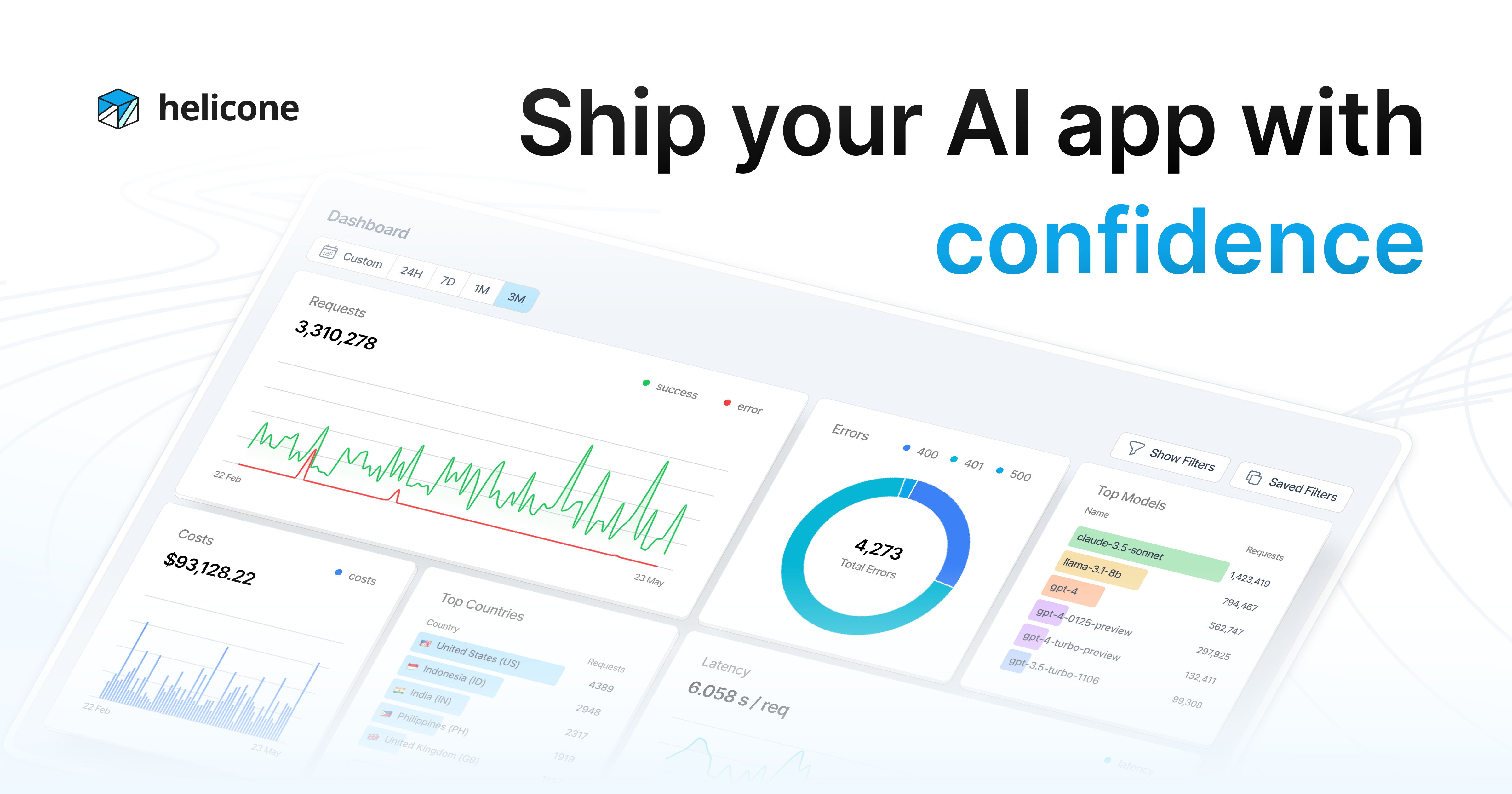
Helicone sits between an application and its model providers, recording requests so teams can inspect traces, sessions, costs, latency, and quality. Its browser workspace also supports prompt experiments and versioning, while routing rules can move traffic between providers or retry through fallbacks.
Why it's ranked here
The appeal comes from combining operations and analysis in one control point. Provider routing, automatic fallback, production-derived prompt versions, session debugging, and detailed usage costing form a coherent workflow. Docker self-hosting and an MCP server broaden access beyond the hosted dashboard.
What's good
Integration can be as small as changing the endpoint used by an existing OpenAI client. Cost accounting distinguishes prompt, completion, audio, cache reads, cache writes, images, and per-call charges. Request and session queries accept filters and pagination, while custom metadata connects model activity to users and application sessions.
Tradeoffs
Self-hosting brings a substantial stack: a web frontend, edge worker, logging server, authentication database, analytics database, and object storage. The production Helm chart requires enterprise contact, and manual deployment is explicitly discouraged. Fine-tuning depends on partner services rather than a native training system.
How to use it well
Use Helicone when a team wants one operational layer for model traffic, incident investigation, spend analysis, and prompt iteration. Start by redirecting an existing OpenAI-compatible client, then add session and user metadata for useful traces. Keep separate tools for model training, since Helicone delegates fine-tuning to partners.
Technical notes+
The root package.json defines a private Yarn workspace monorepo requiring Node 20 or newer, with workspaces for bifrost, web, packages/*, valhalla/jawn, worker, and e2e. worker/src/index.ts selects proxy and gateway behavior from request hosts, supports regional environment substitution, signs Bedrock requests, and targets numerous provider endpoints. packages/cost/index.ts calculates token, cache, audio, image, and per-call costs and generates ClickHouse expressions. packages/llm-mapper/path-mapper/index.ts exposes OpenAI, Anthropic, and Gemini chat mappers. helicone-mcp/src/index.ts runs an MCP stdio server with query_requests, query_sessions, and use_ai_gateway tools. valhalla/prompt_security/main.py provides a FastAPI service backed by a locally loaded Transformers classifier. scripts/populate-keys/main.py contains a hard-coded bearer credential for localhost key seeding.
Observed
- Primary implementation
- TypeScript monorepo with additional Python services and scripts
- Runtime and packaging
- Private Yarn workspaces monorepo requiring Node.js 20 or newer
- Primary interfaces
- HTTP AI gateway, browser interface, and MCP stdio server
- Client integration surface
- AI Gateway supports JavaScript, TypeScript, Python, and cURL
- Self-hosting
- Docker Compose is documented; manual deployment is discouraged
- Production deployment
- A Helm chart is available through enterprise contact
- Storage architecture
- Supabase handles application data and authentication, ClickHouse handles analytics, and Minio stores logs
Read from README.md, package.json, packages/cost/index.ts, packages/common/index.ts, packages/pricing/index.ts, packages/common/result/index.ts, packages/common/attribution/index.ts, packages/llm-mapper/path-mapper/index.ts, packages/llm-mapper/router-bindings/index.ts, web/pages/index.tsx, worker/src/index.ts, helicone-mcp/src/index.ts, scripts/populate-keys/main.py, helicone-heartbeat/src/index.ts, valhalla/prompt_security/main.py.
What it can do
Route AI requests across multiple LLM providers
Single API key and AI request → Request delivered to the appropriate model from 100+ supported providers
Track real-time cost and latency of LLM API calls
AI application requests and responses → Cost breakdowns and latency metrics per request, model, and time period
Log and replay AI requests for debugging
LLM API calls from the application → Searchable request/response logs with the ability to replay and inspect failures
Trace multi-step AI agent workflows
Agent execution sessions with multiple LLM calls → Visual trace of agent steps, tool calls, and model interactions
Version and manage prompts
Prompt templates with variables → Versioned prompt history with the ability to compare and roll back changes
Integrate LLM observability into an existing app
Existing OpenAI or Anthropic API client code → Fully instrumented application with one-line code change
Self-host the AI gateway and observability platform
Docker or Helm configuration → Privately deployed Helicone instance running on the user's own infrastructure
Tags
Tech Stack
Media
Comments (0)
No comments yet
Editorially curated, with community endorsements as a secondary signal. Corrections welcome.