Television
television.run- Category
- AI Agents
- Rank
- No. 1202Tools index
Previous survey · No. 1144 ·
- Pricing
- Open Source
- Type
- APP
- Use case
- Coding
- Interfaces
- CLI · Desktop · Web · Agent Skill / Plugin
- GitHub
- 250 stars
- Date
About
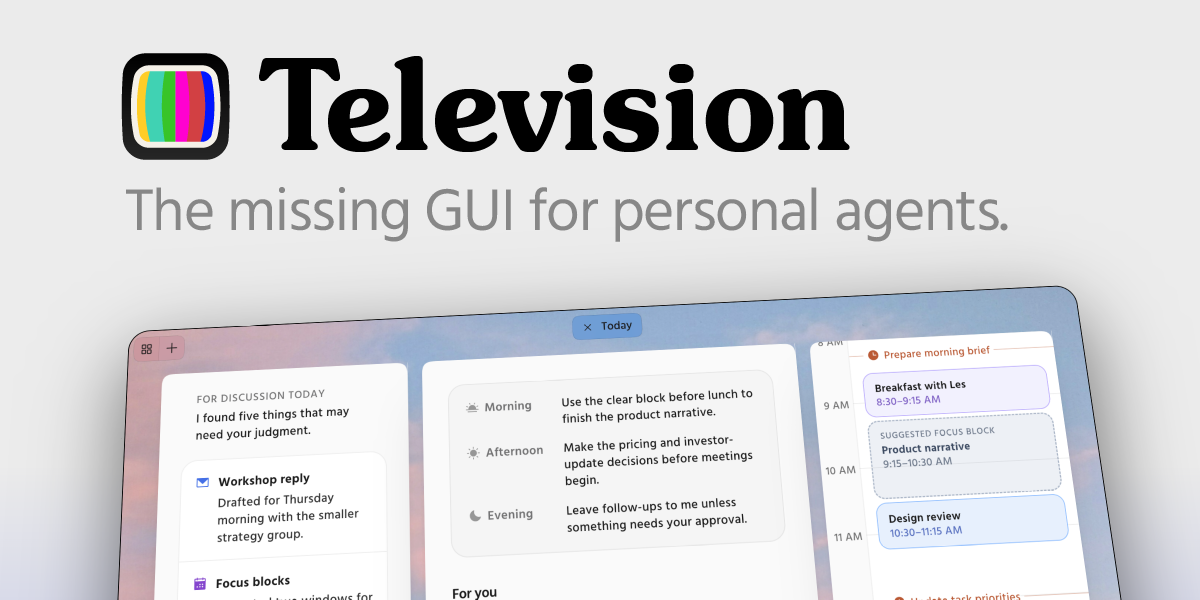
Television is an open source GUI for agent harnesses, giving users a visual space to create and work with artifacts alongside their agent. A CLI and lightweight server run where the harness runs (Linux or macOS), and connect to a macOS client app, with limited browser support. Skills teach the agent to place and modify artifacts on screen, and it works with harnesses such as Claude Code, Codex, OpenCode and Pi using the inference providers they already use.
What it does
Television adds a second screen to a chat-based coding or personal agent. Instead of answering only in text, the agent can pin documents, charts, task lists, calendars, web pages or small interactive apps onto persistent tabs and keep editing them later. A small server runs next to the agent, a bundle of instructions tells the agent how to use it, and you watch the result in a desktop app on a Mac or, experimentally, in any browser.
Why it's ranked here
Agents that only reply in a scrolling transcript lose anything visual the moment the chat moves on, and Television answers that with persistent, editable panels that any harness supporting skills and file access can drive. The engineering behind it is unusually documented for a young tool: written specifications govern telemetry, the artifact sandbox and frame lifecycle, the license is MIT, and the server prints explicit warnings when run without a token. The limits are real too. Outside code contributions are not accepted yet, and the polished client is macOS only.
What's good
The privacy design is checkable rather than promised. Every usage event passes through one typed gate with a closed list of event names and value types, so a file path, page title or channel name has no field to travel in, and one environment variable or a single command turns it off. Artifacts load behind a sandbox header, the server refuses unauthenticated requests by default, and switching between tabs keeps each panel's live state instead of reloading it, which matters for interactive dashboards.
Tradeoffs
Usage telemetry is on by default, sent to a hosted analytics service in the US, so you must opt out deliberately. The polished client is a macOS app; everyone else gets a browser interface the project itself calls experimental, and the agent must run on Linux or macOS with no Windows support. Building from source pins a very specific toolchain, Node 24 with npm from 11.5 up to but not including 12. Outside code changes are not accepted under the current spec-driven process, and the unauthenticated health endpoint can reveal network interface addresses when bound to all interfaces.
How to use it well
Run it on the same machine as an agent you already use, such as Claude Code, Codex, Pi or Hermes, and keep the token requirement switched on, especially if the server listens beyond localhost. Ask for things you want to look at repeatedly: a running task list, a chart you will refine, a draft document. Install it as a background service so panels survive restarts, and disable telemetry first if that matters to you. It does not replace your chat window or your editor; it is a display surface beside them.
Technical notes+
package.json declares an npm-workspaces TypeScript monorepo (packages/*, bundled skills, storybook) exposing a tv binary, pinned to engines node 24.x and npm >=11.5 <12, with Express 4, ws, Electron 43, Vitest and Playwright in devDependencies. packages/server/src/server.ts composes an Express app with a /events WebSocket stream, an optional /acp bridge built on the Agent Client Protocol SDK, admin and artifact routers, an X-TV-Version header on every response, and applySandboxHeader on /artifact and /theme; its own comment notes that the unauthenticated /health route exposes wildcard-listener interface addresses until TV-952 moves them behind the token. packages/cli/src/index.ts prints a tokenless-mode warning, retires old serve flags in favour of tv config set, and installs a persistent service under the name com.television.server. specs/arch/telemetry/index.md defines a single capture chokepoint over a closed event union where installed_by_agent is the only free string; PRIVACY.md documents DO_NOT_TRACK=1 and tv telemetry disable. specs/arch/artifact-frame/index.md requires tab moves to preserve frames while channel switches recreate them.
Observed
- License
- MIT; the Television name and logo are excluded as trademarks
- Language
- TypeScript monorepo using npm workspaces
- Build toolchain
- Node.js 24 with npm from 11.5 up to but not including 12
- Agent host platforms
- Linux or macOS; Windows not supported
- Client
- Electron desktop app for macOS; experimental browser interface for other platforms
- Interfaces
- tv command line tool, HTTP API, WebSocket event stream, bundled agent skills
- Telemetry
- Anonymized usage telemetry on by default, opt out with tv telemetry disable or DO_NOT_TRACK=1
- Authentication
- Bearer token required by default; tokenless mode prints a warning
- Outside code changes
- Not accepted yet; bug reports and feedback only
Read from README.md, package.json, LICENSE, docs/README.md, packages/server/src/server.ts, packages/cli/src/index.ts, specs/arch/artifact-frame/index.md, specs/arch/telemetry/index.md, PRIVACY.md, packages/server/docs/index.md.
Tags
Tech Stack
Media
Comments (0)
No comments yet
Editorially curated, with community endorsements as a secondary signal. Corrections welcome.