Attention from scratch: Q/K/V and masked self-attention in PyTorch
- Source
- x.com
- Date

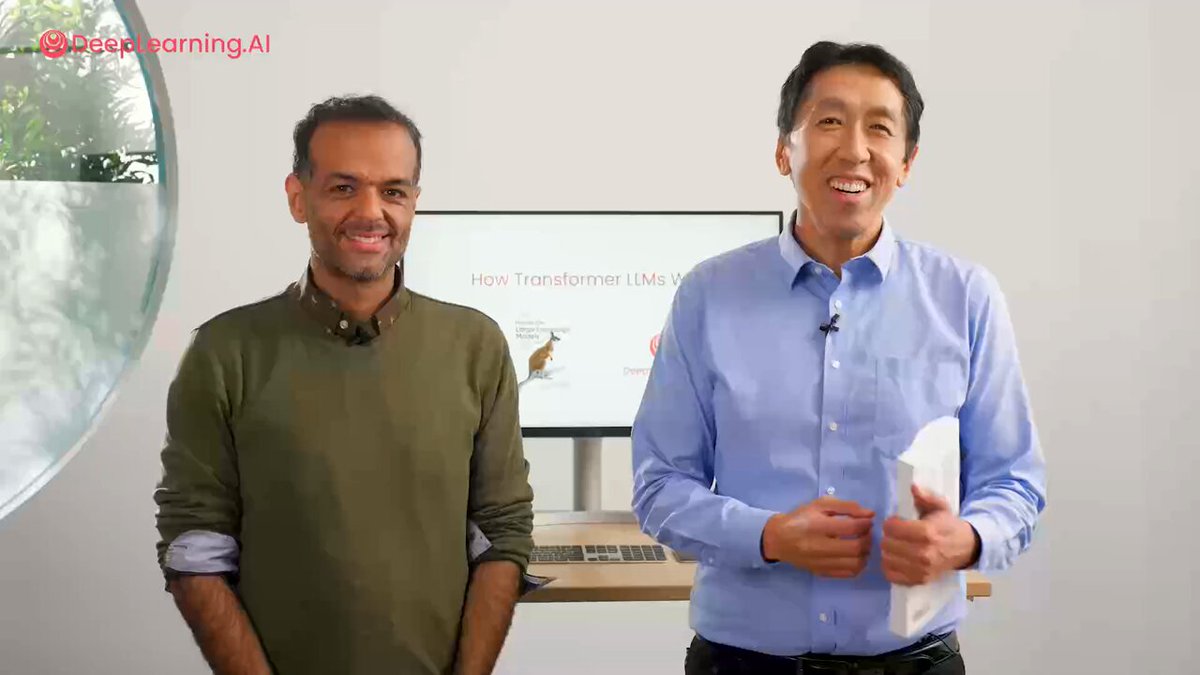
New short course: Attention in Transformers: Concepts and Code in PyTorch. Last week we released a course on how LLM transformers work. This week, go deeper and learn about the technical ideas behind the attention mechanism, and see how to code it in PyTorch. This course is built with @joshuastarmer, Founder and CEO of StatQuest. The attention mechanism was a breakthrough that led to transformers, the architecture powering large language models like ChatGPT. Transformers, introduced in the 2017 paper: "Attention is All You Need" by Viswani and others, took off because of its highly scalable design. In this course, you’ll learn how the attention mechanism, a key element of transformer-based LLMs, works and implement it in PyTorch. You'll develop deep intuition about building reliable, functional, and scalable AI applications. What you will do: - Understand the evolution of the attention mechanism, a key breakthrough that led to transformers. - Learn the relationships between word embeddings, positional embeddings, and attention. - Learn about the Query, Key, and Value matrices, and how to produce and use them in attention. - Walk through the math required to calculate…

Context
lets a model update a text unit's representation using information from other positions in the sequence. Queries and keys determine how strongly positions relate; those weights determine how their values are combined. Masked self-attention blocks access to later positions so a prediction cannot use the future output it is supposed to generate. These mechanisms are specified in the original Transformer paper. The announced PyTorch course connects those operations to code, making the relationship between contextual information and generation restrictions explicit.
- attention — The mechanism that lets a model weigh which earlier words matter for the word it's currently processing — the core operation of a transformer.
- transformer — The neural network architecture behind modern AI models, built on attention — letting every word directly consider every other word in parallel.
- embedding — A list of numbers representing a piece of text's meaning, so that similar meanings end up numerically close and can be searched.
- context window — The maximum amount of text a model can consider at once — its working memory for the current conversation or task.




Checking sign-in…
Loading comments…