Herdr UI
herdrui.dev- Category
- Developer Tools
- Rank
- No. 968Tools index
- Pricing
- Open Source
- Type
- APP
- Use case
- Coding
- Interfaces
- Desktop
- Builder
- @fabienpenso
- GitHub
- 2.4k stars
- Latest release
- v20261126.1
- Date
About
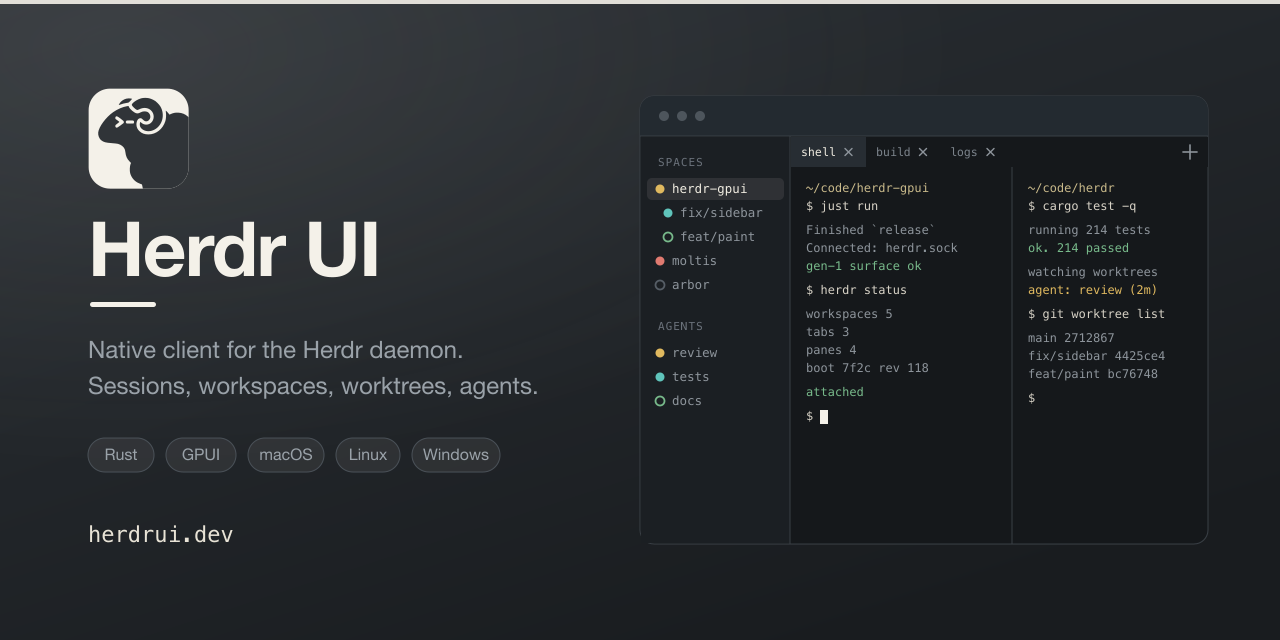
Herdr UI is a native Rust/GPUI window for macOS, Linux and Windows that attaches to a Herdr daemon you already run, painting its terminal cells and split panes. It adds worktree and agent sidebars, side-by-side diff review with notes sent back to the agent, browser tabs with annotations, checkpoints, and Teleport to move a worktree with its sessions to another host. The TUI and the window can be used on the same sessions at once.
What it does
A desktop front end for the Herdr agent daemon. Instead of running a second terminal emulator, it draws the cells the daemon already holds, so the same sessions stay reachable from the text interface too. Around those panes it builds the things a terminal cannot show well: a sidebar of repositories, linked checkouts and agents with live status, a diff viewer where line comments go back to the agent as feedback, embedded web pages you can mark up, plan usage for signed-in AI services, and a command line that lets agents drive the open window.
Why it's ranked here
The case is engineering discipline in a young project. The Rust workspace denies unsafe code and bans unwrap and expect at lint level. Releases ship signed, notarized macOS builds plus Linux and Windows packages, with checksums, Sigstore signatures and build provenance for every artifact, and an in-app updater that checks an Ed25519 signed manifest. The security policy scopes the threat model precisely. The ceiling is dependency: it is useless without Herdr, and it is an unaffiliated client of that daemon, so upstream protocol changes are its risk.
What's good
The command line is designed for agents, not just people: every command takes a JSON flag, and nine documented exit codes separate cases like app not running, window missing and dialog open. Destructive steps such as checkpoint restore, teleport and cloud machine creation only open a dialog; a human confirms. Usage providers keep secrets on the remote host as shell variables rather than copying them back. The orchestrator shares a database with another launcher tool under an explicit ownership contract, and a newer schema opens read only instead of being downgraded.
Tradeoffs
You must install and run the Herdr daemon yourself; this app only starts an already installed local one and never installs it on remote hosts. Linux builds need glibc 2.39 or newer and a Vulkan driver, and the ARM64 Arch package is not install tested. macOS needs 14.2 or later. The surface is very large, with well over a hundred modules, so expect a lot of settings. The security policy still says the project is pre-1.0 with no published releases, which contradicts the release instructions in the readme.
How to use it well
Pick it if you already run several coding agents under Herdr and want a graphical place to watch their status, review their uncommitted changes and send notes back without leaving the window. Let agents call the bundled command line to open preview pages or read your feedback, and use the JSON output in scripts. Keep the text interface for SSH sessions where a desktop window is unavailable. It does not replace Herdr itself, and GitLab merge requests are not listed yet.
Technical notes+
Cargo.toml defines a five-crate workspace (edition 2024, rust-version 1.96, Apache-2.0, publish = false) with unsafe_code, unwrap_used and expect_used set to deny, GPUI pinned as gpui-pre =0.3.6 and wry for browser tabs. crates/herdr-gpui/src/app.rs parses CLI and runs the updater helper before GPUI starts, so control commands and --build-info never open a window; each window holds its own daemon connection and a shared sound worker avoids duplicate notification playback. crates/herdr-gpui/src/cli.rs rejects a herdr-gpui:// link followed by extra arguments to block option smuggling, and forbids --socket with --session or --dev. crates/herdr-gpui/src/main.rs gates cloud providers (azure, boat, coder, daytona, railway) behind Cargo features with a compile_error guard. docs/cli.md documents the control socket under XDG_STATE_HOME and exit codes 0 to 8. docs/orchestrator.md caps GitLab listings at 2,000 issues. docs/usage-providers.md routes all host access through a Probe type. SECURITY.md lists 23 signed base artifacts.
Observed
- License
- Apache-2.0 (LICENSE, Cargo.toml)
- Language
- Rust, edition 2024, GPUI framework
- Platforms
- macOS 14.2+, Linux x86_64 and ARM64 (glibc 2.39+), Windows x86_64 and ARM64
- Install
- Homebrew cask, install scripts for Linux and PowerShell, .deb/.rpm/Arch packages, Nix flake
- Interfaces
- Desktop GUI plus a control CLI with --json output (docs/cli.md)
- Dependency
- Requires a separately installed Herdr daemon; unaffiliated client (README.md)
- Lint policy
- unsafe_code, unwrap_used and expect_used denied workspace-wide (Cargo.toml)
- Release signing
- Checksums, Sigstore signatures and GitHub provenance per artifact; Ed25519 signed updater manifest (SECURITY.md)
Read from README.md, Cargo.toml, LICENSE, docs/cli.md, docs/orchestrator.md, docs/usage-providers.md, SECURITY.md, crates/herdr-gpui/src/main.rs, crates/herdr-gpui/src/app.rs, crates/herdr-gpui/src/cli.rs.
Similar tools
Tags
Tech Stack
Media
Editorially curated, with community endorsements as a secondary signal. Corrections welcome.