Mini Coding Agent
- Source
- magazine.sebastianraschka.com
- Author
- Sebastian Raschka, PhD
- Date
Context
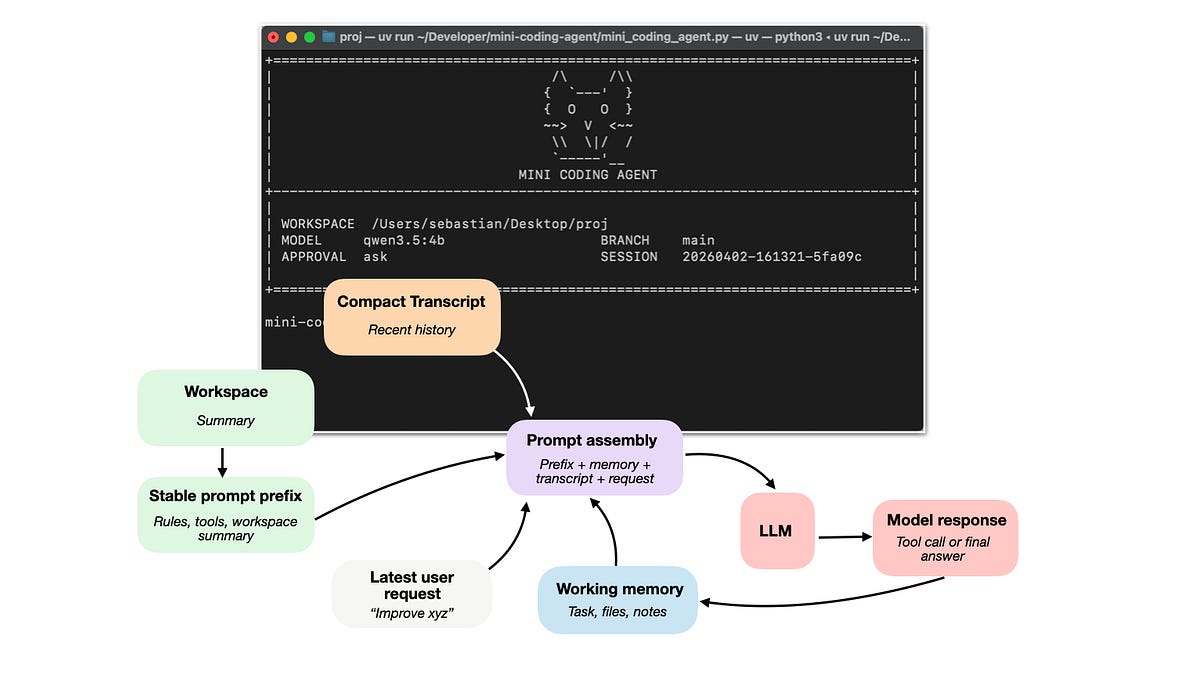
A coding becomes useful by connecting a model's suggestions to actions and feedback. Sebastian Raschka's Mini Coding Agent explanation describes the surrounding software, often called a , that supplies project and executes tools.
The model requests an action in a defined format. The harness checks the request, handles any required approval, runs the tool and returns the result to the model. That loop lets a coding session inspect files, make changes and respond to test errors. It explains why the surrounding application matters: access to the repository and the consequences of previous actions shape what the model can do next.
- The vocabulary matters. The agent is the decision loop of observe, inspect, choose, act; the harness is the software scaffold around it that assembles prompts, exposes tools, tracks file state, and manages permissions.
- Before doing anything the agent builds a small workspace summary of repo root, branch, git status, and files like AGENTS.md or README, because 'fix the tests' is not self-contained until you know which test command this project uses.
- Rebuilding the whole prompt every turn throws away the provider's prompt cache. Split it into a stable prefix of rules, tool descriptions, and workspace facts, then append only the changing transcript and request.
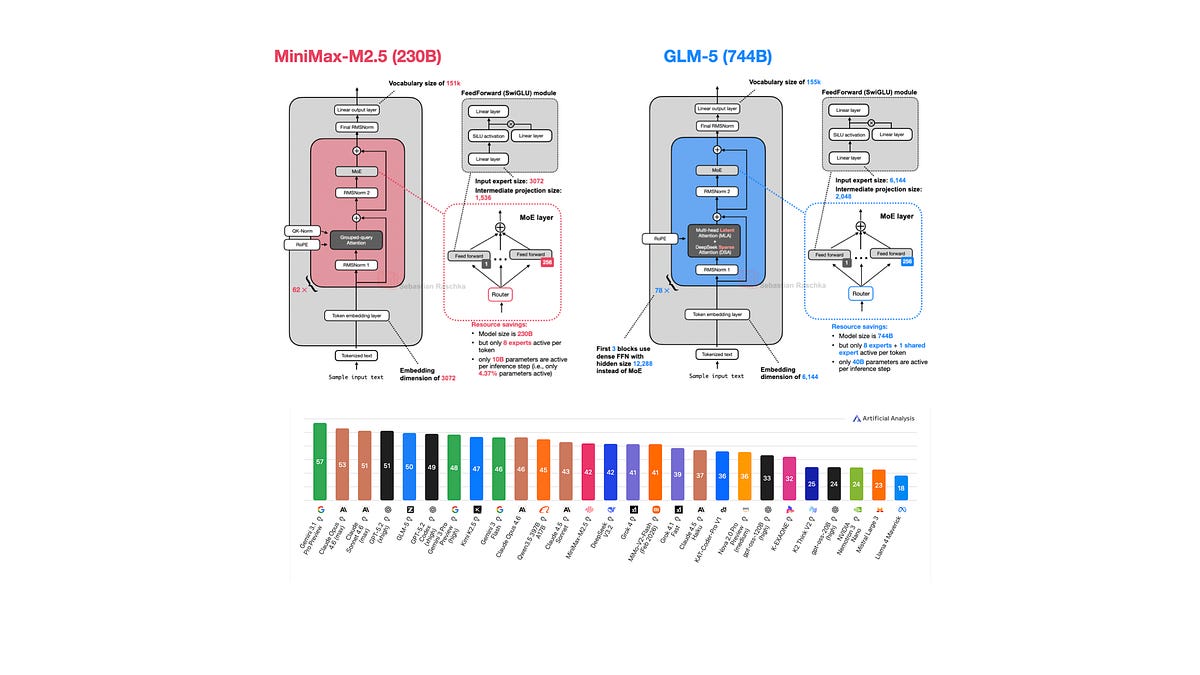
- Raschka's bet: drop a strong model like GLM-5 into a Codex-quality harness and it would land near GPT-5.4, because vanilla model capabilities have converged and the scaffold now carries most of the difference.
- Delegation is its own building block. Bounded subagents take a scoped task and return just the result, which keeps the main loop's context from filling with the details of a side errand.
- AI agent — An AI system that doesn't just answer once but works toward a goal in a loop — taking actions, reading the results, and deciding what to do next.
- agent harness — The scaffolding around a model that turns it into a working agent — the loop, the tools it can call, and the rules for when to stop.
- context window — The maximum amount of text a model can consider at once — its working memory for the current conversation or task.
- open weights — A model whose trained parameters are published for anyone to download and run — unlike API-only models you can access but never possess.
“the LLM is the engine, a reasoning model is a beefed-up engine (more powerful, but more expensive to use), and an agent harness helps us the model.”
“So the tricky design problem is not just how to spawn a subagent but also how to bind one :).”
Checking sign-in…
Loading comments…