TorchNeuron opens up Trainium to PyTorch, validated by agents
- Source
- amazon.science
- Author
- Amazon Science
- Date
Context
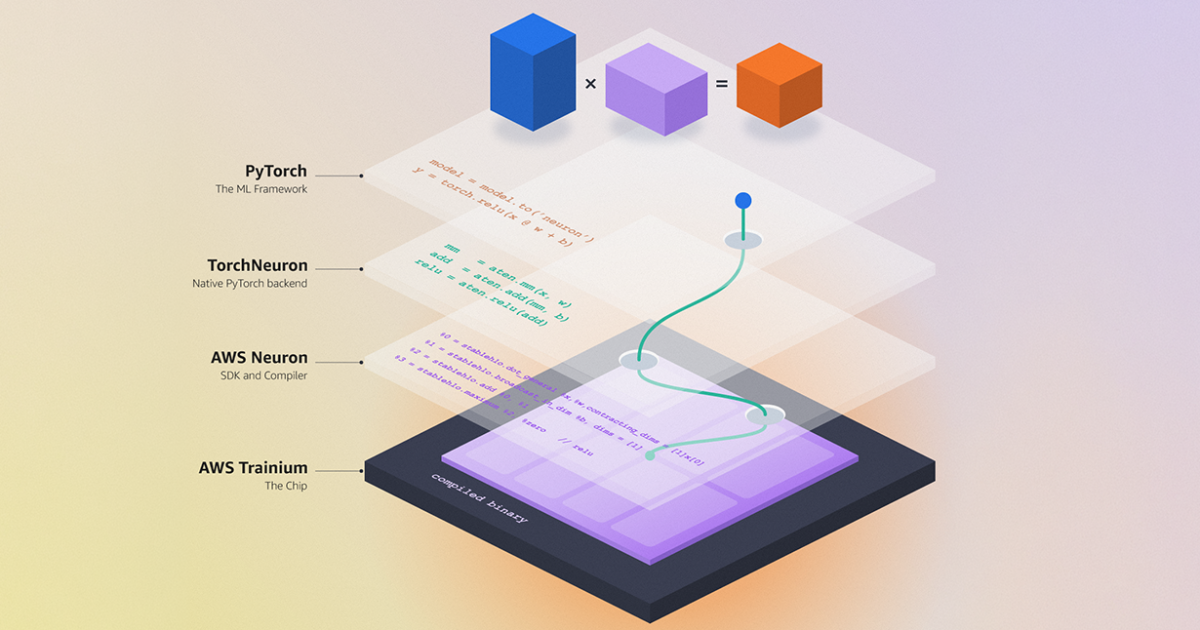
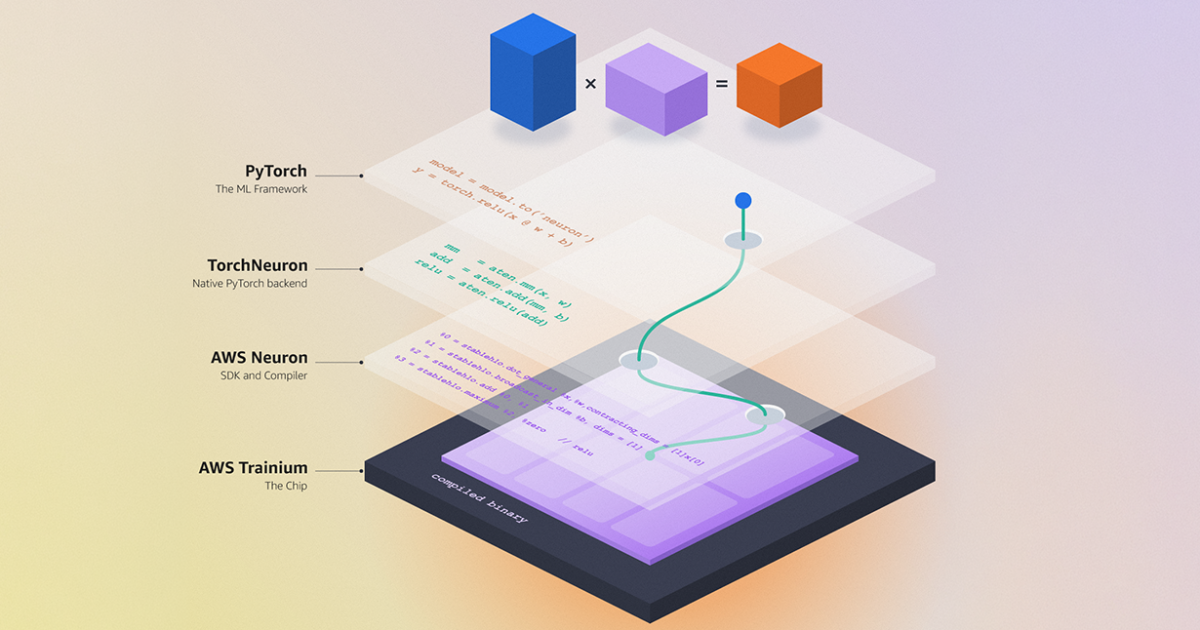
TorchNeuron is Amazon's new open-source bridge between PyTorch, the Python library most AI developers write models in, and Trainium, AWS's AI chip, which Amazon says was built from the ground up for large tensor workloads. According to Amazon Science's explanation, it translates PyTorch code into operations Trainium can execute, so code that already runs on other accelerators should run on Trainium with minimal or no changes. The harder part, and the focus of the post, is giving developers reason to believe their particular model will run correctly and fast, and Amazon's answer is a testing process built with AI agents.
The agents swept Hugging Face repositories, discarded models whose broken configurations would not run on any accelerator, and found hundreds of thousands with working code. Testing every TorchNeuron revision on all of them would take too long, so another sorted the models by architectural traits, such as what kind of input encoder they use and which variant sits in their core. Amazon says 841 representative models covered every design characteristic TorchNeuron was likely to meet. While running those, the team recorded the tensor sizes, called shapes, that Trainium was asked to process, building a registry of tens of thousands of real operations. A new code revision now goes through fast unit tests generated from that registry, then the 841 models, then the full collection, so problems surface early in development.
Two runtime features address a cost of running PyTorch on Trainium: waiting for code to compile. An opt-in adaptive eager mode groups operations into small graphs and compiles them in parallel while already compiled pieces run, which Amazon says hides compile time for many models and approaches fully compiled speed while still letting developers trace hardware activity back to lines of their code. Caching keeps every compiled executable in memory and on disk, and a shared compilation service on each machine compiles an operation once for all the processes that need it. In Amazon's test of a spread across 64 processes on one machine, that service cut the time to the first training step by about a third.
These results are Amazon's own. The post reports no head-to-head speed comparison with other hardware and no published pass rates for the 841 models, so how well TorchNeuron delivers on "right out of the box" for a given model is something developers will have to check against their own code.
- TorchNeuron's opt-in adaptive eager mode builds small graphs from PyTorch's operator dispatch, compiles them in parallel, and dynamically picks subgraphs so compile time overlaps execution of already compiled pieces, while keeping per-line source correlation for debugging.
- Each compiled operation becomes a NEFF executable cached in memory and on disk. A shared per-machine compilation service means identical operations compile once; Amazon says this cut time to first training step by about a third for an LLM across 64 processes.
- Validation was staged: unit tests generated from a shape registry of tens of thousands of real tensor operations run first, then 841 representative models chosen by agents from hundreds of thousands on Hugging Face, then the full model distribution.
- Agents classified models by architecture, such as encoder front end, attention flavor in the trunk, and output backend, which is how Amazon concluded 841 models cover the design characteristics TorchNeuron is likely to meet.
- AI agent — An AI system that doesn't just answer once but works toward a goal in a loop — taking actions, reading the results, and deciding what to do next.
- attention — The mechanism that lets a model weigh which earlier words matter for the word it's currently processing — the core operation of a transformer.
- LLM — A large language model — the neural network behind tools like Claude and ChatGPT, trained on huge amounts of text to predict what comes next.
- transformer — The neural network architecture behind modern AI models, built on attention — letting every word directly consider every other word in parallel.


Checking sign-in…
Loading comments…