- Category
- AI Tools
- Rank
- No. 212Tools index
- Pricing
- Open Source
- Type
- TOOL
- Use case
- Models: Train & Run
- Builder
- google-research
- GitHub
- 34.7k stars
- Latest release
- v3.0.0
- Date
About
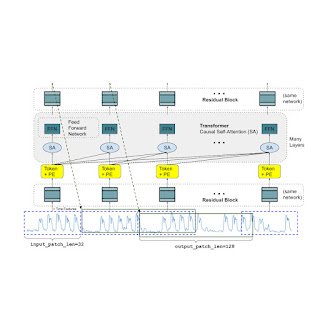
A pretrained time-series foundation model developed by Google Research for forecasting time-series data. It's a decoder-only model that can handle various forecasting tasks with up to 16k context length and quantile forecasting capabilities.
What it does
TimesFM takes batches of numeric histories and produces point forecasts plus optional probability ranges. Before inference, users set context and horizon limits, input normalization, positivity behavior, flip invariance, and quantile correction. Inputs shorter than the context limit are padded, while longer inputs are truncated.
Why it's ranked here
The project offers a practical forecasting library with downloadable checkpoints, two execution backends, uncertainty estimates, and covariate support. Its configuration exposes useful output constraints instead of hiding them. The case is tempered by optional dependency weight and the explicit absence of official Google product support.
What's good
Users can choose PyTorch or Flax without changing the forecasting goal. Batched inference supports multiple accelerator devices. The optional quantile head returns a mean and percentile forecasts, while configuration can correct crossed quantiles, preserve sign behavior, normalize extreme magnitudes, and guarantee nonnegative output for nonnegative histories.
Tradeoffs
The open package is not an officially supported Google product. PyTorch, Flax, and covariate regression require separate dependency extras, and the latter brings JAX plus scikit-learn. Context limits are operationally strict because excess history is truncated. Decomposed forecasting has a declared window setting, but its implementation remains a to-do.
How to use it well
It suits Python teams that want pretrained forecasting inside an existing numerical pipeline and can evaluate predictions against their own data. Start with point forecasts, enable normalization for extreme scales, then add quantiles or covariates when the decision needs uncertainty or external signals. It does not replace managed hosting, operational support, or domain-specific validation.
Technical notes+
pyproject.toml defines the timesfm package for Python 3.10 or newer, with core NumPy, Hugging Face Hub, and safetensors dependencies plus torch, flax, and xreg extras. src/timesfm/__init__.py conditionally exposes TimesFM_2p5_200M_torch and TimesFM_2p5_200M_flax when their dependencies import successfully. src/timesfm/configs.py defines the frozen ForecastConfig, including compiled context and horizon bounds, normalization, multi-device batch sizing, continuous quantiles, invariance, positivity, crossing correction, and backcast control. src/timesfm/torch/transformer.py and src/timesfm/flax/transformer.py provide parallel causal transformer implementations with rotary positions, RMS normalization, per-dimension query scaling, masks, and decode caches. src/timesfm/utils/xreg_lib.py formats and validates batched static and dynamic numerical or categorical covariates.
Observed
- License
- Apache-2.0
- Primary language
- Python
- Runtime
- Python 3.10 or newer
- Install surface
- PyPI package with separate PyTorch, Flax, and XReg extras
- Interface
- Python library with pretrained checkpoints loaded from Hugging Face
- Compute support
- Documented for CPU, GPU, TPU, and Apple Silicon
- Backend structure
- Parallel PyTorch and Flax implementations
- Testing
- Unit tests cover core layers, configurations, and utilities
Read from README.md, pyproject.toml, requirements.txt, src/timesfm/configs.py, src/timesfm/__init__.py, src/timesfm/flax/util.py, src/timesfm/flax/dense.py, src/timesfm/torch/util.py, src/timesfm/torch/dense.py, src/timesfm/flax/__init__.py, src/timesfm/torch/__init__.py, src/timesfm/utils/xreg_lib.py, src/timesfm/flax/transformer.py, src/timesfm/torch/transformer.py, src/timesfm/flax/normalization.py.
What it can do
Forecast future values in time-series data
Historical time-series data → Predicted future data points
Generate quantile forecasts for uncertainty estimation
Time-series data with forecast parameters → Probability distributions and confidence intervals for predictions
Process long-context time-series sequences
Time-series data up to 16,000 data points → Forecasts based on extended historical context
Perform zero-shot forecasting on new datasets
Unseen time-series data without additional training → Forecasts leveraging pretrained knowledge
Handle multiple time-series forecasting tasks
Various types of temporal data (sales, metrics, sensor readings, etc.) → Task-specific forecasts and predictions
Tags
Tech Stack
Media
Comments (0)
No comments yet
Editorially curated, with community endorsements as a secondary signal. Corrections welcome.