Datacenters 2027: The Year of Acceleration, +50GW in a Single Year
- Source
- newsletter.semianalysis.com
- Author
- Jeremie Eliahou Ontiveros
- Date
Context
SemiAnalysis argues in a new report that 2027 will be the year the AI datacenter buildout accelerates sharply, with a headline figure of about 50 gigawatts of new capacity in a single year. Datacenter capacity is counted in power: a gigawatt describes how much electricity a site's computing equipment can draw, so the number is a way of measuring how much AI hardware can be switched on. SemiAnalysis itself notes that 50GW roughly equals the entire global datacenter market built up through 2024, which is why the forecast draws doubt. It cites Altimeter's Brad Gerstner, who said on the All-In Podcast that a SemiAnalysis forecast of 43GW for 2027 was too aggressive and guessed that about 25GW would get built.
The firm's case starts with what is already standing. It says more than 24GW of capacity across just 40 campuses is in an advanced stage of construction for delivery in 2027, most of it past the halfway point with cooling and electrical gear installed outside, and that these are a small share of the several hundred advanced sites it tracks. It acknowledges labor shortages, vendor delays and funding problems, and says its model already discounts developer timelines it considers too optimistic. Its September piece on local bans made a similar argument for the US alone: there it forecast about 38GW of US capacity in 2027 and estimated that local moratoriums and New York's executive order were genuinely delaying only around 2.3GW.
The confidence comes from two leading indicators, signals that show up months before buildings are finished. The first is construction starts at the datacenters US hyperscalers build for themselves, which SemiAnalysis says have never been higher and are rising steeply, driven mainly by two companies it does not name in the free text. The second is leasing. Developers of very large sites typically spend only 5 to 10 percent of a project's capital before they have a customer; they need a pre-lease, usually a 15 to 20 year contract worth $30 to 50 billion per gigawatt, to raise the debt that pays for construction. Because leases come before debt and debt comes before buildings, lease signings are an early read on what will be delivered.
On that measure, SemiAnalysis says the market changed in the second half of 2025. Leasing had been fairly flat from late 2023 to mid-2025, which it attributes largely to Microsoft pausing after dominating the market in 2023 and 2024, and which it says is why 2026 growth looks modest. Then Oracle closed about 4.5GW of capacity across three sites between August and October 2025, and buyers including Meta, Amazon's AWS, Microsoft, Google, Nvidia, AMD, Anthropic and OpenAI entered the market for gigawatt-scale leases. SemiAnalysis says it has identified over a trillion dollars of lease value signed and closed in 2026 so far, and that most of the related debt has been raised.
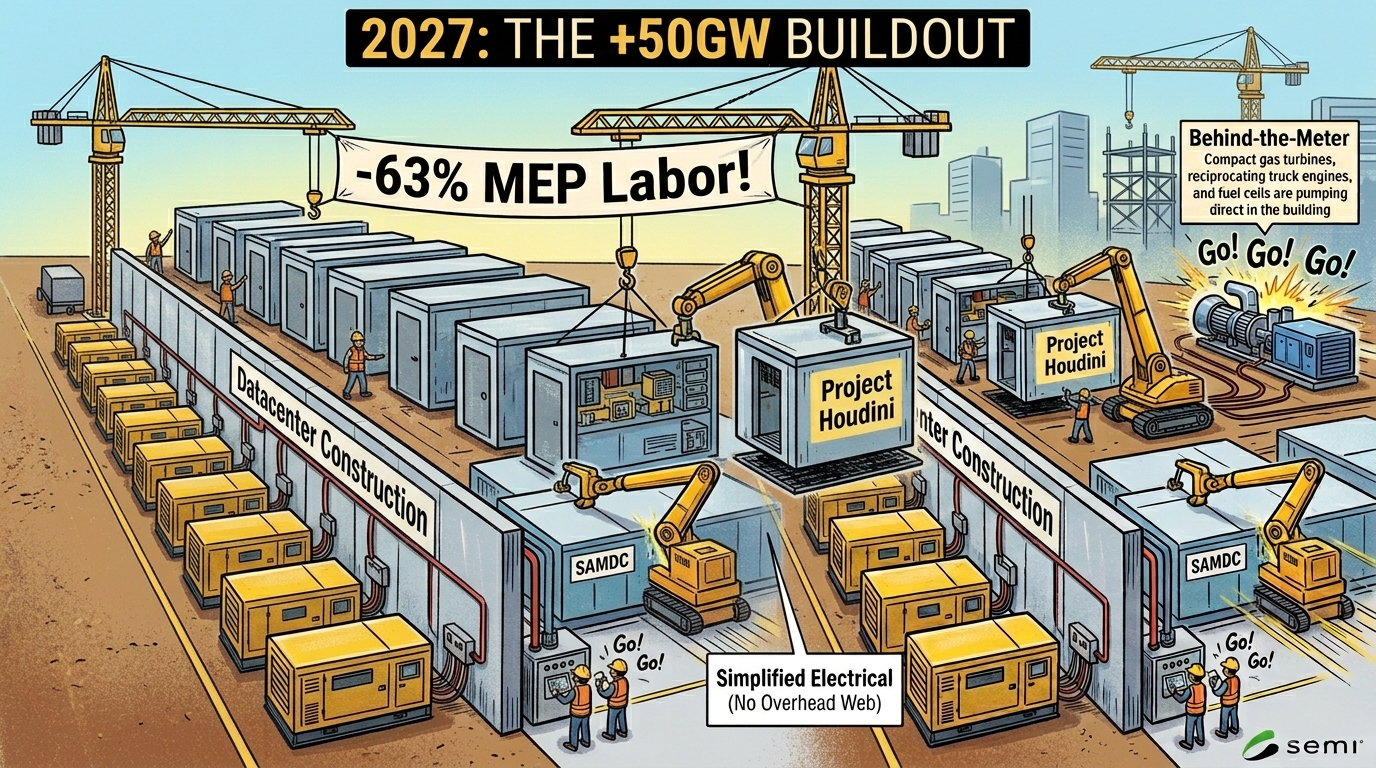
The rest of the free section explains how the industry plans to build that fast. SemiAnalysis points to simpler and prefabricated designs, such as Google's modular electrical systems, Meta's tent structures and AWS's prefabricated data halls, which it says bring construction under 10 months, and to developers such as DayOne cutting build times to about nine months from more than 18. It says on-site generation, known as behind-the-meter power, has let builders skip grid connections that can take 5 to 10 years, and it calls the power problem broadly solved. It also expects building outside the US to accelerate. The report suggests that by 2027 and 2028 the bottleneck may move from buildings and power to memory and logic chips. Its section on whether all this leads to a datacenter oversupply is for paid subscribers only, so the public text does not show SemiAnalysis's answer.
 articlexAI’s Colossus 2 – First Gigawatt Datacenter In The World, Unique RL Methodology, Capital Raise
 articleAmazon’s AI Resurgence: AWS & Anthropic’s Multi-Gigawatt Trainium Expansion
 articleSpaceX 10GW in 2027 – Why It’s Real, Will Drive $300B ARR for SpaceX, and Why Microsoft Will Be the Largest Offtaker
 articleMeta Compute: Everyone Wants To Be A Neocloud


Checking sign-in…
Loading comments…