Anthropic Subscriptions Offer 5x+ More Value Than OpenAI
- Source
- newsletter.semianalysis.com
- Author
- Andrew Megalaa
- Date
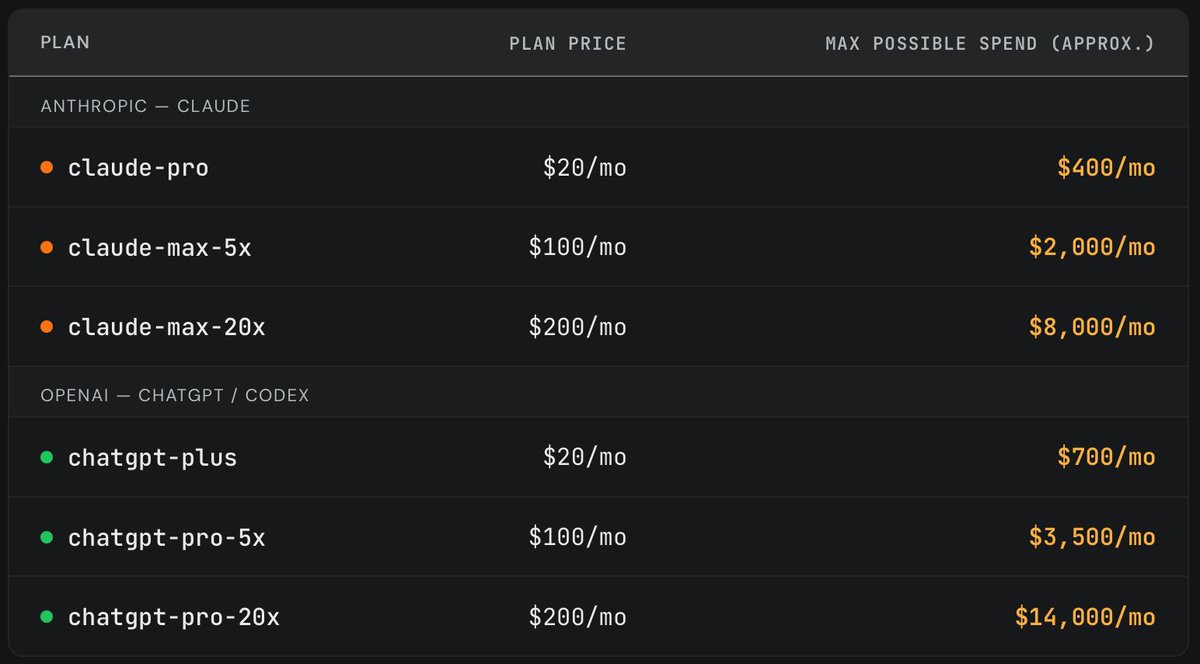
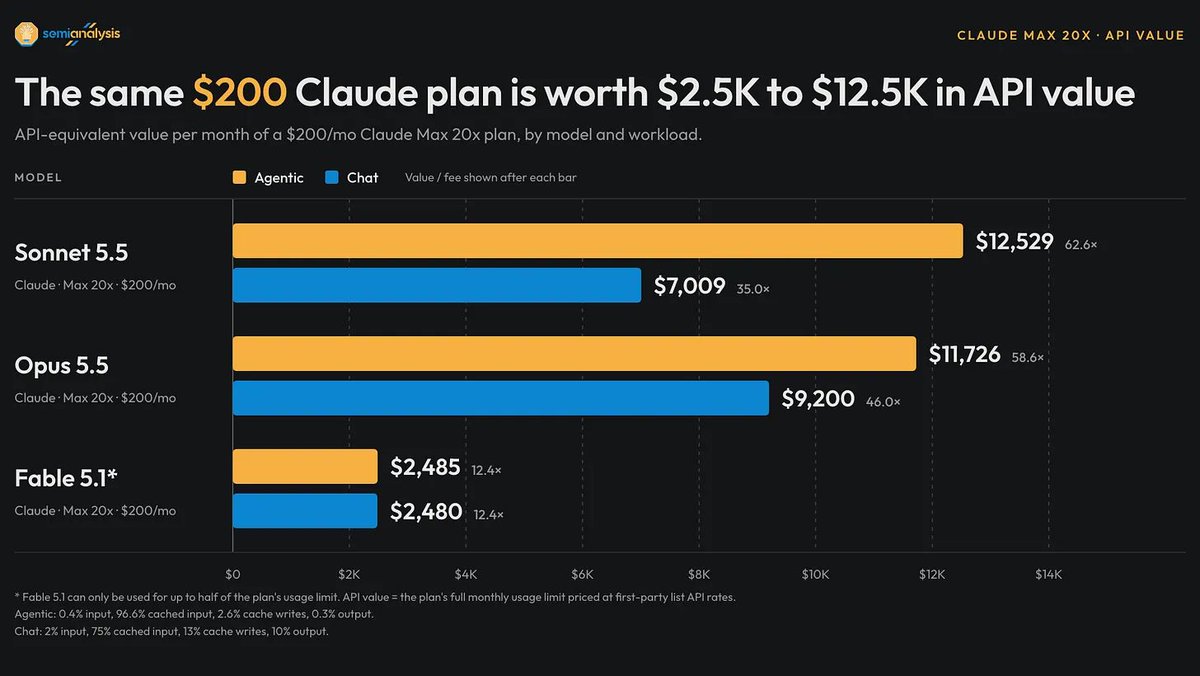
SemiAnalysis treats a subscription as a monthly grant of credits, with each model and token type consuming credits at its own rate. To measure those rates it ran repeated calls that isolate one token type at a time, input, cache write, cache read or output, and recorded how far each provider's usage meter moved, narrowing each estimate to within about 5%. Because credit ratios differ from API price ratios, the API-equivalent value of the same $200 Claude plan changes with the model and workload, so a plan has no single dollar value. Across Anthropic and OpenAI plans, the firm found Claude subscriptions deliver more than five times the API-equivalent value. A separate analysis summarized by Latent Space says adjusting for task cost narrows that edge to 1.3 to 2.9 times. SemiAnalysis also estimates subscriptions are about 10% of Anthropic's revenue but can take over 40% of its inference compute. For teams choosing between subscriptions and API billing for coding agents, the lesson is to price your own model mix rather than headline multipliers, and to expect limits to move.
Context
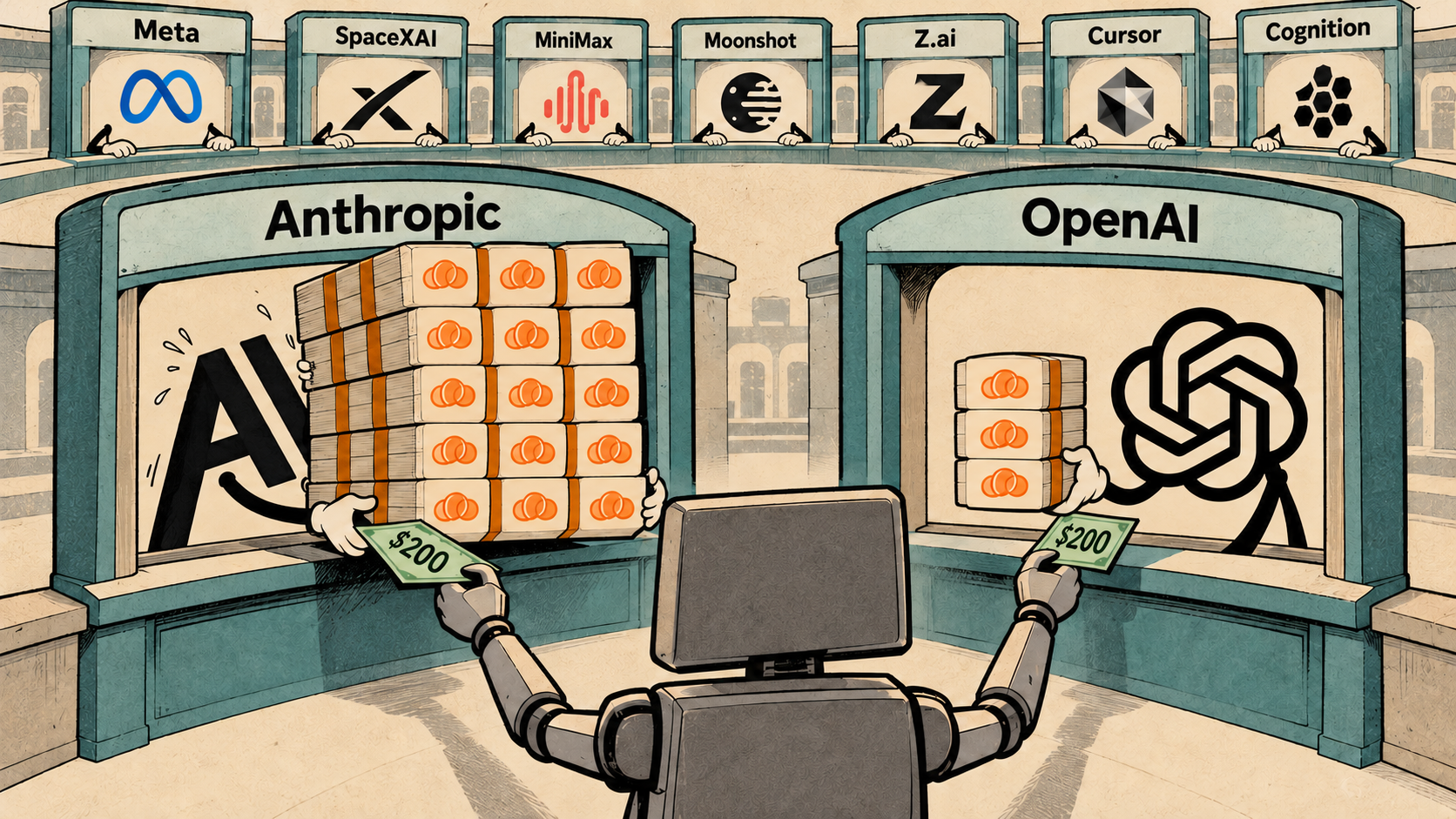
SemiAnalysis estimates that Claude plans give about five times the API-equivalent value of OpenAI's at the mid-tier, meaning the dollar worth of the a plan allows when priced at API rates. Its newsletter analysis compares Opus 5.5 from Anthropic with GPT 6.1 Sol from OpenAI and says the gap stays massive when counting tokens, a check it makes because Sol is much cheaper per token.
Plans expose only a usage meter, so SemiAnalysis sends repeated requests that isolate one token type at a time, such as fresh input or output, tracks how many tokens it takes to move the meter, and converts that into the share of a monthly limit a million tokens uses. It narrows each rate to within five percent, then multiplies by API prices for an assumed workload.
It also reports that OpenAI halved the tokens on its $200 plan and that Anthropic's Opus limit increases did not fully offset its price cut. The public text ends partway and some results sit behind a paid dashboard.
- SemiAnalysis measures plan limits by sending prompts that isolate one token type (input, cache write, cache read or output) and counting the tokens needed to move the provider's usage meter one step, repeating until the rate is within plus or minus 5%.
- That metering caught one of three identical subscriptions with about 20% lower limits; the provider said it was an extremely small A/B test, which SemiAnalysis takes as proof limits can change silently.
- Top-tier limits are close: $2,485 of Fable 5.1 reaches Fable's cap at half of a $200 Claude plan, leaving the rest for other models, while $2,897 of GPT-6 Astra exhausts OpenAI's $200 plan.
- OpenAI halved per-tier token allowances on its $200 plan, with older purchases keeping prior limits until October 29, and its new $500 plan offers only 21% more Astra than the old $200 plan, per SemiAnalysis tracking.
- Anthropic trims subsidies by giving less API-equivalent value on pricier models; at 20% utilization and assumed 92% API margins, SemiAnalysis puts Claude plan gross margins near 6% on Opus 5.5 and 80% on Fable 5.1. OpenAI cut to Fable-level limits everywhere.

Checking sign-in…
Loading comments…