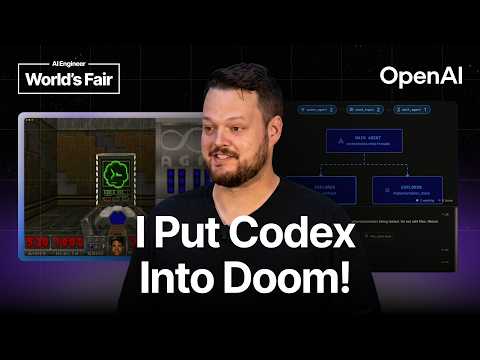
Building on the Codex Harness — Dominik Kundel, OpenAI
Source
youtube.com
Author
AI Engineer
Date
Context
An application can build on the software behind Codex instead of constructing its own agent harnessThe scaffolding around a model that turns it into a working agent — the loop, the tools it can call, and the rules for when to stop.Full definition →. In this talk, Dominik Kundel, from OpenAI's Codex developer-experience team, describes the App Server interface used by Codex clients. Applications exchange structured messages and events with the server to control the AI agentAn AI system that doesn't just answer once but works toward a goal in a loop — taking actions, reading the results, and deciding what to do next.Full definition →.
The described controls include developer instructions, tools and model or sandboxAn isolated environment where AI-generated code or agent actions run without being able to touch anything real.Full definition → settings for individual threads. This gives an application room to define its own interaction and capabilities while reusing the Codex harness underneath.
Key takeaways · AI-distilled
The Codex App Server is an open-source JSON-RPC protocol wrapping the Codex harness. It powers the Codex app, the IDE extensions and third-party clients in Xcode and JetBrains, and is not tied to one model provider.
Kundel says clients get more than 120 messages to work with, plus developer instructions layered on top of the system promptThe standing instructions a model receives before any user input — defining its role, rules, tools, and tone for the whole conversation.Full definition → and dynamic and deferred tools.
To integrate it you ship the binary and generate bindings or use the Python SDK; the talk also covers when the simpler codex exec is the better fit.
Terms in this piece · Glossary
agent harness — The scaffolding around a model that turns it into a working agent — the loop, the tools it can call, and the rules for when to stop.
AI agent — An AI system that doesn't just answer once but works toward a goal in a loop — taking actions, reading the results, and deciding what to do next.
sandbox — An isolated environment where AI-generated code or agent actions run without being able to touch anything real.
system prompt — The standing instructions a model receives before any user input — defining its role, rules, tools, and tone for the whole conversation.
 videoWhy Compute Still Trades in Group Chats — Affaan Mustafa & Alejandro Soumah Fernandez, Jump Trading
 videoHow OpenAI Built ChatGPT for Bankers and Analysts — Joseph Kim, OpenAI
 videoBuying GPUs Should Work Like Buying Stocks — Carmen Li, Compute Exchange
 videoDon't Trust Your AI Agents. Test Them Like a Scientist — Stephanie Jarmak, Omni Analytics