Forecasting the Impacts of AI R&D Acceleration: Results of a Pilot Study
- Source
- metr.org
- Date
Context
This is a pilot survey run by METR with the Forecasting Research Institute (metr.org). The worry it probes is a feedback loop: if AI agents become good enough to do AI research, they could speed up the next round of AI improvement, compressing years of progress into months. METR asked 8 AI forecasting domain experts and 10 superforecasters (people with top track records in forecasting tournaments) two questions. How likely is a dramatic acceleration of AI progress, especially if evaluations show AI matching human researchers? And if that acceleration happens, would it produce extreme effects on society?
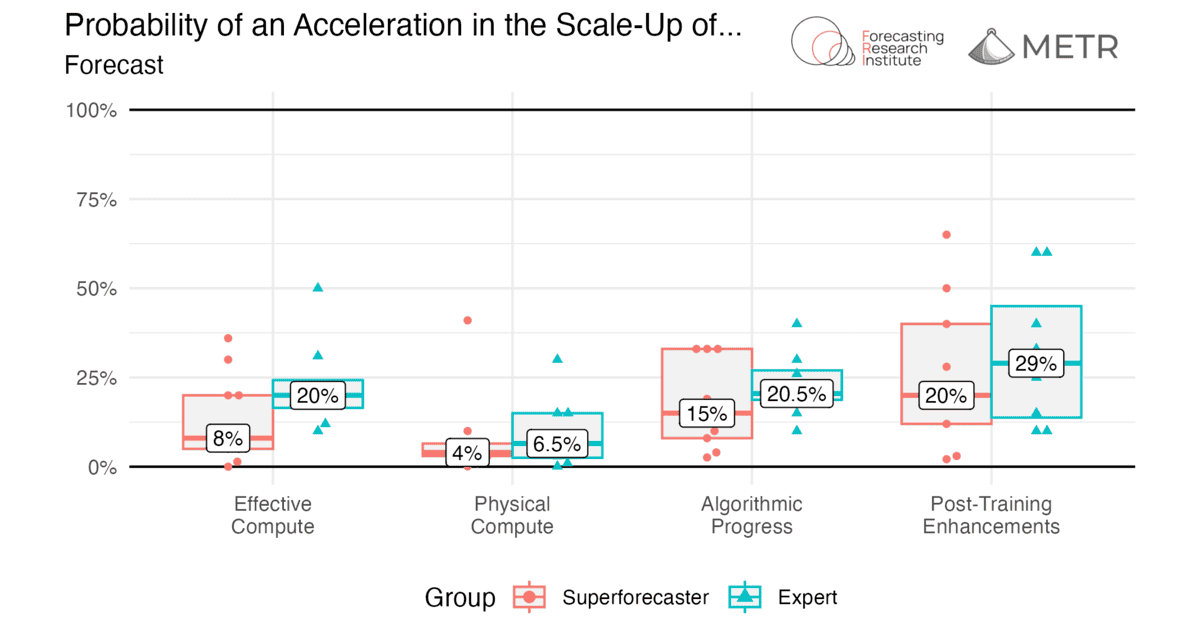
Acceleration was defined through effective compute, a single number that folds together more raw computing power and better algorithms. If a later model used twice the compute and its algorithms needed only half as much to reach the same performance, that counts as a 4X scale-up. The target event was a three-fold speed-up: some two-year window before 2029 in which effective compute grows as much as it did across the six years from 2018 to 2024, roughly one year of that era's progress every four months. Experts gave it a median 20% chance and superforecasters 8%. When told to assume AI beats human researchers at open-ended month-long research projects, the two groups converged to 20.5% and 18%. Beating humans on the day-long tasks of RE-Bench, METR's AI research , would not be very informative to either group, since many already expect that benchmark to be saturated by 2027. METR reads this as partial support for the idea that longer task horizons are what predict automated AI research.
The second question split the groups. For all four extreme outcomes asked about, which included global energy use doubling or halving within a year and an increased risk of a COVID-level disaster, superforecasters gave median estimates below 0.5% while experts gave medians above 18%. Assuming a three-fold or even ten-fold acceleration raised both groups' numbers but did not close the gap. Experts tended to treat a three-fold acceleration as implying artificial general intelligence that would transform energy use; superforecasters doubted that link, citing technical and physical barriers and human intervention.
METR is explicit that these results are only suggestive: the sample is small and not representative, the forecasts are subjective judgments, some aggregate figures are fragile because participants disagreed by several orders of magnitude, and some participants may have read the definitions differently. Its stated next step is to understand the source of the disagreement before running a larger survey, and the detailed question wording and rationales sit in FRI's full write-up.
- Experts gave a three-fold acceleration of effective compute scale-up before 2029 a median 20% chance and superforecasters 8%. Both expected post-training gains, not physical compute, to accelerate fastest.
- If AI beat human researchers on open-ended month-long research projects, the groups moved to medians of 20.5% and 18%. Superhuman RE-Bench scores were seen as uninformative, since many expect that benchmark to saturate by 2027.
- On extreme events such as global energy use halving or doubling in a year, superforecasters gave medians below 0.5% and experts over 18%. Conditioning on 3x or even 10x acceleration did not close that gap.
- The study's 'effective compute' combines spending and algorithms: a model trained with twice the compute using algorithms that halve compute needs counts as a 4x scale-up.
- benchmark — A standard public test set for comparing AI models — the shared scoreboards behind every "model X beats model Y" claim.
- eval — A repeatable test for AI quality — a set of tasks plus scoring — used the way software teams use test suites, because model output is too variable to judge by eyeballing.
Checking sign-in…
Loading comments…