c15t
c15t.com- Category
- Developer Tools
- Rank
- No. 996Tools index
- Pricing
- Open Source
- Type
- TOOL
- Use case
- Business & Commerce
- GitHub
- 2.0k stars
- Latest release
- c15t@3.2.2
- Date
About
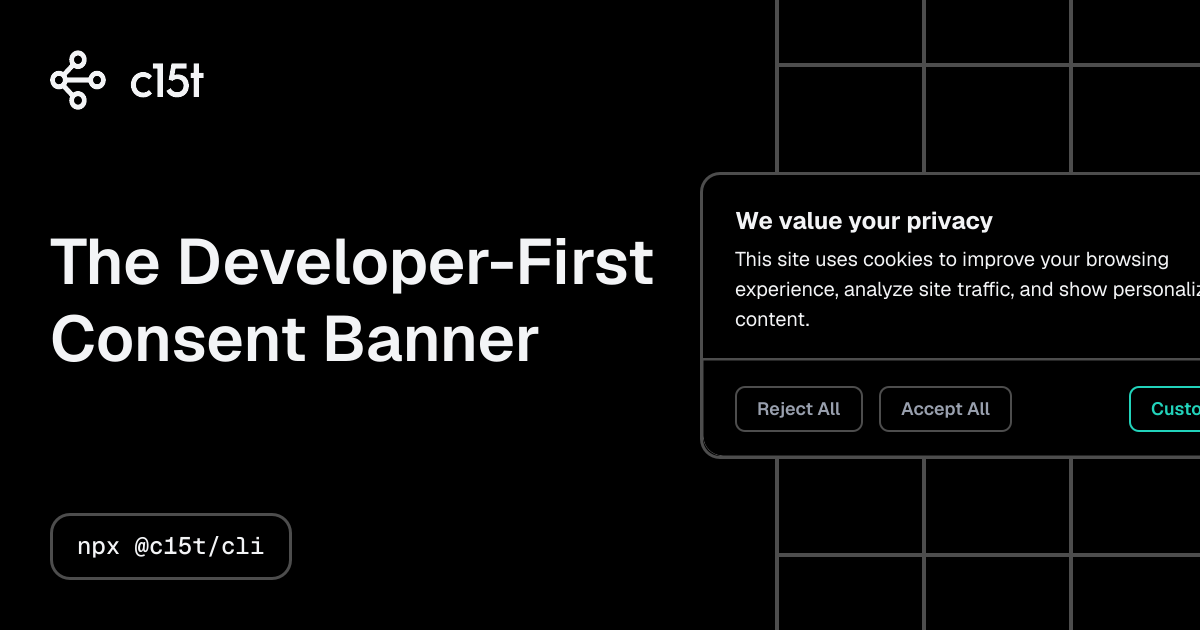
c15t is an open-source consent management platform for React, Next.js and other JavaScript frameworks. It provides the cookie banner and preferences dialog in your codebase and loads scripts according to consent. It can be self-hosted or run as a managed deployment.
What it does
A set of JavaScript packages that asks site visitors what tracking they accept, remembers the answer, and holds back analytics, ad pixels and embeds until the visitor allows them. Region rules decide who gets asked: opt-in for EU visitors, opt-out for some US states, or rules you write. The prompt renders as part of your own app rather than arriving from an outside script, and choices are recorded either by Inth, the company behind the project, by a server you run on Postgres, MySQL or SQLite, or only in the browser for demos.
Why it's ranked here
The appeal is ownership with standards attached. It is Apache 2.0 licensed, ships adapters for React, Vue, Nuxt, Svelte, Astro, TanStack Start and plain script tags, and builds in Google Consent Mode, the IAB Transparency and Consent Framework used by ad networks, IAB GPP and Global Privacy Control. Ready-made loaders cover dozens of analytics and ad vendors. Server-rendering frameworks can resolve the visitor's policy before the page reaches the browser, so the prompt arrives in the first HTML. Few open alternatives pair framework-native components with a record backend you can host yourself.
What's good
The consent engine is built with no side effects at construction: no network, no DOM, no window writes, so it imports cleanly on the server and at the edge, and storage, blockers and script loading are opt-in modules. React hooks subscribe to exactly the slice of state they read, which keeps re-renders narrow. The ad-framework module fetches its roughly 50KB string encoder on demand, only when a choice is saved. The project's own comparison page lists what it does not do, which is unusually candid for a vendor doc.
Tradeoffs
The packages do not scan your site for trackers, generate privacy or cookie policies, or handle data-subject requests; you need separate tools for those. The docs warn that a visible prompt does not stop scripts already on the page, some vendor loaders fire before consent and only pass a denied signal, and withdrawing consent normally reloads the page. The guided setup tool belongs to Inth and connects to an Inth project; self-hosters follow framework guides by hand. The README claims 40+ vendor loaders while the docs introduction says 30+. Upgrading the self-hosted server from v2 drops the old ORM adapters, and MongoDB users get no migration path.
How to use it well
Pick it when you ship a framework app, want the consent prompt styled and versioned with your code, and are willing to own a backend or use Inth's. Move every analytics, pixel and embed into its loaders, then verify the way the docs say: open a private window, reject, reload, and watch network requests rather than the banner. Use offline mode only for local work and previews, since it keeps no records. If you need automatic tracker discovery or generated legal text, pair it with a separate service or choose a fuller privacy suite.
Technical notes+
package.json declares the workspace Apache-2.0, bun as package manager, turbo-driven builds, Vitest and Playwright in devDependencies, and a benchmark suite across frameworks; LICENSE.md is the Apache 2.0 text. packages/core/src/index.ts documents createConsentKernel() as side-effect free with a getSnapshot/subscribe/set/commands contract, offering hosted, offline and custom transports plus network and iframe blockers. packages/react/src/index.ts uses useSyncExternalStore selector hooks. packages/nextjs/src/index.ts re-exports the React adapter and adds ConsentRoot and defineConsentConfig. packages/backend/src/index.ts describes c15tInstance(options).handler(request), an Effect rewrite with numbered SQL migrations and dropped Drizzle/Prisma/TypeORM/Kysely/Mongo adapters. packages/iab/src/index.ts installs window.__tcfapi and requires a registered cmpId. docs/comparisons/index.mdx lists the excluded features; docs/cli/overview.mdx covers the inth c15t command.
Observed
- License
- Apache-2.0 (LICENSE.md, package.json)
- Language
- TypeScript monorepo built with bun and turbo
- Install surface
- npm package c15t with framework subpath imports; @c15t/browser for script-tag use; @c15t/integrations for vendor loaders
- Framework adapters
- React, Next.js, Vue, Nuxt, Svelte, SvelteKit, Astro, TanStack Start, headless JavaScript, plain HTML
- Self-hosted backend
- @c15t/backend with PostgreSQL, MySQL or SQLite (packages/backend/src/index.ts)
- Standards
- Google Consent Mode, IAB TCF via add-on, IAB GPP, Global Privacy Control
- CLI
- Setup runs through the Inth CLI (docs/cli/overview.mdx)
- Not included
- Site scanning, generated legal policies, privacy operations suite (docs/comparisons/index.mdx)
- Security reporting
- Private vulnerability reporting via GitHub (SECURITY.md)
Read from README.md, package.json, LICENSE.md, docs/index.mdx, docs/cli/overview.mdx, docs/cli/quickstart.mdx, docs/comparisons/index.mdx, docs/frameworks/index.mdx, packages/core/src/index.ts, packages/react/src/index.ts, packages/nextjs/src/index.ts, packages/backend/src/index.ts, packages/iab/src/index.ts, SECURITY.md.
Similar tools
Tags
Tech Stack
Media
Editorially curated, with community endorsements as a secondary signal. Corrections welcome.