Recursive's Flint, an open-weight coding-agent MoE, lands free on OpenRouter
- Source
- x.com
- Date

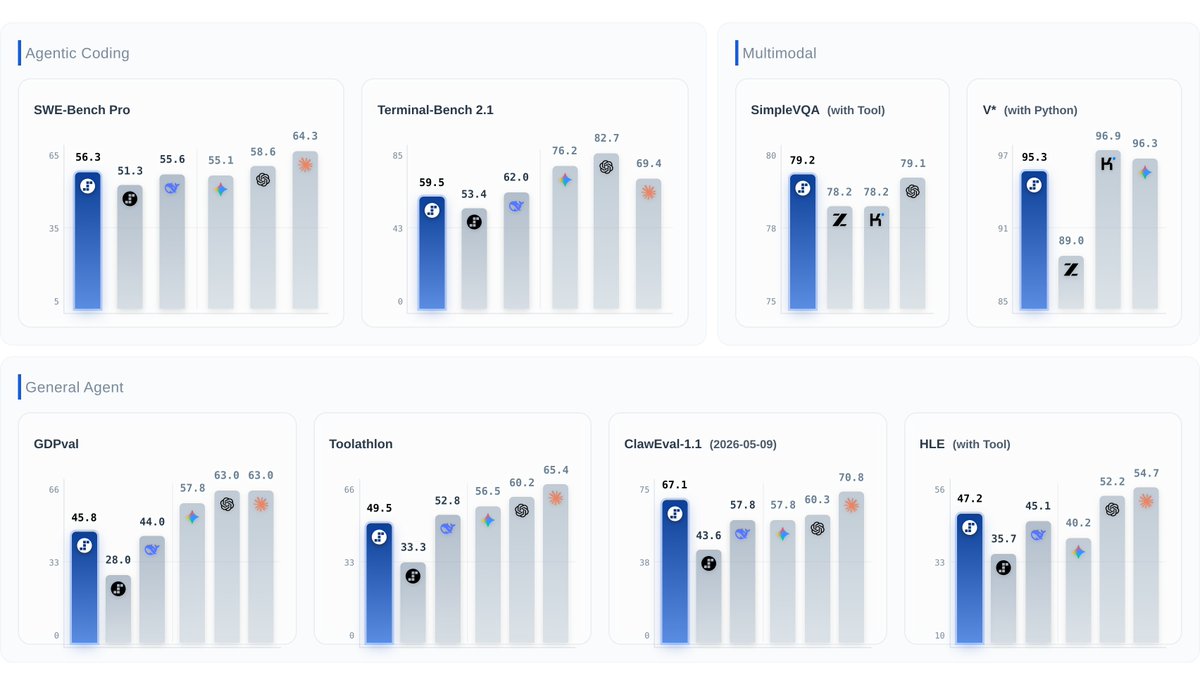
Flint from @Recursive_SI is now on OpenRouter! Recursive's first model: an open-weight 40B MoE (~2.5B active) built for coding agents by their autoresearch system, the Eureka Machine. 262K context, reasoning and tool calling. Recursive reports 54.9% on Terminal-Bench 2.1, 89.7% on SWE-bench Pro v2 and 74.2% on SWE-bench Verified. Free to use at launch. Try it now: https://t.co/8XU9Vqm3jk
Context
OpenRouter has added Flint, the first model from Recursive, and it is free to use at launch. Flint is a model: it holds 40 billion parameters, but per Recursive's announcement only 2.5 billion are active for each token. OpenRouter's post gives the same figure, while Recursive's homepage rounds it to about 2 billion. Recursive says it picked that shape to raise throughput on local hardware, and claims more than 125 tokens per second on an M4 Pro MacBook Pro at short contexts. The weights are on Hugging Face under the Apache 2.0 license. The sources also differ on context length: OpenRouter lists a 262K-token context with reasoning and , while Recursive says the model supports up to 512K tokens and recommends staying within 256K.
The unusual claim is how it was built. Recursive says its automated research system, the Eureka Machine, helped develop nearly every part of the model-building stack. Starting from a baseline with 35 billion total and 3 billion active parameters, it searched expert configurations and widths and settled on the 40B shape as the best projected mix of speed and coding performance among those it tried. After training, it found a recipe whose distillation stage, the company says, nearly halved training steps compared with Recursive's own quantization-aware training baseline. Richard Socher described that system's goals earlier on Latent Space.
The three scores in OpenRouter's post, 54.9% on Terminal-Bench 2.1, 89.7% on Pro v2 and 74.2% on SWE-bench Verified, are attributed there to Recursive. The text of Recursive's announcement reviewed here names those benchmarks and its test settings but does not itself state the figures. Those settings are the Terminus 2 harness with internet access for Terminal-Bench, mini-swe-agent without internet for the two SWE-bench tests, agent timeouts of up to five hours, and pass@1 averaged over at least five attempts. Recursive claims Flint leads mixture-of-experts models under 50 billion total parameters on agentic coding. None of the material reviewed here included an independent evaluation, so for now these are the developer's own numbers under its chosen settings.
- mixture-of-experts — A model built from many specialist sub-networks where only a few activate per token, giving big-model capability at small-model running cost.
- tool use — A model's ability to call external functions — run code, search the web, edit files — instead of only generating text.
- quantization — Shrinking a model by storing its numbers less precisely — like rounding — so it runs faster and fits on smaller hardware, at a small quality cost.
- SWE-bench — The standard benchmark for AI coding agents: real GitHub issues from real repositories, scored by whether the agent's patch passes the project's own tests.


Checking sign-in…
Loading comments…