Projects built in response to Jev illustrate a software pattern: give a model context windowThe maximum amount of text a model can consider at once — its working memory for the current conversation or task.Full definition → and a set of possible decisions, then receive scores that code can use directly. TypeSafe AI introduced this approach with Jev's structured-decision interface, which returns predefined kinds of values instead of free-form prose.
One project covered in a Latent Space roundup of Jev look-alikes, Jevlike, accepts text and a changing list of options, then scores those options in one pass. Its README describes it as an independent starter model with the same input and output shape, noting that TypeSafe has not published Jev's design. A similar interface therefore does not establish matching accuracy or an identical underlying model.
Key takeaways · AI-distilled
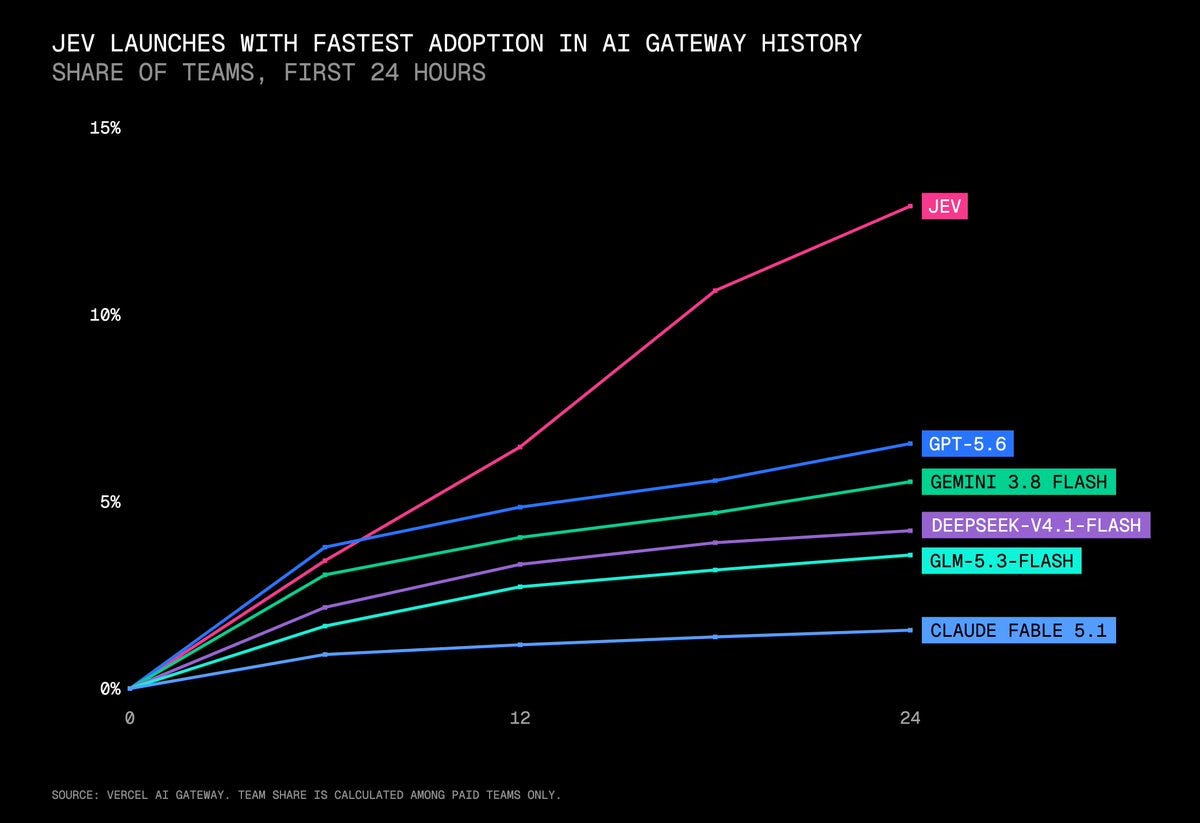
Jev's launch video reached 36M views in two days, compared with 74M for OpenAI's Navier-Stokes result and 57M for Anthropic's Fable 5, per Latent Space's AI News roundup.
Within two days, six teams cloned Jev's discriminative approach; @madiator's Bespoke Nimble (a LoRAA cheap way to fine-tune a model by training a small add-on layer instead of changing all of the model's weights.Full definition →fine-tuningTaking a trained model and training it a bit more on your own examples so it gets better at one specific job.Full definition → of Qwen3.5-9B) raised a baseline from 66% to 90% versus Jev's 93%, at about 100ms on an H100, while @jaredpalmer's Kev-0.5B runs on a MacBook Pro.
@trq212 confirmed Claude Code v2.1.277 now checks for AGENTS.md when no CLAUDE.md is present, with a config-level toggle; @simonw called the payoff fewer shim files that just point one config format at the other.
@Azaliamirh released Turbo-dLLM, an open-source library for training diffusion LLMs at scale, reporting a 2.48x speedup at 512K context and 7.59x at 1M context on 8x H100 GPUs via Context-Sharded Block Parallelism.
@skalskip92 reported GPT-6 Astra as the strongest vision model Roboflow tested, but its 'high effort' setting only raised detection from 82.1% to 83.6% mAP@50 while roughly doubling per-image cost ($0.050 to $0.101) and latency (11s to 32s).
Terms in this piece · Glossary
context window — The maximum amount of text a model can consider at once — its working memory for the current conversation or task.
calibration — How well a model's confidence matches reality — a calibrated model saying "90% sure" is right about 90% of the time.
LoRA — A cheap way to fine-tune a model by training a small add-on layer instead of changing all of the model's weights.
fine-tuning — Taking a trained model and training it a bit more on your own examples so it gets better at one specific job.
article[AINews] Jev: a “System One Model” that only decides/classifies/routes/scores — >100x faster, >200x cheaper than small frontier LLMswww.latent.space
 articleJev: System One models for Prod, not God — with Diogo Almeida, CEO, TypeSafe AIwww.latent.space
 articleOpenAI is well positioned to fast-follow JevJohnBerryman