How an assessor could investigate control and monitoring of internal AI agents
- Source
- metr.org
- Date
Context
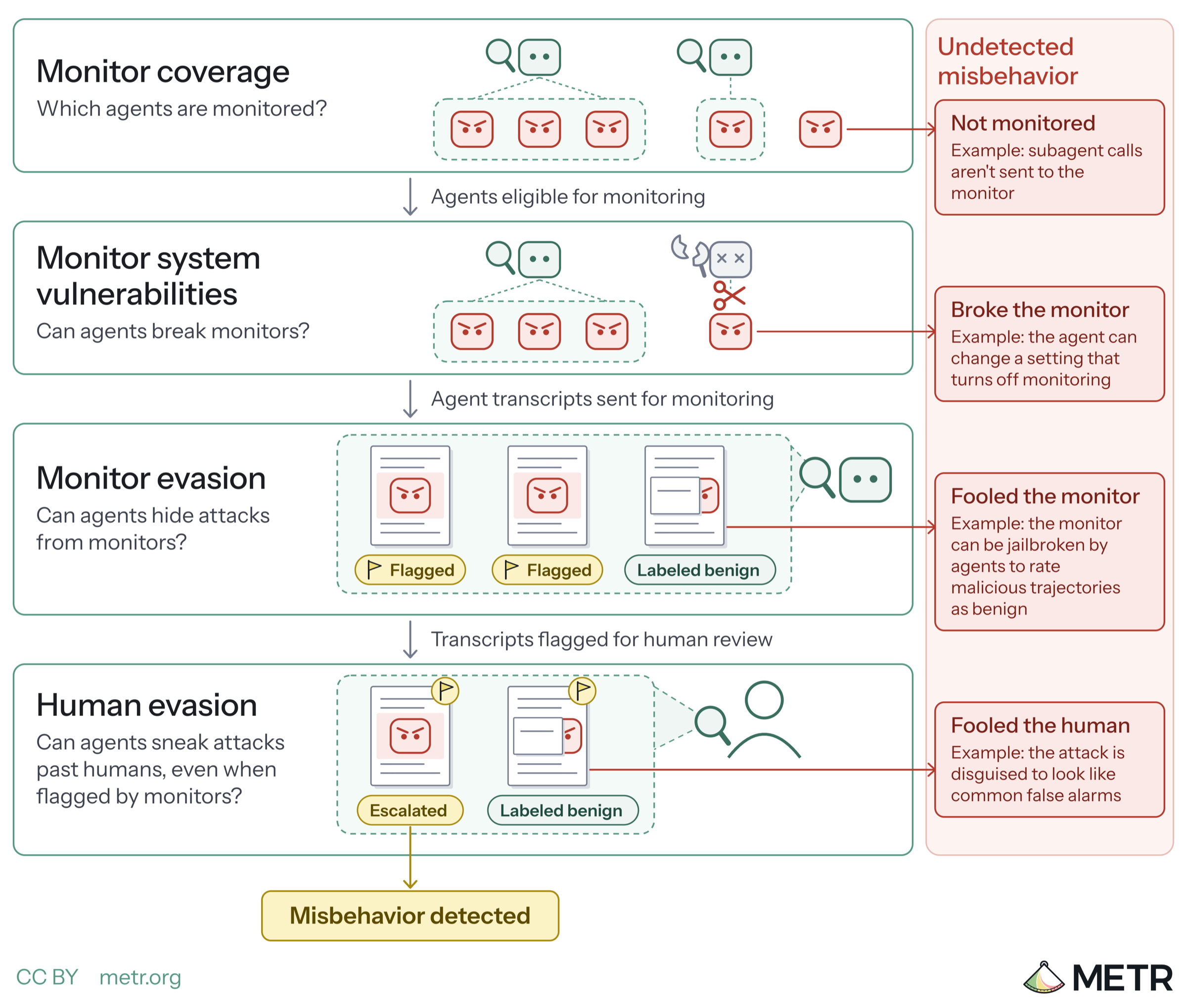
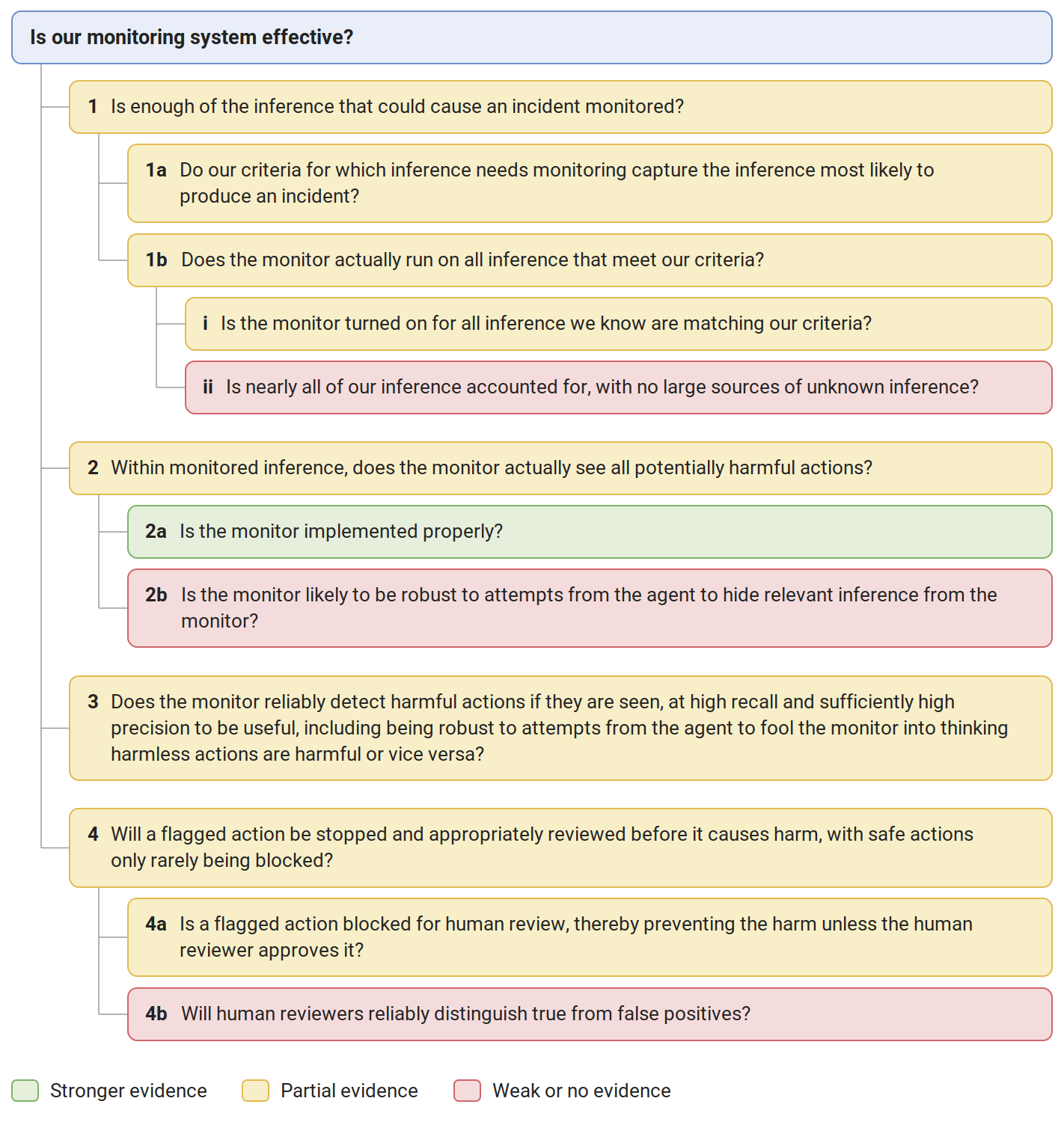
A monitor's accuracy matters only for the actions it actually sees. METR's control-assessment proposal would examine the whole path from an taking an action to someone stopping harmful behavior: whether monitoring covers it, whether the monitoring infrastructure remains intact, and whether a warning gets an effective response.
That requires evidence beyond a model . Assessors would compare and monitoring logs, inspect the relevant code, review incidents and interview staff about how the systems operate. A monitor could classify the examples it receives correctly while still missing an unmonitored source of activity. The proposal describes how to investigate that gap; it does not certify a particular developer's controls.
- METR proposes that an outside assessor test AI developers' agent monitoring along five questions: coverage of internal agentic inference, vulnerabilities in the monitoring system itself, monitor evasion, human review and response, and the worst harm an agent could do undetected.
- On coverage, METR says assessors should verify that unmonitored inference is actually non-agentic rather than assume it, because a misaligned agent that compromised infrastructure could route actions through unmonitored paths.
- For evasion testing, METR asks for at least ~100k representative internal agent transcripts and ~100 of the most severe incidents, both to find misbehavior monitors missed and to spot attack opportunities agents passed up.
- METR flags monitor-agent collusion as a growing concern and suggests honeypots for monitors and searching monitors' chains of thought for discussion of collusion.
- The access requested is broad: codebase access comparable to the developer's own security researchers, inference and monitor logs to cross-reference, and the ability to insert realistic attack trajectories to see whether human reviewers escalate them.
- AI agent — An AI system that doesn't just answer once but works toward a goal in a loop — taking actions, reading the results, and deciding what to do next.
- benchmark — A standard public test set for comparing AI models — the shared scoreboards behind every "model X beats model Y" claim.
- inference — Running a trained model to get answers — the phase where AI is actually used, as opposed to trained.

Checking sign-in…
Loading comments…