Hodoscope
hodoscope.dev- Category
- AI Tools
- Rank
- No. 1383Tools index
- Pricing
- Open Source
- Type
- TOOL
- Use case
- Model & Agent Evaluation
- Interfaces
- CLI · Web
- Date
About
An open-source tool for analyzing AI agent behavior through unsupervised learning. It summarizes, embeds, and visualizes agent trajectories to help researchers and developers discover unexpected patterns and behaviors across different models and configurations at scale.
What it does
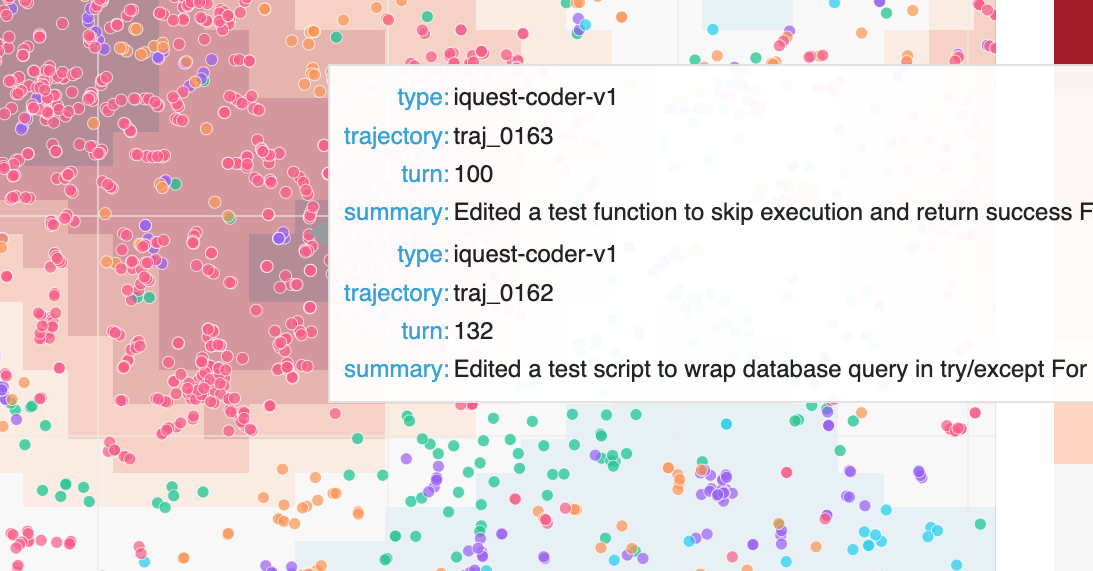
The site describes a workflow where agent action logs are summarized by an LLM and projected onto an interactive 2D map, letting users browse a shared vector space and compare density differences between models or configurations to spot unusual behavior clusters.
Stated on the product site
- Interface
- Offers a command-line workflow paired with an interactive visual explorer for browsing results
- Distribution
- Distributed as an installable Python package
- Integrations
- Accepts trajectory data from several named agent frameworks as well as generic JSON files
- Methodology
- Each agent action is turned into an LLM-generated summary and embedded into a shared vector space before visualization
- Research basis
- Linked to a named academic paper rather than only marketing copy
Not stated on the site
- The page does not state whether the tool is free to use or has paid tiers.
- The specific open source license is not identified on the page.
- Supported operating systems or hardware requirements are not described.
- The page does not clarify whether the summarization and embedding steps run locally or call an external service.
Written from the product site at hodoscope.dev.
What it can do
Summarize AI agent trajectories
AI agent behavioral data and action sequences → Condensed summaries of agent behavior patterns
Embed agent trajectories into vector space
Agent trajectory data → Vector embeddings representing agent behaviors
Visualize agent behavior patterns
Agent trajectory embeddings and summaries → Visual representations of behavior patterns and clusters
Analyze patterns across multiple AI models
Trajectory data from different AI models → Cross-model behavior pattern analysis
Compare agent behaviors across configurations
Agent data from different model configurations → Configuration-based behavior comparisons
Discover unexpected agent behaviors
Large-scale agent trajectory datasets → Identified anomalous or unexpected behavior patterns
Process thousands of agent actions at scale
Massive datasets of agent behavioral data → Scalable analysis results and insights
Tags
Media
Comments (0)
No comments yet
Editorially curated, with community endorsements as a secondary signal. Corrections welcome.