OlmoEarth v1.3: State-of-the-art embeddings for the whole planet
- Source
- huggingface.co
- Date
Context
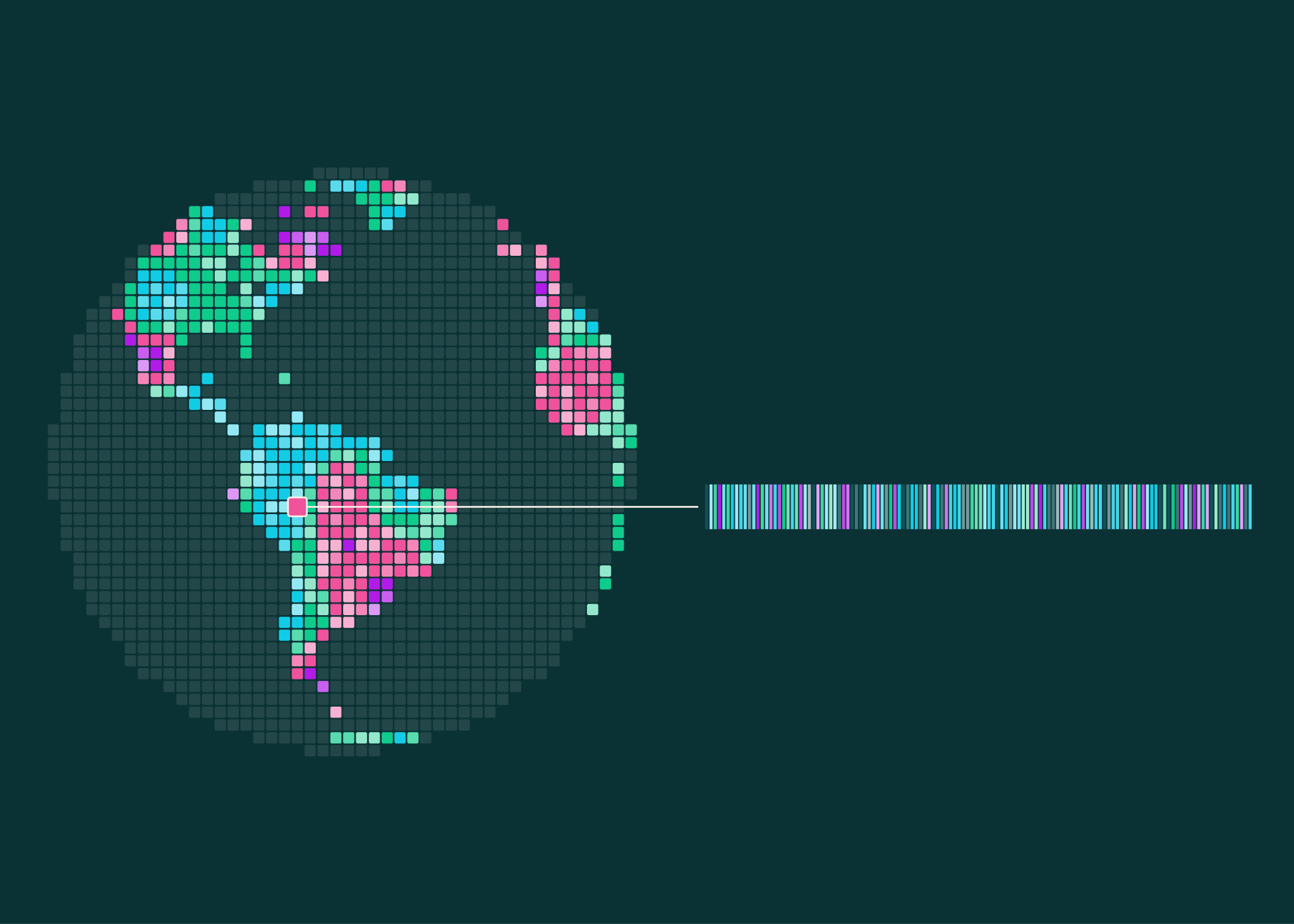
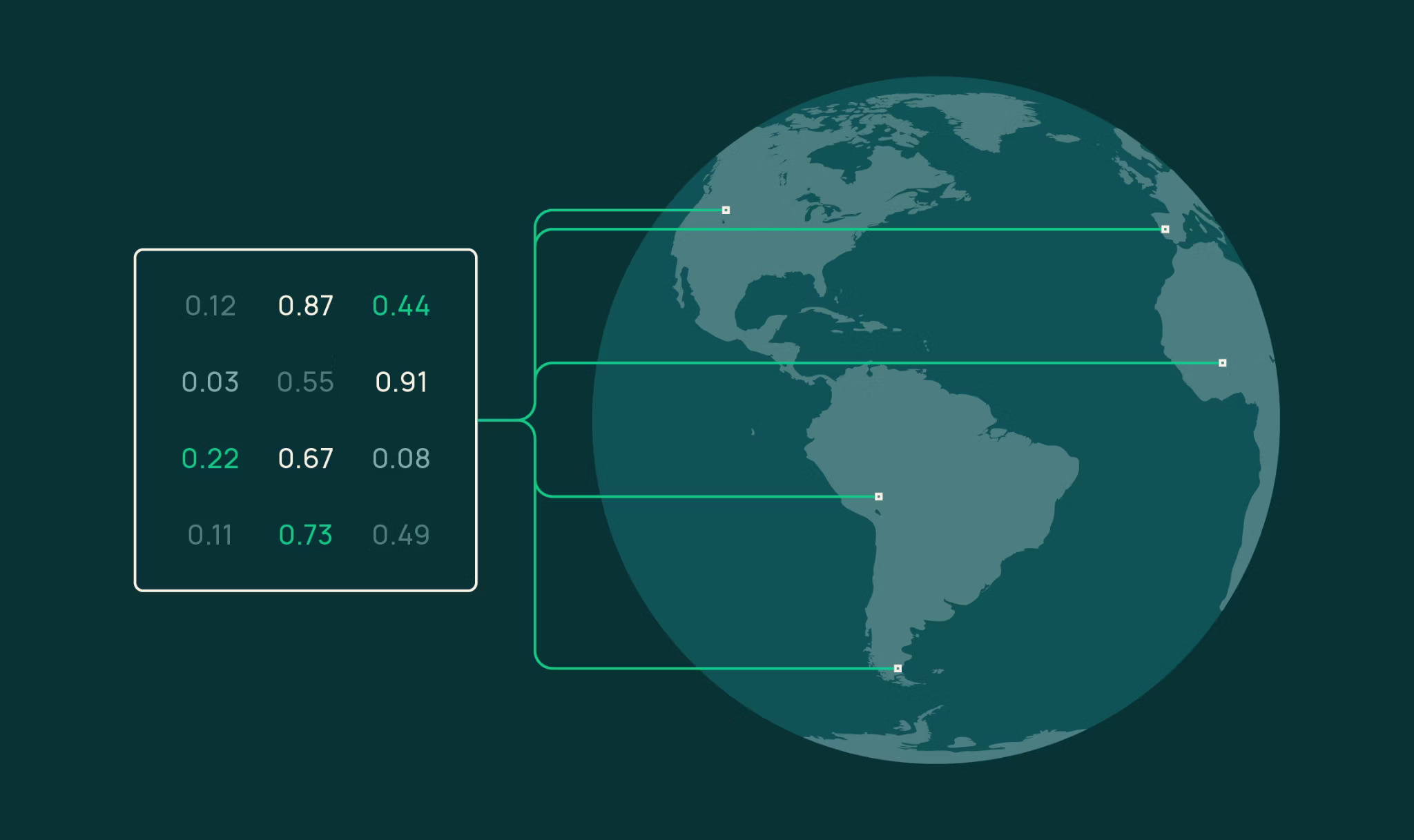
The main change in OlmoEarth v1.3 is how people use it. Before this release, the main way to use Ai2's model was to run it yourself: you fine-tuned a model for each task in OlmoEarth Studio and ran it over satellite imagery, which takes GPUs and space to download and store that imagery. With v1.3, Ai2 has computed the embeddings for the whole planet once and published them. An is a list of numbers that sums up what the model saw at one spot. Here, every 10-meter pixel gets one 128-number vector, built from a year of radar (Sentinel-1) and multispectral (Sentinel-2 and Landsat) imagery. The first 64 numbers also work as a smaller version. Places with similar ground cover get similar vectors, so a crop map or land-cover map can come from a small classifier trained on top of the vectors and run locally.
That goes further than Ai2's August embedding feature. That feature let OlmoEarth Studio users compute embeddings on demand for an area and time span they chose. The August post said those custom exports were limited to Studio users and asked people to get in touch for access. The v1.3 archive is open and needs no sign-in. It is about 150 TB per year of embeddings, and a browser tool, the Embeddings Explorer, sits on top of it. In the Explorer you can switch between years, click a place to find similar ones, or drop a few labeled points to train a classifier, then export the map as a GeoTIFF. Coverage is uneven for now: 2023 through 2025 are global, and 2017 through 2022 cover only select countries. Studio is still there for custom date ranges and for .
Ai2's example is gold mining in Peru's Madre de Dios region. Comparing each pixel's vector across years, with no model training, shows mining spreading southeast between 2017 and 2020. In the 2020 to 2025 comparison, that area goes quiet after the 2019 crackdown, and the change shifts to the older mining zone, where the land is partly regrowing and partly being dug again.
The performance claims come from Ai2's own evaluation. Across 27 tasks, Ai2 says the 128-number embeddings scored highest on 20 against AlphaEarth Foundations and Tessera v2, and the 64-number version led on 18. One of those tasks is a new tropical crop Ai2 built, called PLANTEUR. Ai2 also says v1.3 took 53% of v1.2's training compute, still matches v1.2 when fine-tuned, and that the final run would cost about $2,720 in rented H100 time. The weights, pretraining data and code are released under the same OlmoEarth Artifact License as earlier versions, and the full methodology is in Ai2's technical report.
- OlmoEarth v1.3 turns a year of Sentinel-1 radar and Sentinel-2 and Landsat imagery into one 128-dimension vector per 10-meter pixel, and the first 64 dimensions also work alone. Ai2 precomputed these for the planet, roughly 150 TB per year.
- Against AlphaEarth Foundations and Tessera v2 across 27 evaluations, Ai2 reports its 128-dimension embeddings scored highest on 20 and the 64-dimension version led on 18. The evaluations include PLANTEUR, a new crop-type benchmark for tropical farming.
- With precomputed embeddings, a crop or land-cover map becomes a small classifier trained locally instead of a GPU fine-tuning run, and change detection can compare a pixel's vectors across years with no training at all.
- v1.3 took 53% of v1.2's training computing time and 18% of v1's. Ai2 estimates the final Base pre-training run would cost roughly $2,720 of rented H100 time to reproduce, and the weights, data and code are open.
- Coverage is uneven at launch: 2023 to 2025 are global, while 2017 to 2022 cover select countries. Provenance tables for each 20 km tile and year list the Sentinel-1, Sentinel-2 and Landsat scenes behind the embeddings.
- embedding — A list of numbers representing a piece of text's meaning, so that similar meanings end up numerically close and can be searched.
- fine-tuning — Taking a trained model and training it a bit more on your own examples so it gets better at one specific job.
- benchmark — A standard public test set for comparing AI models — the shared scoreboards behind every "model X beats model Y" claim.
- pretraining — The first, biggest phase of building a model: training it on enormous amounts of text so it learns language, facts, and reasoning in general.
Checking sign-in…
Loading comments…