HeyGen Video launches on MiniMax H3 with API pricing from $0.01/s
- Source
- developers.heygen.com
- Author
- HeyGen
- Date

Context
HeyGen Video is HeyGen's own video-generation model, made by post-training MiniMax's H3. Post-training means HeyGen kept training an existing model to change its behavior rather than building one from scratch. HeyGen announced the model for businesses that want production-quality video at lower cost, and sells it through an API. Its developer catalog page shows clips generated from text prompts and times an image-to-video clip. The same page says every endpoint comes with an server and typed schemas, so coding agents such as Claude or Cursor can request videos directly.
The page makes the case mostly through price and speed. At 768p with audio, before promotions, it lists HeyGen Video at $0.03 per second of video, against $0.04 for H3 Max Turbo, $0.08 for H3 Max, $0.168 for Kling 3.0 Pro, $0.303 for Seedance 2.0 and $0.40 for Veo 3.1. H3 Max is itself a post-trained H3, built by fal according to earlier Intel coverage, so part of this comparison is between rival versions of the same base model. The announcement's price, starting at $0.01 per second, is an October launch promotion described as 50% off. The table's $0.03 is a list price for 768p with audio, and the page does not explain how the two figures relate. On speed, HeyGen reports 3.7 seconds of for a 10-second image-to-video clip, against 4.1 seconds for H3 Max Turbo and 8.3 seconds for H3 Max, with captioning time excluded.
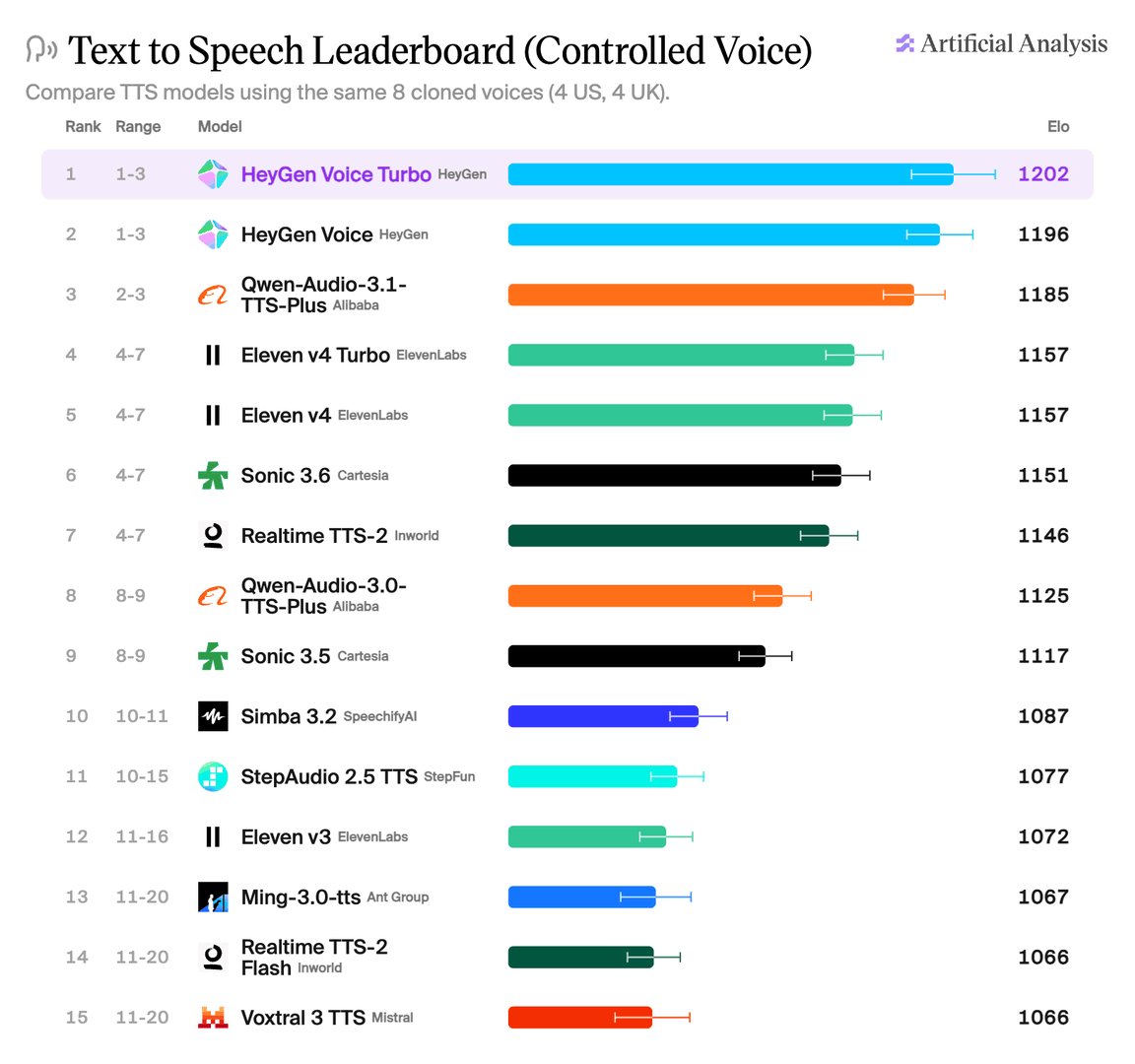
The page also ranks HeyGen Video first on quality, using an Elo rating, a score built from head-to-head comparisons. HeyGen sets its own score to 1000 and places Seedance 2.0 at 955 and H3 Max at 952. The page does not say who judged the clips or which prompts were used, so these are HeyGen's own claims rather than an independent ranking. The short demo video's speech only repeats the launch message, and its visuals were not analyzed.
- MCP — The Model Context Protocol — an open standard that lets any AI assistant plug into any tool or data source without custom integration code.
- inference — Running a trained model to get answers — the phase where AI is actually used, as opposed to trained.
- llms.txt — A file at a site's root that gives AI systems a curated, plain-text map of its most useful content — robots.txt's counterpart for comprehension rather than permission.




Checking sign-in…
Loading comments…