LLM Research Papers: The 2026 List
- Source
- magazine.sebastianraschka.com
- Author
- Sebastian Raschka, PhD
- Date
Context
Sebastian Raschka's January–May 2026 paper list is organized around the problem a reader is investigating. It separates work on model architecture from inference efficiency and the systems that give models tools, making it easier to find papers relevant to a particular project.
Compared with the 2025 collection, Raschka says the new bookmarks include more agent infrastructure and long- work, which Raschka attributes to current projects and to where the field appears headed. The list is not a census of everything published. Raschka also distinguishes organizing papers by their abstracts from reading them in depth, so inclusion should be treated as a reading lead rather than an endorsement of a finding.
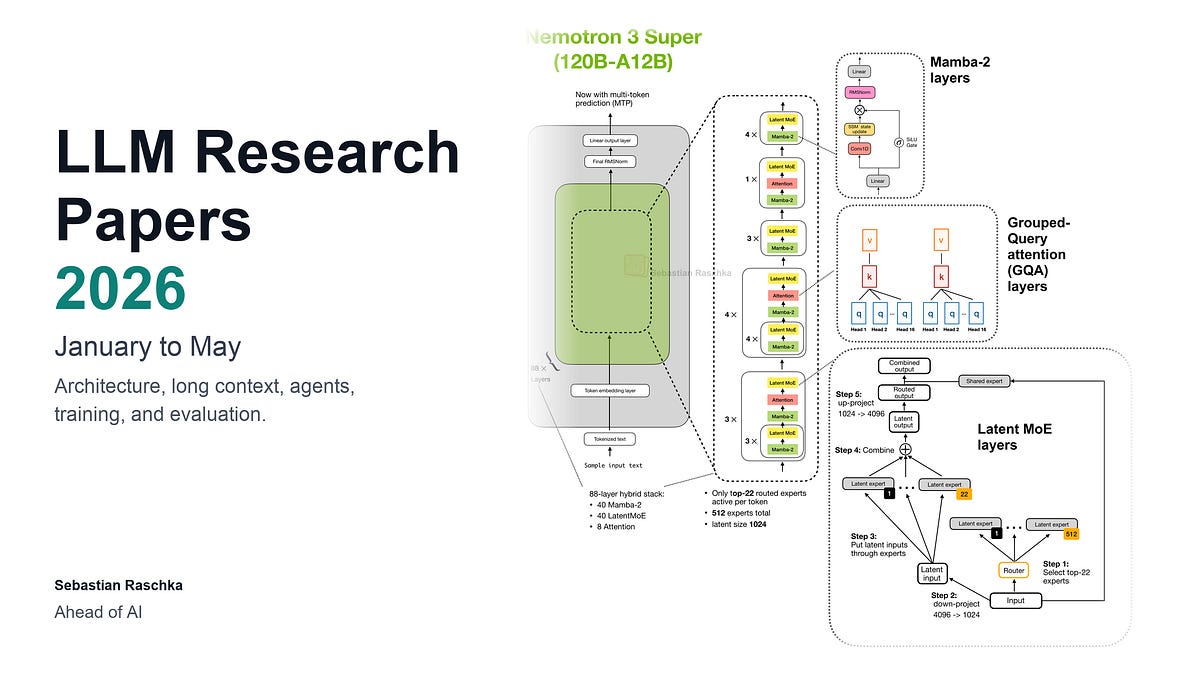
- The 2026 architecture theme is hybrids, not scale. Models alternate ordinary attention layers with state-space layers, Mamba-2 in Nemotron 3 and Gated DeltaNet in Qwen3.6, because long agent contexts make full attention on every layer too costly.
- Nemotron 3 Ultra at 550B total and 55B active uses the same building blocks as Super, widened in embedding and projection dimensions. Labs are scaling one fixed recipe across sizes rather than redesigning per model.
- The Nemotron 3 paper is worth reading past the architecture: it ablates multi-token prediction for , NVFP4 versus BF16 , synthetic MMLU-style data, and post-training recipes.
- Size gates who can run what. Nemotron 3 Super at 120B total and 12B active is beyond typical consumer hardware, which is why a 4B Nano variant ships alongside it.
- context window — The maximum amount of text a model can consider at once — its working memory for the current conversation or task.
- speculative decoding — A speed trick where a small model drafts several tokens ahead and the big model verifies them in one pass, often doubling generation speed.
- pretraining — The first, biggest phase of building a model: training it on enormous amounts of text so it learns language, facts, and reasoning in general.
- quantization — Shrinking a model by storing its numbers less precisely — like rounding — so it runs faster and fits on smaller hardware, at a small quality cost.
“In 2026, long-context efficiency is king as more and more LLMs get plugged into agent harnesses (OpenClaw etc.), which requires working with longer and longer contexts.”
“When I work on an article, book section, code example, or lecture, I often remember that I saw a relevant paper somewhere, but finding it again can be surprisingly annoying.”

Checking sign-in…
Loading comments…