[AINews] Claude Haiku 5.5 — better than GPT-6 Luna at the same pricing
- Source
- latent.space
- Date
Context
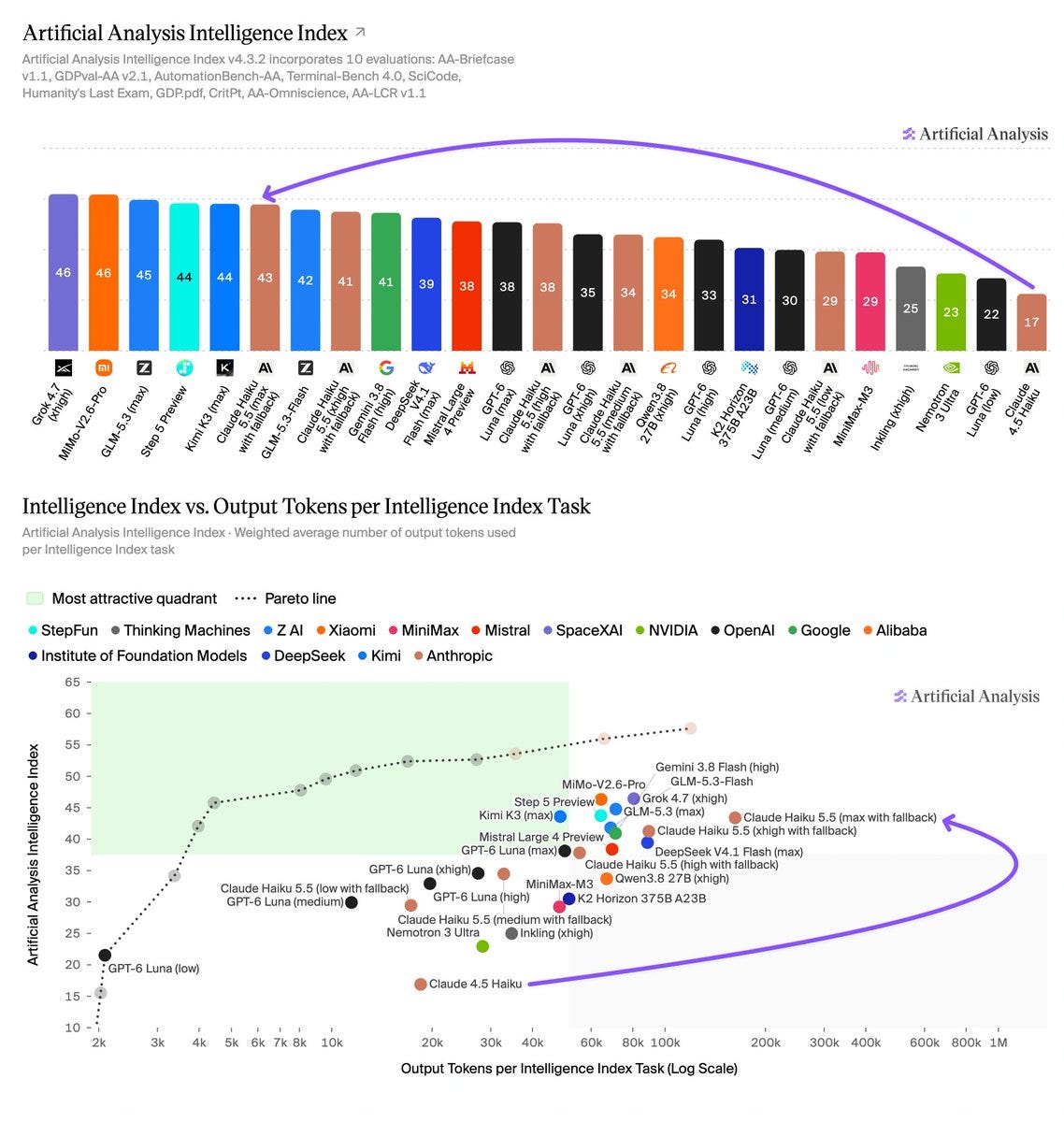
Claude Haiku 5.5, from Anthropic, is priced to match OpenAI's GPT-6 Luna, but measurements from Artificial Analysis, an independent evaluator, suggest a low per- price does not translate directly into low cost per task. Its Haiku 5.5 page lists an Intelligence Index score of 43 at maximum effort, and Latent Space's AINews roundup for October 6 to 7, 2026 relays that this is ahead of Luna's 38 but with about 162,000 output tokens per task, roughly three times Luna at its maximum.
At equal scores the gap persisted: Haiku at high effort scored 38 using about 55,000 tokens, against Luna's 38 at about 50,000. Prompts over 100,000 tokens also cost five times as much per token, a step Artificial Analysis had not yet modelled, so its cost-per-task figures were pending. The roundup suggests these effects likely explain why Cursor claimed 10x savings versus Haiku 4.5 on short requests while Anthropic claimed about 75% cheaper on average. That is the newsletter's , and the larger jumps it lists are vendor or secondhand claims.
- Haiku 5.5 costs $0.10/$0.50 per 1M input/output tokens under 100K prompt tokens, but five times that above 100K; AINews suggests this step plus heavy token use explains why Cursor's 10x claim differs from Anthropic's 75% average.
- Artificial Analysis found Haiku 5.5 uses about 162k output tokens per Index task at max effort, roughly 3x GPT-6 Luna, and even at an equal score of 38 it is somewhat more verbose, so per-token savings are partly offset.
- On AA-Omniscience, Haiku 5.5 scored 36% accuracy with a 40% rate, versus Luna's 44% and 77%; the newsletter says part of the lower accuracy comes from the model more often saying it does not know.
- Its 35% AutomationBench-AA score trails Luna and other small models at 53 to 60%, but a pre-release safety bug made it over-refuse; Anthropic is fixing it and Artificial Analysis expects the score to rise on a re-run.
- Alongside the launch, Anthropic built computer-use and browser-use toolsets into its Python and TypeScript SDKs, which now run the action loop and send clicks and keystrokes to drivers such as Browserbase, E2B or Daytona.
- token — The chunk of text a model reads and writes in — roughly three-quarters of a word — and the unit AI usage is billed in.
- inference — Running a trained model to get answers — the phase where AI is actually used, as opposed to trained.
- benchmark — A standard public test set for comparing AI models — the shared scoreboards behind every "model X beats model Y" claim.
- hallucination — When a model states something false with full confidence — inventing facts, citations, or APIs that don't exist.



Checking sign-in…
Loading comments…