- Category
- AI Agents
- Rank
- No. 3318Tools index
- Pricing
- Open Source
- Type
- TOOL
- Use case
- Agent Building
- GitHub
- 537 stars
- Latest release
- v0.2.4
- Date
About
GEAR is an open-source framework that evaluates and refines an AI agent's skills, tools, and workflows against real tasks, using task feedback to improve the agent's harness. Its site reports that on AutomationBench Marketing tasks, an optimized harness raised objective completion from 75.37% to 88.88%, and on Terminal-Bench 2.1 raised task pass rate from 52.87% to 84.26%. The runs changed both the harness and reasoning effort.
What it does
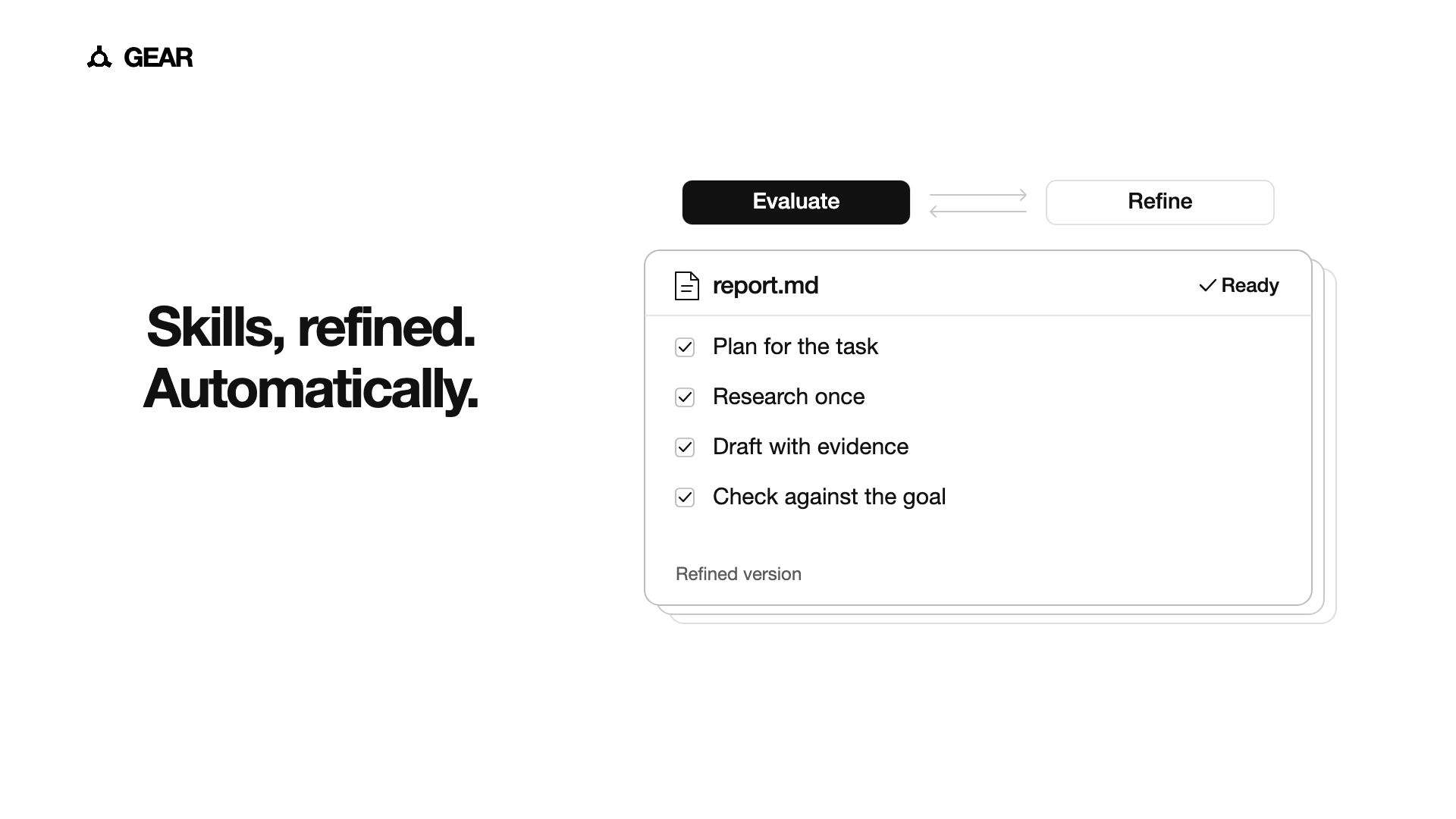
Gear runs your agent against a benchmark of tasks you care about, then hands the transcripts and scores to a second agent, the Meta agent, which proposes edits to the first agent's prompts, tools, hooks, skills and context handling. Each proposed version is tested, compared with its parent on the same tasks, and kept only if it wins. You drive it through a bundled Refine skill inside Codex, Claude Code or DeepSeek's DSH, with the separate Hitch runner and Harbor containers doing the actual task runs. Training model weights from the same feedback exists but is labelled experimental.
Why it's ranked here
The interesting part is the discipline around the loop, not the headline numbers. Candidates live in isolated Git worktrees pinned to exact commits, held-out tasks are kept away from the Meta agent, and the search policy is six small swappable Python modules with GEPA and random search as stock options. The README's fair comparison, same model and same effort, shows Marketing pass rate rising from 27 to 40 and Terminal-Bench 2.1 from 52.8 to 62.9. Larger figures mix in a reasoning effort change, and the project's own guide says its Marketing examples are not independent held-out evidence. MIT licensed.
What's good
The README separates same-effort gains from gains that also raised reasoning effort, and says so in plain words. The scope of what may change is explicit: you authorise which components Gear can touch. The Meta sandbox is on by default, using the system sandbox on macOS and Bubblewrap with a seccomp filter on Linux, and the docs warn that turning it off voids the held-out isolation claim. The contributing guide asks benchmark reports to state dataset split, model versions, effort and budget, and to keep optimisation tasks distinct from held-out ones.
Tradeoffs
Setup is heavy: Node 22.19 or 24, Docker, Harbor, Hitch at version 0.2.5 or later, Python with IPython, and on Linux Bubblewrap, socat and ripgrep. Windows is not supported as a production host. The package is tightly coupled to DSH, with a dozen DeepSeek packages as dependencies or optional peers. The user guide states the production Meta runner, authentication setup and real-model journey are still in progress. The detailed installation guide is in Chinese and still shows an older 0.1.0 install command.
How to use it well
Start with a benchmark you already trust, with clear pass criteria, because Gear can only optimise what it can score. Keep a held-out split and never point the Meta agent at it. Run one round with a cheap task model first and read the diff Gear proposes before running more. It suits a team tuning one agent for a narrow, repeatable workload such as support or marketing automation. It does not help with open-ended tasks that lack a verifier, and weight training is not ready for real use.
Technical notes+
The npm package (rsi-gear, MIT per LICENSE and package.json) exposes a gear binary from src/cli.ts with serve, skill-identity, storage, training and socket request subcommands, the request path needing GEAR_REFINE_SOCKET or --socket. src/index.ts exports ProjectApplication, DshHarnessAdapter and PiHarnessAdapter plus setup, doctor and benchmark import helpers; extra bins wrap Codex as the Meta runner. python/gear/__init__.py exposes Project, Report and Run. docs/guide/en/index.md lists the six algorithm modules (parents, sampling, proposal, ranking, stopping, algorithm) and notes TypeScript owns execution and validation. docs/plugin-installation-and-usage.md describes candidate worktrees from exact 40 or 64 character commit OIDs, a Hitch version preflight, and metaSandbox.mode required by default.
Observed
- License
- MIT
- Language
- TypeScript runtime with a Python SDK and Python algorithm modules
- Packaging
- npm package with a global CLI; bundled Refine skill
- Interfaces
- CLI, Python SDK, agent skill, local socket protocol
- Runtime requirements
- Node 22.19+ or 24+, Docker, Harbor, Hitch evaluation runner
- Platform support
- macOS and Linux; Windows not supported as a production host
- Supported harnesses
- DSH and Pi task harnesses; Codex, Claude Code or DSH as Meta agent
- Model training
- Experimental, per the project README
- Docs language
- English README and user guide; installation and design docs largely in Chinese
Read from README.md, package.json, src/cli.ts, src/index.ts, docs/vision.md, docs/guide/en/index.md, docs/plugin-installation-and-usage.md, python/gear/__init__.py, LICENSE, CONTRIBUTING.md.
Similar tools
Tags
Tech Stack
Media
Editorially curated, with community endorsements as a secondary signal. Corrections welcome.