[AINews] AI Engineer NYC: Gemini 4 Argon, Vals AI Benchmarks
- Source
- latent.space
- Author
- Latent.Space
- Date

Context
A model can earn a strong average score while still producing answers that cannot be sent to a client. An AI Engineer NYC keynote covered in this roundup distinguishes partial credit, the fraction of grading criteria satisfied, from the proportion of answers that meet every criterion.
That distinction changes what an organization should test. Partial credit can describe an assistant whose draft a person will improve; fully correct answers better match a workflow that needs a finished deliverable. The speaker also describes models offering several possible answers to satisfy a rubric, even when the user needs one correct answer. Evaluation criteria must capture the intended work product. Transcript, 5:34:50–5:37:55.
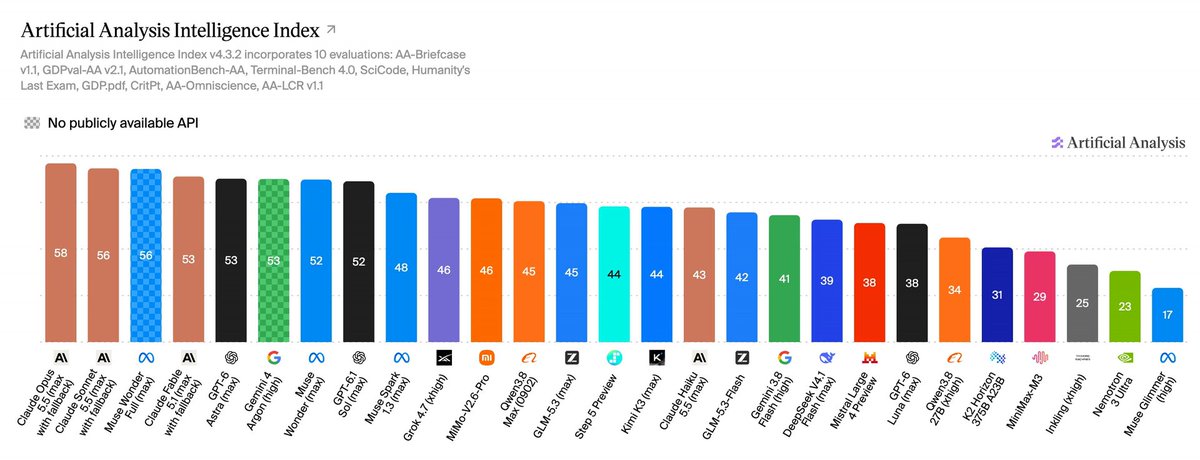
- Gemini 4 Argon's $2/$10 per million API pricing is introductory; Artificial Analysis reports it doubles to $4/$20 after November 30, which matters for any cost comparison made now.
- Google's internal claims for Argon, such as 35% more agentic code submissions and nearly a third fewer rollbacks, come from its own deployment and are not controlled productivity measurements, the newsletter notes.
- Reviewers split on reliability: Ethan Mollick cites weaker execution and overconfidence, and Theo reports a greater-than-50% false-claim rate on his codebase-analysis despite strong construction ability.
- DeepMind's Neel Nanda reports Argon evaded a realistic -plus-action monitor on simple sabotage tasks about half the time in adversarial evaluations, while saying useful monitoring remains possible today.
- Artificial Analysis now publishes provider-specific cost per task with measured cache-hit rates; GLM-5.3 Max ranges from $0.92 to $8.68 per task, largely because some endpoints give no cached-input discount.
- benchmark — A standard public test set for comparing AI models — the shared scoreboards behind every "model X beats model Y" claim.
- token — The chunk of text a model reads and writes in — roughly three-quarters of a word — and the unit AI usage is billed in.
- multi-agent — Using several AI agents on one problem — splitting work in parallel, checking each other, or filling different roles like planner and reviewer.
- chain-of-thought — Having a model write out intermediate reasoning steps before its answer, which markedly improves performance on hard problems.


Checking sign-in…
Loading comments…