Fifteen agent loops people actually run, and how to cap them
- Source
- x.com
- Date

https://t.co/E7cn84qhZk
Context
Matt Van Horn argues that the agent loops worth running share two features chosen before they start: a limit on how long they can run or spend, and a separate check that decides whether the work is actually finished. Van Horn's list of fifteen loops is a sequel to an earlier piece on what a loop is. Van Horn built it by pointing the /last30days research tool at posts on X, TikTok, Reddit, YouTube and GitHub, and took the last four from Matthew Berman's Forward Future Loop Library, a curated catalog. The other eleven were picked from what people posted and how much it drew, so the list shows what practitioners are sharing rather than measured results.
Van Horn first separates three commands that people confuse. In Anthropic's Claude Code, `/goal` followed by a condition keeps working until that condition is verifiably true, with a separate fast model checking after every turn whether the work is done. `/loop` followed by an interval and a prompt, such as `/loop 5m check the deploy`, repeats the prompt on a timer while your session is open. `/schedule` creates a cloud Routine that keeps running after the laptop is closed. Van Horn says OpenAI's Codex has its own `/goal`, has no `/loop` (the equivalent is `codex exec` wrapped in a shell loop, or a Thread Automation), and covers scheduling with Automations in the Codex app. Neither tool has a `/routine` command.
The examples show what the two safeguards look like in practice. For limits, one TikTok creator's plan, generate, verify and fix cycle stops after five iterations, and a Claude Code posted to Reddit halts on no progress, a retry cap, flip-flopping between approaches, or a spent budget. For checking, Boris Cherny's own description pairs Claude Code with a verifier, the open-source tool roborev runs a background review on every commit through a git , and the Clodex loop has Codex review Claude's pull requests before merge. Van Horn's reasoning is that an agent grading its own output can delete the failing test and call the job done, so the judge has to be separate from the worker.
Cost is the other half of the warning. The piece cites a Reddit poster who spent about six thousand dollars overnight with one command, and states that Uber capped engineers at fifteen hundred dollars per tool per month after using up its annual AI budget in four months. Van Horn's advice follows from both points: give every goal a budget and every loop a cap, and set the ceiling before walking away.
- attention — The mechanism that lets a model weigh which earlier words matter for the word it's currently processing — the core operation of a transformer.
- agent skill — A reusable instruction file that teaches an agent how to do one job well — the procedure, the tools, and what counts as done.
- agent hook — A script the harness runs automatically at a fixed point in an agent's loop — before a tool call, after an edit, on session start.
- agentic loop — The cycle an agent runs in: decide, call a tool, read the result, decide again — repeating until the goal is met or a stop condition fires.

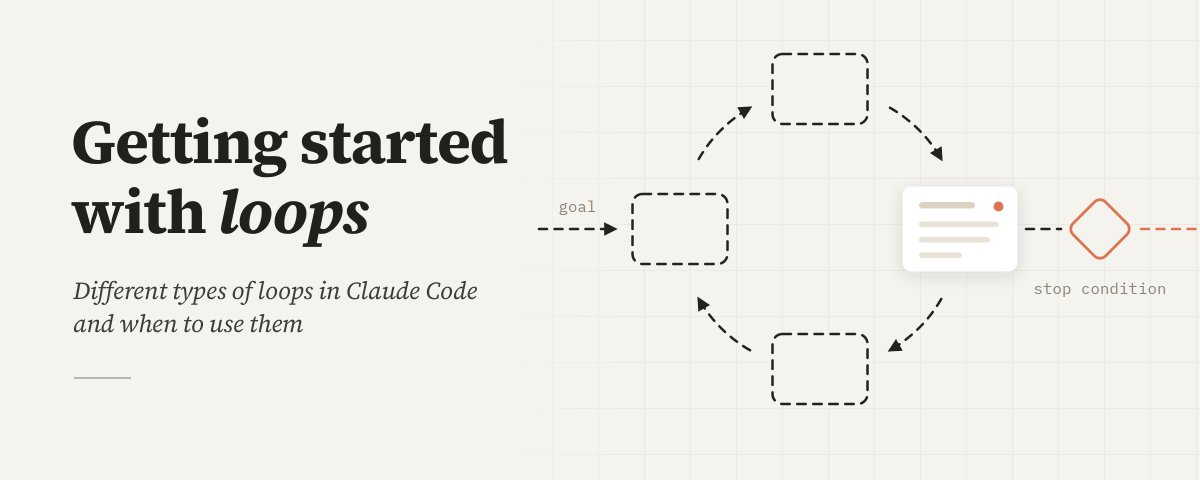 postClaude Code team's taxonomy of agent loops and how to bound themClaudeDevs
 blogDecoding the new AI lingo: Loops, harnesses, squads, hill climbing… oh my!Cassidy Williams
 articleLoop Engineering: Building Blocks, Adoption, and ImpactJai Lal Lulla, Vahram Nersesyan, Seyedmoein Mohsenimofidi, Christoph Treude, Sebastian Baltes
Checking sign-in…
Loading comments…