ollama v0.40.8
- Source
- github.com
- Author
- github-actions[bot]Top Viber
- Date
Context
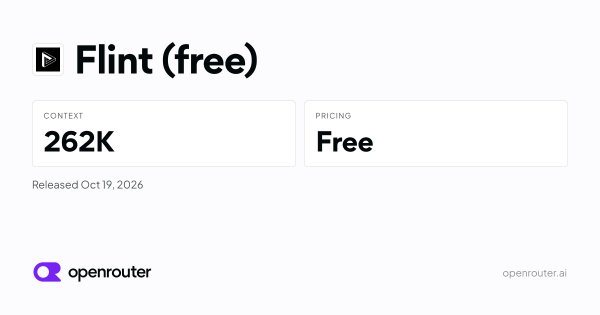
Ollama v0.40.8 has release notes about one thing: it adds Flint, the first model from Recursive, built for the repository work agents do, such as reading unfamiliar code, tracing bugs, implementing features and writing tests. On a supported machine it is one command, ollama run flint. The catch is in the release note itself: Flint is supported on macOS, and "other GPU support will be enabled in a subsequent release," so a Windows or Linux machine with an NVIDIA card is not yet supported by Ollama for this model. The same model also went up as a hosted option on OpenRouter around the same time, free at launch.
Flint's size is easy to misread. According to Recursive's model card, it has 39.8 billion parameters in total but only about 2.5 billion active per token. It is a model: in each of its 47 expert layers a router picks 6 of 256 small expert networks, plus one always-on shared expert, to process each token. That keeps the computation per token close to a small model's, which is what makes it quick to generate, but the full set of weights still has to be loaded. The full-precision checkpoint is about 80 GB; the default download in Ollama's library is 23GB, under a third of that size, which fits a , reduced-precision build; Ollama's page says quantized versions are offered but does not state which precision this download uses. Both list a context window of roughly 262,000 tokens, which the card calls "a capacity limit, not a guarantee of uniform accuracy" at every length.
The benchmark figures in the release, 54.9% on Terminal-Bench 2.1 and 74.2% on , come from Recursive's own release evaluations, not independent testing; the card adds 89.7% on SWE-bench Pro v2. The card says the agentic scores are averages over at least five attempts using specific test harnesses, that comparison scores for other models are developer-reported, and that evaluation setups vary between sources. It also notes that results can change with checkpoint precision and inference runtime, which matters here because the 23GB Ollama download is a quantized build rather than the BF16 checkpoint, and Recursive's published comparison covers only its BF16 and NVFP4 versions. Treat the numbers as a reason to try Flint on your own tasks, not as a measured ranking.
- Ollama v0.40.8 adds Recursive's Flint, an Apache 2.0 mixture-of-experts coding model with 40B total parameters and about 2.5B active per token, runnable locally with `ollama run flint`.
- Flint is aimed at repository-wide agent work, such as reading unfamiliar code, tracing bugs, implementing features and adding tests, backed by reasoning, multi-turn and a 262K-token context window.
- Recursive reports, in its own release evaluations, 54.9% on Terminal-Bench 2.1 and 74.2% on SWE-bench Verified for Flint; the release notes cite no independent measurement.
- In this release Ollama supports Flint on macOS only; the notes say support for other GPUs will be enabled in a later release.
- mixture-of-experts — A model built from many specialist sub-networks where only a few activate per token, giving big-model capability at small-model running cost.
- quantization — Shrinking a model by storing its numbers less precisely — like rounding — so it runs faster and fits on smaller hardware, at a small quality cost.
- SWE-bench — The standard benchmark for AI coding agents: real GitHub issues from real repositories, scored by whether the agent's patch passes the project's own tests.
- tool use — A model's ability to call external functions — run code, search the web, edit files — instead of only generating text.
Checking sign-in…
Loading comments…