Natural Language Postgres
https://github.com/vercel-labs/natural-language-postgres- Category
- Developer Tools
- Rank
- No. 2681Tools index
Previous survey · No. 2542 ·
- Pricing
- Open Source
- Type
- TOOL
- Use case
- Coding
- Interfaces
- SDK
- Builder
- vercel-labs
- GitHub
- 325 stars
- Date
About
Next.js template for querying Postgres with natural language using the Vercel AI SDK.
What it does
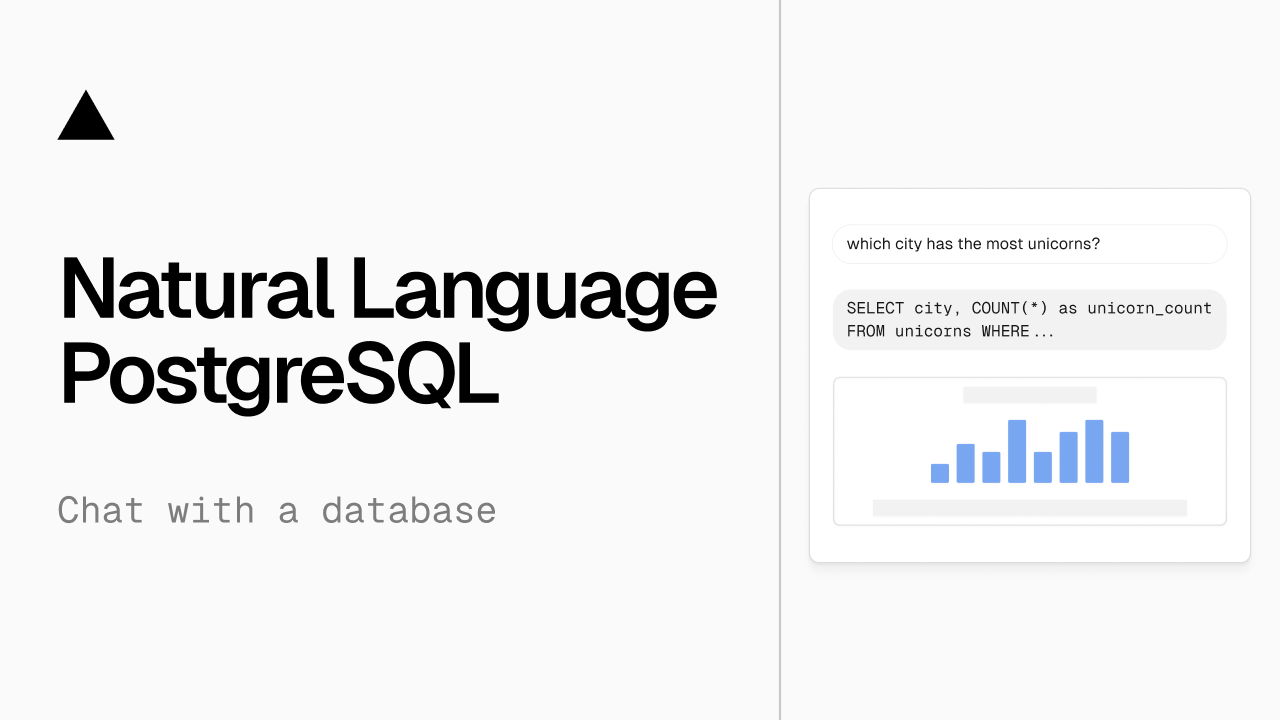
A browser application turns plain-English questions about unicorn companies into SQL, runs the query, and presents the returned data. Users can inspect the generated SQL, request a plain-language explanation, and switch between a table and an automatically configured chart.
Why it's ranked here
This is a useful reference implementation because it covers the full question-to-result loop, including explanation and visualization. Its strongest value is educational and prototyping-oriented. The fixed schema, dataset-specific prompting, and lightweight query filtering make it less convincing as a general database interface.
What's good
The interface exposes the generated SQL instead of hiding the model’s work. Structured schemas constrain chart configuration and query explanations. Results support tables plus bar, line, area, and pie charts. The seed process creates a typed unicorn dataset, while the prompt supplies domain vocabulary and formatting rules.
Tradeoffs
The application is tightly coupled to one unicorn-company table and a separately downloaded CSV dataset. Query safety relies on checking that text starts with SELECT and rejecting several forbidden words, rather than parsing SQL or enforcing database permissions. Chart configuration requires another model request. The README names GPT-4o, while the supplied implementation selects a different OpenAI model.
How to use it well
Use it as a starting point for demos, internal prototypes, or learning how natural-language analytics can expose SQL and charts. Replace the sample schema, prompt rules, and seed data for your domain. Do not treat it as a complete database security layer or a general-purpose administration tool.
Technical notes+
app/page.tsx coordinates query generation, SQL execution, result rendering, and chart generation through server actions in app/actions.ts. generateQuery uses generateText with Output.object and Zod to obtain a query string from openai/gpt-5.4-mini. runGenerateSQLQuery performs string-based SELECT validation before passing the query to @vercel/postgres. generateChartConfig validates model output against configSchema from lib/types.ts, then replaces generated colors with theme variables. lib/seed.ts creates the unicorns table and imports unicorns.csv row by row. components/results.tsx renders table and chart tabs, while lib/rechart-format.ts reshapes grouped results for multiline charts.
Observed
- License
- MIT
- Primary language
- TypeScript
- Packaging
- Private pnpm-managed Next.js application
- Interface
- Browser-based web application with Next.js server actions
- Database
- PostgreSQL through @vercel/postgres
- Deployment surface
- Includes a one-click Vercel deployment flow
Read from README.md, package.json, lib/seed.ts, lib/types.ts, lib/utils.ts, lib/rechart-format.ts, next.config.js, postcss.config.js, tailwind.config.js, app/page.tsx, app/actions.ts, app/layout.tsx, components/header.tsx, components/search.tsx, components/results.tsx.
What it can do
Query Postgres database using natural language
Natural language question or request → Database query results
Convert natural language to SQL queries
Natural language database question → SQL query statement
Execute database queries automatically
Generated SQL query → Raw database results
Format query results for display
Raw database query results → Formatted data presentation
Provide Next.js application template
Developer setup requirements → Ready-to-use Next.js codebase
Tags
Tech Stack
Media
Comments (0)
No comments yet
Editorially curated, with community endorsements as a secondary signal. Corrections welcome.