Agent Reviews
https://github.com/pbakaus/agent-reviews- Category
- AI Agents
- Rank
- No. 2610Tools index
Previous survey · No. 2468 ·
- Pricing
- Open Source
- Type
- TOOL
- Use case
- Software Testing & Quality
- Interfaces
- Host Plugin
- Builder
- pbakaus
- GitHub
- 306 stars
- Latest release
- v1.3.0
- Date
About
Token-efficient automated GitHub PR review and bug-fixing workflows you can drop into any repo.
What it does
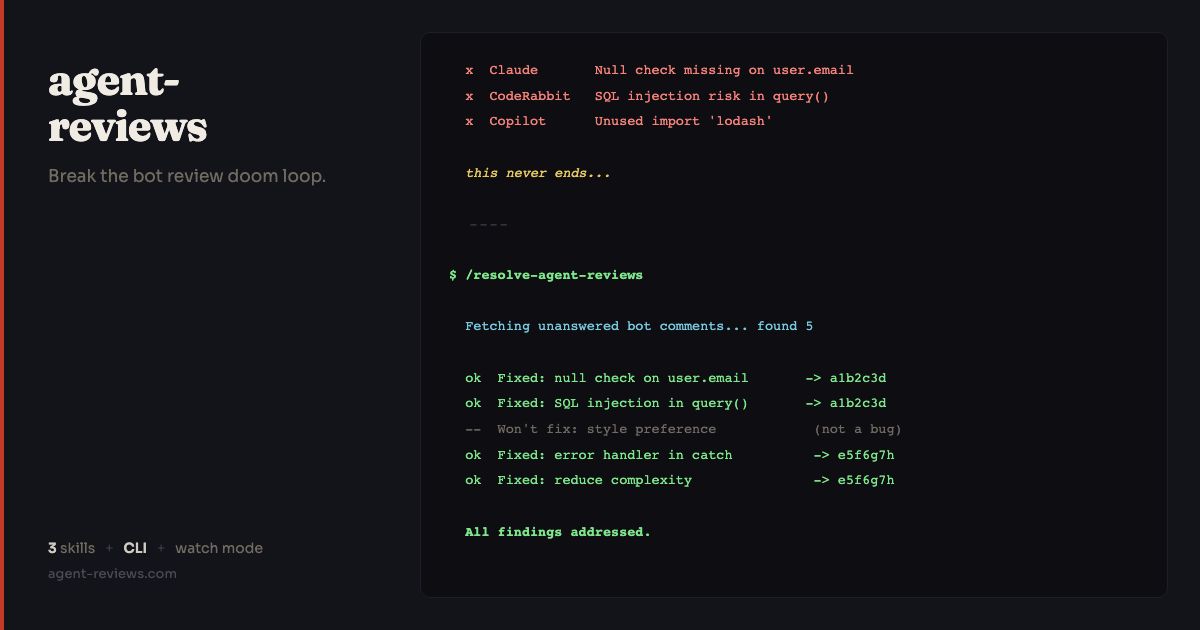
Agent Reviews turns scattered pull request conversations into a terminal work queue. It gathers inline findings, general comments, and review summaries, then labels reply state and filters by author type or resolution status. Operators can inspect context, answer comments, resolve threads, or poll for new feedback. Optional agent skills run the broader triage, fix, validate, reply, and repeat cycle.
Why it's ranked here
The tool solves a narrow coordination problem with unusually complete mechanics. It paginates GitHub responses, unifies three comment types, distinguishes human and bot replies, removes known status noise, and supports structured output. The included skills extend that solid command surface into repeatable remediation loops without duplicating the underlying implementation.
What's good
Filtering reflects real pull request noise. Known deployment updates, review summaries, and bot boilerplate are removed while inline findings remain. Authentication works through environment tokens, a local environment file, or an existing GitHub CLI session. Enterprise hosts, proxies, detached repositories, formatted terminal output, and JSON consumers all receive explicit support. Replies can also resolve their review threads.
Tradeoffs
Bot detection and noise removal depend partly on known usernames and body patterns, so unfamiliar services or changed message formats may be classified poorly. Watch mode polls rather than receiving events, and its loop exits when comments arrive so a caller must process them and restart it. The product is specific to GitHub pull request discussion, not a general issue tracker or review engine.
How to use it well
Use it when several humans or review bots leave repeated GitHub pull request feedback, especially when an agent already edits and tests the repository. Start with unanswered comments, separate bot and human queues when ownership differs, and use structured output for automation. Keep uncertain findings under human judgment. It organizes and closes feedback; it does not independently provide the original code analysis that creates findings.
Technical notes+
package.json exposes bin/agent-reviews.js as an npm binary, requires Node.js 18 or newer, and uses CommonJS runtime modules. lib/comments.js fetches REST comment pages in parallel, derives a GraphQL endpoint for thread resolution, normalizes three GitHub comment forms, and applies bot and meta-comment heuristics. lib/github.js resolves credentials, repository context, proxy-aware transport, and a curl fallback. lib/format.js provides ANSI text and JSON serialization. scripts/install-skills.js copies three skill definitions for local development. test/github.test.js and test/comments.test.js use Vitest to cover authentication precedence, repository detection, header parsing, body cleanup, bot detection, and meta-comment filtering.
Observed
- License
- MIT
- Primary language
- JavaScript
- Runtime
- Node.js 18 or newer
- Packaging
- npm package with a global command, plus three installable Agent Skills
- Interfaces
- Command-line interface with formatted text and JSON output
- Platform support
- GitHub.com, GitHub Enterprise Server, and API-compatible hosts
- Authentication
- GitHub tokens, a repository-local environment file, or GitHub CLI credentials
- Tests
- Vitest suites cover GitHub utilities and comment processing
Read from README.md, package.json, lib/format.js, lib/github.js, lib/comments.js, bin/agent-reviews.js, website/vite.config.js, website/svelte.config.js, scripts/install-skills.js, website/src/routes/+layout.js, test/github.test.js, test/comments.test.js, LICENSE, AGENTS.md, CLAUDE.md.
What it can do
Review GitHub pull requests automatically
GitHub pull request → Code review comments and suggestions
Fix bugs in code automatically
Code with identified bugs → Corrected code
Integrate into existing repositories
GitHub repository → Configured automated workflow
Analyze code changes for issues
Code diff/changes → Issue identification report
Generate pull request feedback
Pull request code changes → Structured feedback and recommendations
Tags
Tech Stack
Media
Comments (0)
No comments yet
Editorially curated, with community endorsements as a secondary signal. Corrections welcome.