Tegaki
tegaki.ink- Category
- Developer Tools
- Rank
- No. 951Tools index
Previous survey · No. 919 ·
- Type
- TOOL
- Use case
- Design & Media
- GitHub
- 3.3k stars
- Latest release
- tegaki@1.1.0
- Date
About
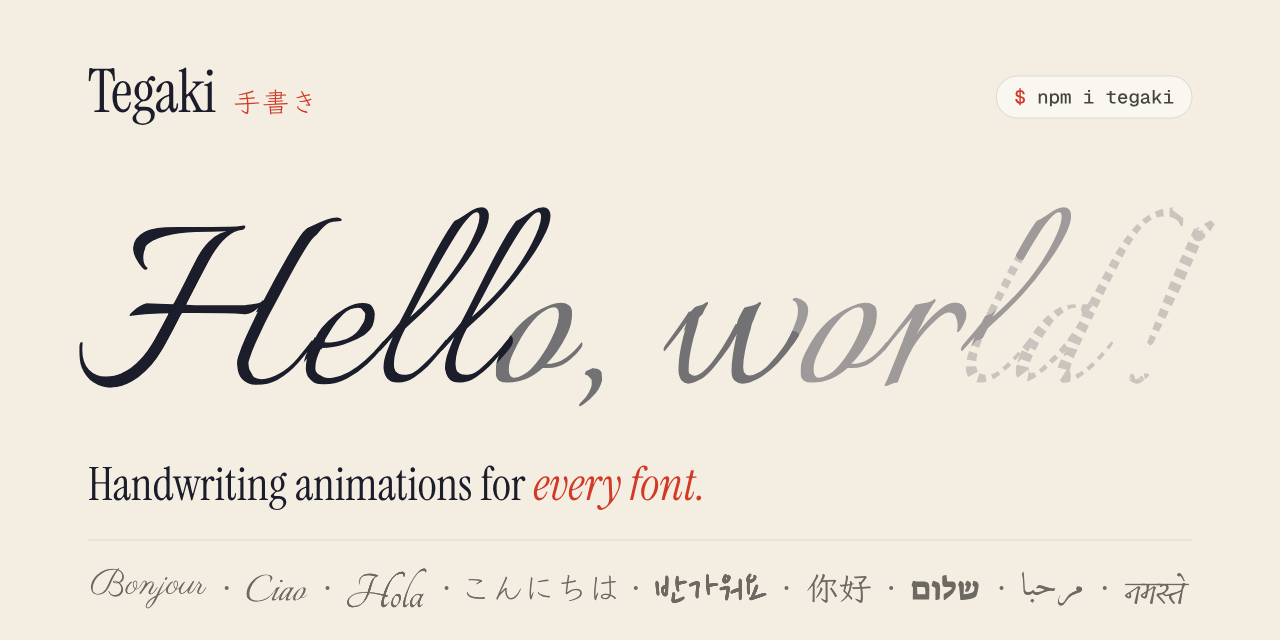
Tegaki animates handwriting for arbitrary fonts. A generator extracts glyph skeletons from raster and geometry data and matches them to known stroke orders such as Hershey and KanjiVG, then bundles the result for a client-side renderer. Renderer plugins can restyle strokes, add variation, show stroke order guides for learning apps, or create effects like burning text, which helps motion designers avoid plain typewriter effects.
What it does
Type a sentence, pick a typeface, and the letters draw themselves one pen movement at a time, with natural pacing between strokes. The project has two halves: an offline tool that works out how each character would be written by hand, and a small web package that plays that data back as animated vector graphics inside React, Vue, Svelte, Solid, Astro, Nuxt, Web Components or plain JavaScript pages. A command line mode skips the code entirely and writes a self-drawing SVG file you can drop into a slide or a project page.
Why it's ranked here
MIT licensed, no native dependencies, and thirteen ready-made typefaces that cover Latin, Arabic, Hebrew, Devanagari, Bengali, Japanese, Korean and Simplified Chinese. Text is shaped by HarfBuzz compiled to WebAssembly, so ligatures, Arabic joining and right-to-left lines render correctly rather than as isolated letters. Every framework binding is an optional peer dependency, and the code separates a public interface covered by semantic versioning from an internal one that is not. That is a deliberate, multi-script animation library, not a demo.
What's good
The stroke extraction is configurable rather than a single trick: five classical thinning algorithms plus a Voronoi medial-axis option, each reducing a letter to its centerline. Stroke order can be checked against published references for kanji, hanzi, Hangul and Hershey plotter lettering, and the tool ships a scoreboard that reports how often the computed order agrees with those references. Visual effects come as composable plugins: glow, taper, gradients, a hand-drawn wobble, stroke variation and annotation marks. The animation engine also exposes a reduced-motion setting.
Tradeoffs
The command line output is SVG only; PNG, GIF and WebM exports go through the hosted studio. Any typeface beyond the bundled thirteen needs the studio or the offline generator, and that generator is marked private in its package manifest, so it is run from a checkout under Bun rather than installed from npm. Script coverage is partial where it gets large: the Chinese typeface carries the 1000 most frequent hanzi and the Japanese one only first and second grade kanji. Bundled typefaces are under the SIL Open Font License, except Hershey Script, which carries its own acknowledgement terms.
How to use it well
Best fit is a short animated headline: a landing page title, a slide built with Sli.dev, or a video rendered with Remotion, both named as existing integrations. Start with a bundled typeface and the command line mode to see the effect before wiring a component. Pick loop, once or static mode depending on whether the drawing should repeat, play a single time or arrive finished. It is not a tool for animating long body text, and for full Chinese or Japanese coverage expect to generate your own bundle.
Technical notes+
The root package.json is a Bun workspace (packages, examples, e2e) using Biome for lint and Playwright for example tests. packages/renderer/package.json publishes the npm package tegaki with a bin entry for the SVG CLI, per-framework subpath exports, a harfbuzz shaper export, thirteen font bundle exports, and React, Vue, Svelte, Solid, Astro, @nuxt/kit and harfbuzzjs all as optional peers. packages/renderer/src/core/index.ts states it is the semver-covered API and exports TegakiEngine, textToSvg, computeTimeline and the plugin set (glow, taper, boil, variation, gradient, annotate). packages/generator/package.json is private and depends on the opentype font parser, d3-delaunay and harfbuzzjs. packages/generator/src/processing/skeletonize/index.ts dispatches between zhang-suen, guo-hall, lee, morphological and medial-axis thinning or a voronoi medial axis. packages/generator/src/cli/index.ts downloads from Google Fonts or reads --font-file and wires KanjiVG and Make Me a Hanzi stroke-order providers.
Observed
- License
- MIT; bundled fonts under SIL Open Font License 1.1 except Hershey Script, which has its own terms
- Language
- TypeScript, Bun workspace monorepo
- Packaging
- npm package for the renderer and CLI; the font generator package is private
- Interfaces
- Library components for React, Vue, Svelte, SolidJS, Astro, Nuxt and Web Components, a vanilla JS engine, and an SVG-only CLI
- Text shaping
- HarfBuzz bundled as WebAssembly, handling ligatures, Arabic joining and right-to-left text
- Bundled fonts
- Thirteen, spanning Latin, Hebrew, Arabic, Devanagari, Bengali, Japanese, Korean and Simplified Chinese
- Stroke-order references
- KanjiVG, Make Me a Hanzi, Hershey and Hangul decomposition
- Native dependencies
- None, per the README
Read from README.md, package.json, LICENSE, CHANGELOG.md, packages/renderer/package.json, packages/renderer/src/index.ts, packages/renderer/src/core/index.ts, packages/renderer/src/react/index.ts, packages/generator/package.json, packages/generator/src/index.ts, packages/generator/src/cli/index.ts, packages/generator/src/processing/skeletonize/index.ts, packages/renderer/FONTS-LICENSE.md.
Tags
Tech Stack
Media
Comments (0)
No comments yet
Editorially curated, with community endorsements as a secondary signal. Corrections welcome.