The State of Context Engineering
- Source
- dbreunig.com
- Author
- pchristensen
- Date
Context
Drew Breunig's State of Context Engineering, adapted from his AGNTCon talk, argues that the newest failure in AI agents comes from running them too long, and that the fix is often to make them forget. is the work of choosing what goes into a model's , the text it sees on each turn: instructions, tool descriptions, retrieved documents and the history of the session so far. Breunig's 2025 taxonomy of how that goes wrong (bad facts that persist, long histories that distract, irrelevant material that confuses, instructions that clash) still holds, he writes, and so does the toolbox for fixing it: retrieve only what is relevant, expose only the needed tools, hand side tasks to subagents with a clean history, prune old turns, store information in files, and summarize.
What changed in 2026 is that models now run for hours and manage their own context. Breunig cites METR's measurements of how long a task models can complete with a , from 3.4 hours for GPT-5 to 12 hours for Opus 4.6. Long runs expose what he calls context inertia: a model fixes on a hypothesis or subtask in its history and keeps pursuing it after it should stop. He points to research that treats forgetting as the remedy. In Anthropic's self-replication research, an writes a short note every hour and a half and then has its conversation cleared while its working environment stays intact. Microsoft researchers' Fork-and-Flush paper found agents making tinier and tinier changes to one idea. In Scaling Discovery Requires Forgetting, a team of four agents that periodically cleared their context but kept the work they had produced reached a score of 1,144,695 on the AHC014 optimization task, against 1,007,073 for four parallel agents without forgetting and 961,136 for a single agent, according to a chart Breunig reproduces.
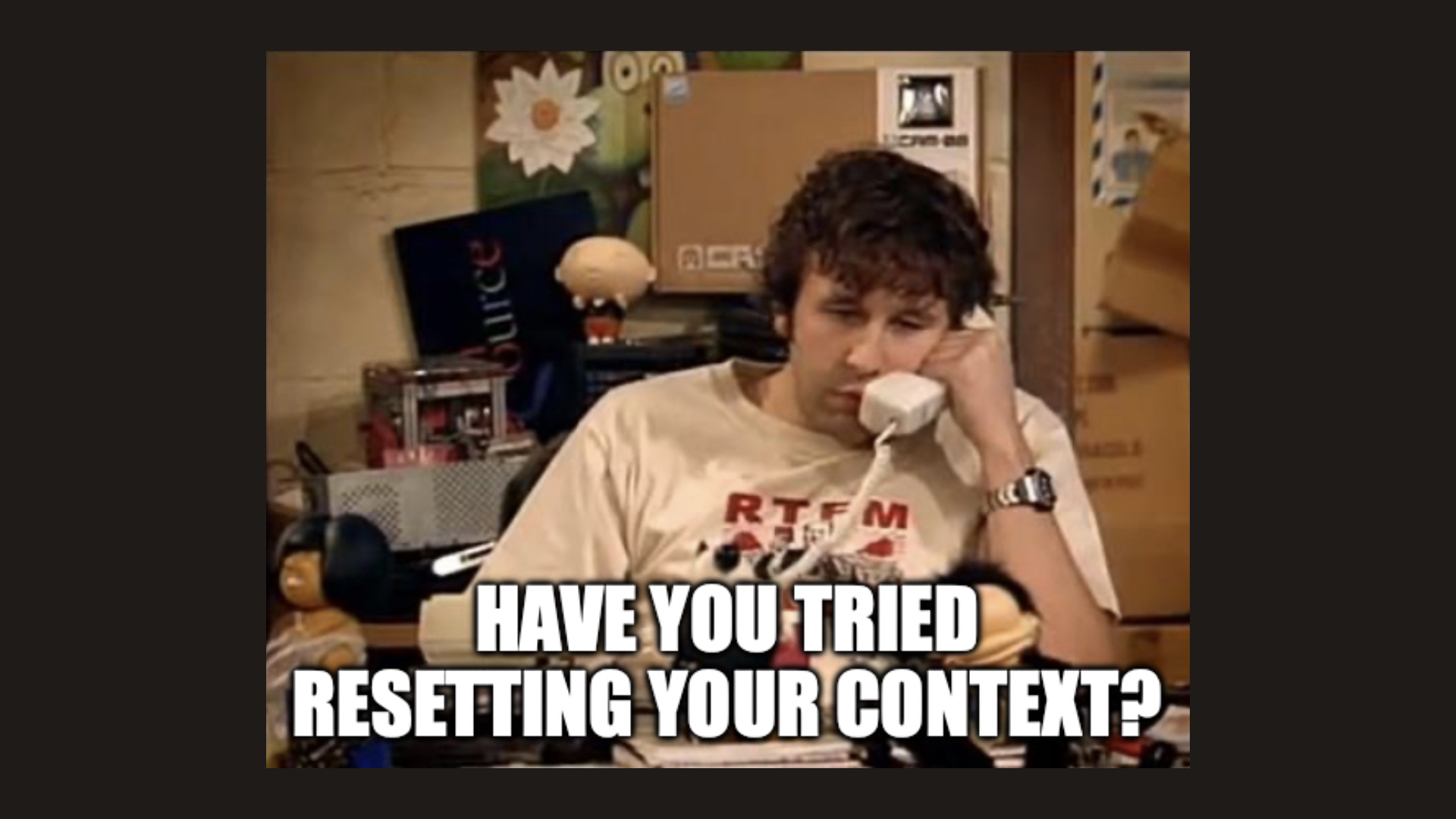
The practical upshot is modest and testable. When a coding agent starts behaving strangely, Breunig asks how large its context has grown before blaming the model, and he starts looking for a reset around 200,000 to 300,000 tokens. That threshold is his personal rule of thumb, not a measured limit. His broader claim is that the craft, whether called prompt, context or harness engineering, is deciding which parts of context assembly to fix in code and which to leave to the model, and he expects personal agents that accumulate memories and skills over months to need deliberate forgetting too.
- context engineering — Deciding what an agent sees at each step — the discipline that replaced prompt engineering once context windows got large enough to fill badly.
- context window — The maximum amount of text a model can consider at once — its working memory for the current conversation or task.
- agent harness — The scaffolding around a model that turns it into a working agent — the loop, the tools it can call, and the rules for when to stop.
- AI agent — An AI system that doesn't just answer once but works toward a goal in a loop — taking actions, reading the results, and deciding what to do next.



Checking sign-in…
Loading comments…