Prompt Caching Explained: Stop Overpaying for AI Agents
- Source
- youtube.com
- Author
- Hugging Face
- Date
Context
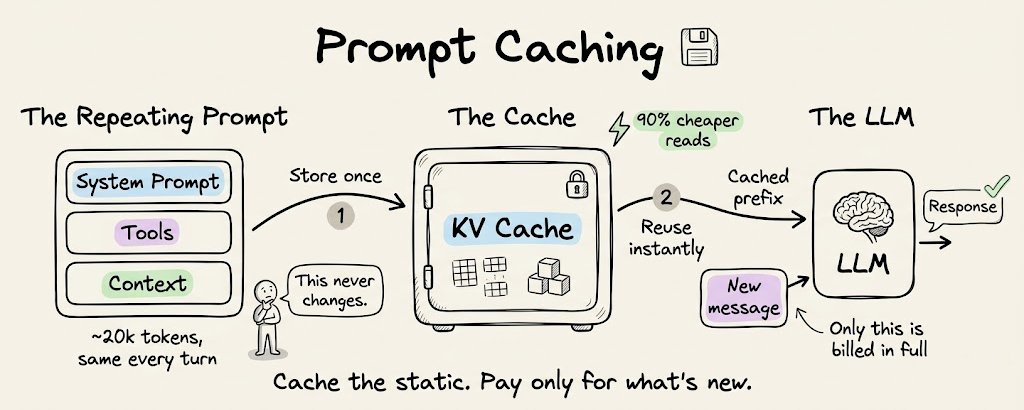
can make long coding-agent sessions far cheaper, and a Hugging Face video explains why. A coding agent resends the whole conversation to the model every turn, so 50,000 units of (tokens) plus a new 1,000-unit question means about 51,000 units processed again, then more on the next turn.
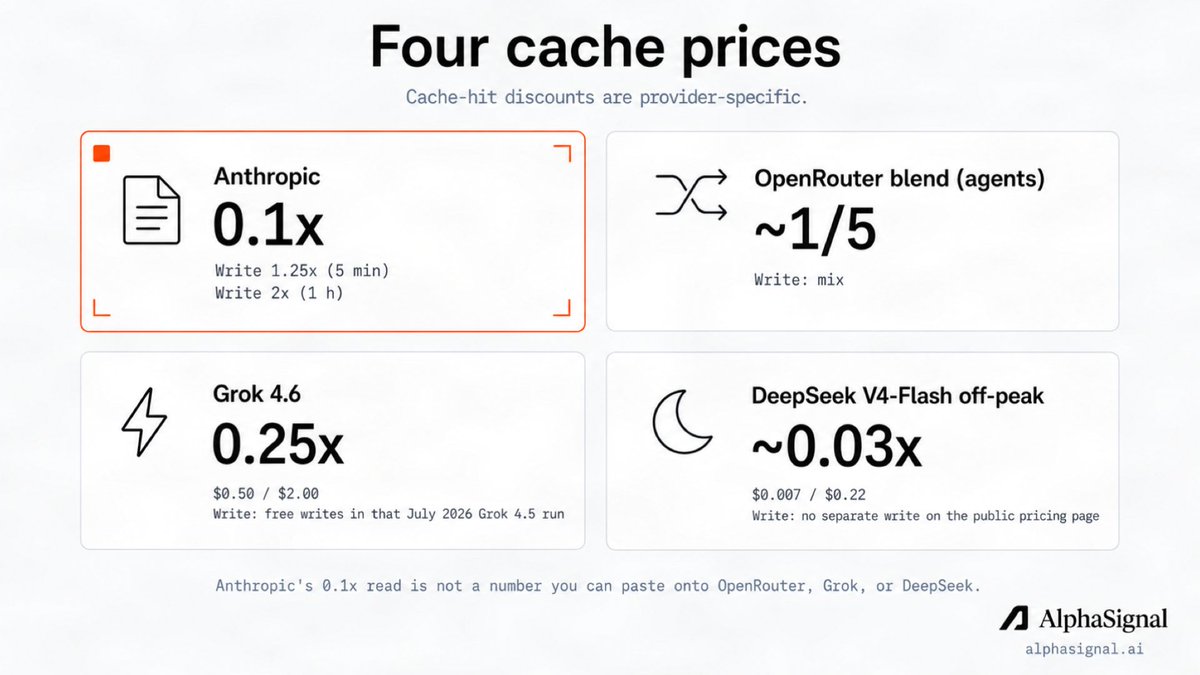
The presenter stresses that prompt caching does not store answers. It stores already-processed input, so when the next request starts with the same material, the provider routes it to reuse the earlier work and charges a lower rate, about a tenth of the normal input price according to the presenter. Caches expire after minutes to an hour depending on provider, after which the next request pays full price again.
As a demonstration the presenter reports a session in Tau, the agent they build, that exchanged about 10.9 million units with DeepSeek V4 Flash and cost six cents. That is one self-reported run on a very cheap model, and the cost charts shown are simulations, so they illustrate the mechanism rather than measure typical savings.
- Prompt caching stores the processed input prefix, not the model's answer. Each agent turn resends the whole transcript plus the new message, so cached re-reads are billed at a discount, which the speaker puts at about 10% of the normal input price.
- Cache lifetime varies by provider. The speaker says OpenAI keeps it for about an hour, while Anthropic defaults to roughly five minutes on the API. When he took long meal breaks mid-session, the cache expired and the next turn was billed at full price again.
- Not every provider caches automatically. The speaker says OpenAI and Hugging Face inference providers do it by default, but with Anthropic or Gemini the agent has to turn caching on in its API calls. Chat-completions APIs often lack the default that Responses-style APIs have.
- Anything dynamic in the system prompt, like a timestamp, the current working directory, or a tool list that changes, invalidates the cache for everything after it. Keep the history append-only. Compaction also resets the cache, which is expected but costs a full-price turn.
- In the speaker's own session with DeepSeek V4 Flash through Hugging Face inference providers, about 10.9 million tokens moved through a roughly 126K context for about 6 cents. He recommends a harness that shows cache hit rate per request and per session.
- prompt caching — Reusing the model's processed form of a repeated prompt prefix so subsequent calls skip re-reading it, cutting cost and latency substantially.
- Context and context window — Context is the information available for a generation; the context window is the capacity available to hold it.
- Large language model — A model trained on large amounts of data to process and generate language.
- Harness engineering — Designing the full environment and feedback system around an agent.



Checking sign-in…
Loading comments…