A decent text-to-image model trained for ~$20K (Apache 2.0 Weights)
- Source
- linum.ai
- Author
- schopra909
- Date
Context
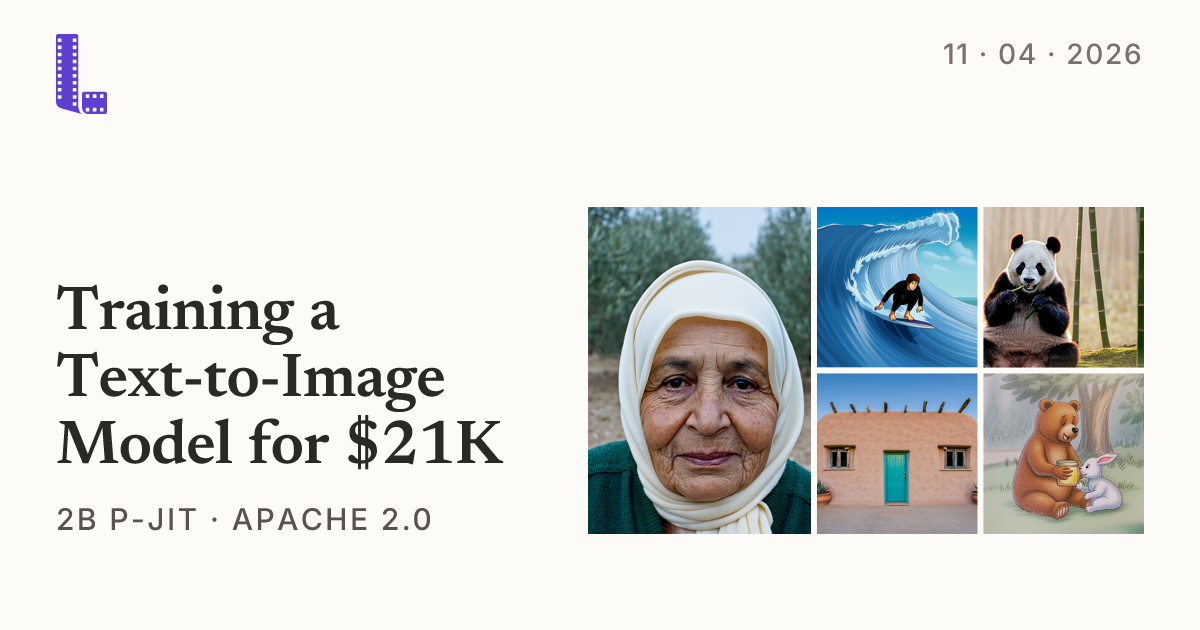
Linum is a two-person lab, run by the brothers Sahil and Manu Chopra, that trains its own video-generation models from scratch. In a field notes post it released a text-to-image model with about 2 billion parameters as under the Apache 2.0 license. The price in the title is a compute bill: $21,038 in total, made up of $20,348 for (8,139 H100-hours on 64 H100 GPUs, restarts included) and $690 for post-training (276 H100-hours), all priced at $2.50 per H100-hour. The founders' Hacker News post rounds that to about $20K. The figure is the cost of this one run. The post gives no cost for the earlier experiments that produced the design.
The model is a test of an architecture rather than a product. Linum is building toward a video model, Linum v3, whose main goal is cheaper generation, and the post explains that video models almost always start as image models: they learn people, places and things before they learn movement. Linum names as the cost bottleneck for video. Attention compares every token of the input with every other, so its cost grows with the square of the input length. Most image generators shorten the input with a separate compression model, a variational autoencoder or VAE, and the diffusion model then learns to generate inside that compressed representation. Linum's Pyramid-JiT design drops the VAE and works directly on pixels, cutting each image into patches of 32 by 32 pixels, so each token stands for a square of the image twice as wide as in most models, where a token covers 16 by 16 pixels. That lets it represent a 512-pixel-square image with as many tokens as Linum's previous model, Linum v2, used for a 256-pixel-square one, which Linum describes as a 4× reduction in the attention .
In an earlier post, Linum reported that this design converged in 11 times fewer training samples than Linum v2, a fairly standard VAE-based model, but those experiments ran for 50 to 100 million samples. This run checks whether the design holds up over much longer training: 610 million samples at 512 pixels, then 50 million at 1024 pixels, followed by a short post-training stage using a variant of a method called Finite Difference Flow Optimization with JEV-Image and human reviewers as judges. Prompts are read by a frozen Qwen3.5-4B language model from Qwen, which is not trained further.
The evidence for quality is Linum's own. The founders say they were surprised by how good the results looked for a model this size, and the post shows a gallery of 249 samples, but its text reports only Linum's own validation loss, not a benchmark comparison with other image models. This explanation is based on the post's text; the gallery images and charts were not examined. The post is direct about limits. The model was trained without images of rendered text, which Linum filtered out as irrelevant to animation, so it cannot write text or make posters. It also struggles with full-body figures, scenes with many entities such as six cars or crowds, interactions between several people, and world knowledge, and Linum says a larger model, for example 7 billion parameters, and further post-training would likely help. The run shows that a two-person lab could train a 2-billion-parameter image model on its own pixel-space architecture for about $21K of compute and judge it good enough to release. The post does not show whether the approach makes video generation cheaper; this model is Linum's stepping stone toward that.
- Linum, a two-person lab, says its pixel-space diffusion design drops the separate VAE stage and converged 11x faster than the team's own latent diffusion counterpart.
- Linum attributes cheaper inference to 4x more aggressive token reduction in attention context windows, which it says comes without significant loss in quality.
- The released image model was a longer stress test of the Pyramid-JiT architecture, trained for about $20K on 660M samples. Linum treats it as a step toward cheaper video models, since most video models start as image models.
- open weights — A model whose trained parameters are published for anyone to download and run — unlike API-only models you can access but never possess.
- pretraining — The first, biggest phase of building a model: training it on enormous amounts of text so it learns language, facts, and reasoning in general.
- attention — The mechanism that lets a model weigh which earlier words matter for the word it's currently processing — the core operation of a transformer.
- context window — The maximum amount of text a model can consider at once — its working memory for the current conversation or task.


Checking sign-in…
Loading comments…