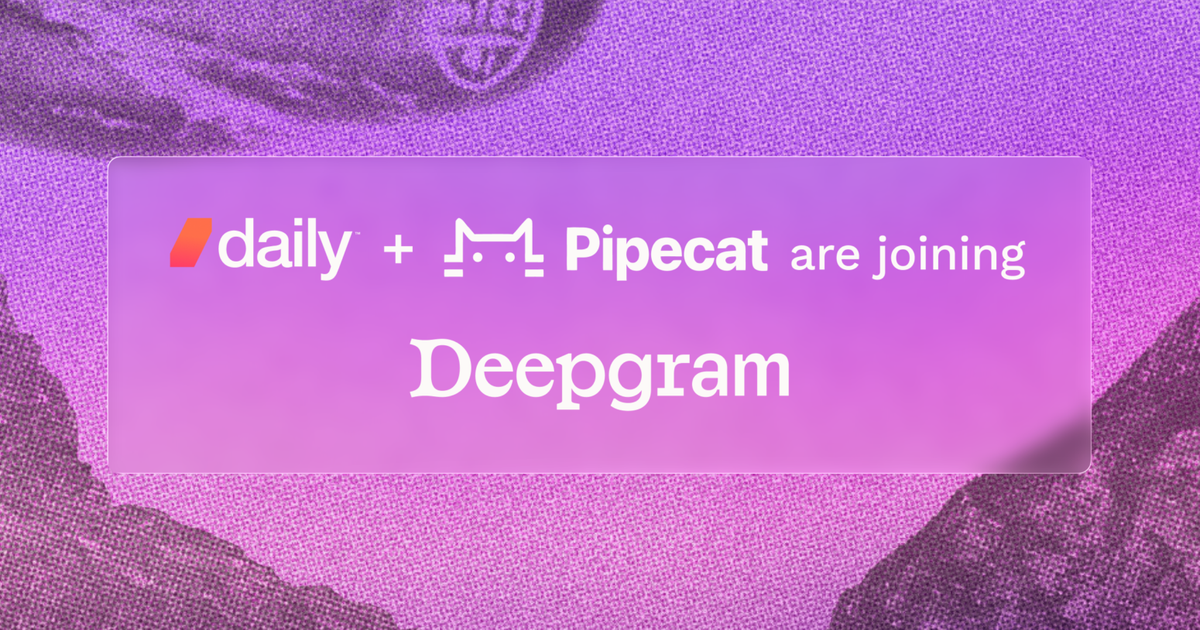
Deepgram acquires Daily and Pipecat, introduces Real-Time Context Standard
Source
deepgram.com
Author
Deepgram
Date
Why it matters
Pipecat, a widely used voice agent framework, now sits under Deepgram while staying BSD licensed with a planned independent foundation. The Real-Time Context Standard adds metadata so tone and speaker cues survive between models.
Key takeaways · AI-distilled
Deepgram says Pipecat stays open source under its existing BSD license after the Daily acquisition, with an independent Pipecat Foundation formed alongside organizations that contribute to and use it.
Deepgram's Real-Time context windowThe maximum amount of text a model can consider at once — its working memory for the current conversation or task.Full definition → Standard targets a gap in voice pipelines: when one model passes words to the next, cues like tone, who is speaking and background sound are lost along the way.
RCS adds three metadata types: audio context such as a whisper or unclear word, instructions for how the LLMA large language model — the neural network behind tools like Claude and ChatGPT, trained on huge amounts of text to predict what comes next.Full definition → should use those signals, and guidance for how the reply should sound, with per-model adapters for different providers.
Deepgram's stated use cases are an AI agentAn AI system that doesn't just answer once but works toward a goal in a loop — taking actions, reading the results, and deciding what to do next.Full definition → asking for clarification when it did not hear clearly, or replying quietly to someone whispering, and it invites model providers to test and contribute to the RCS specification.
Terms in this piece · Glossary
AI agent — An AI system that doesn't just answer once but works toward a goal in a loop — taking actions, reading the results, and deciding what to do next.
context window — The maximum amount of text a model can consider at once — its working memory for the current conversation or task.
LLM — A large language model — the neural network behind tools like Claude and ChatGPT, trained on huge amounts of text to predict what comes next.