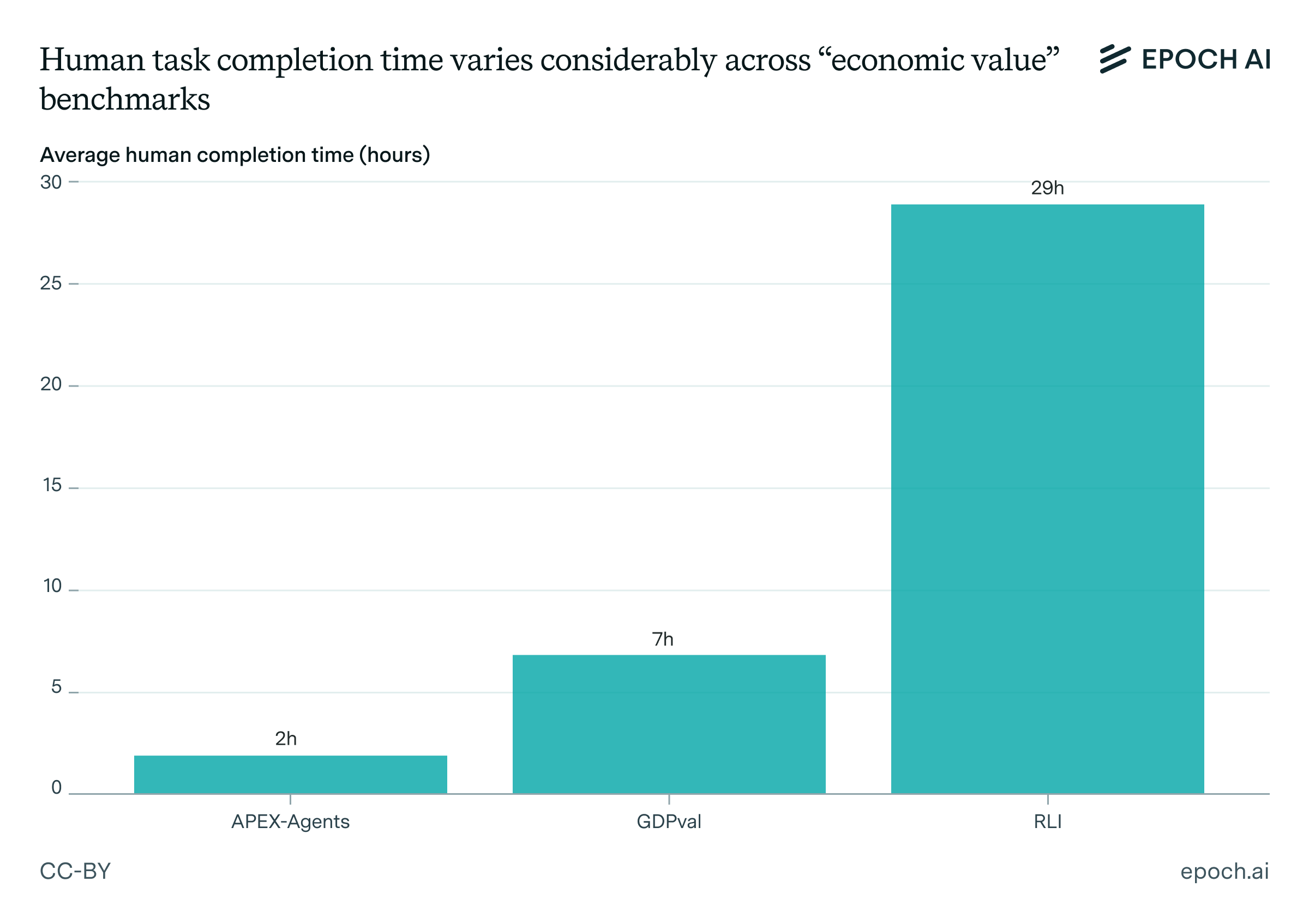
Lower running costs do not yet mean equivalent office work. In OmegaUse-OfficeVal, the evaluated AI agents completed tasks faster and more cheaply than humans, but their deliverables remained below human quality. The BenchmarkA fixed set of tasks with a stated way of scoring them, used to compare models or setups.Full definition → contains 100 practitioner-derived office tasks that took people an average of 2.32 hours each.
Each task pairs detailed, code-checked quality criteria with human completion time and a price proxy. That lets researchers compare the usefulness of the output alongside InferenceUsing a trained model to produce an output from a supplied input.Full definition → spending. The reported cost advantage therefore needs to be read together with the quality gap; the price proxy and inference bill do not constitute a complete accounting of replacing human work.
Terms in this piece · Glossary
Benchmark — A fixed set of tasks with a stated way of scoring them, used to compare models or setups.
Inference — Using a trained model to produce an output from a supplied input.
Agent — A system in which a model repeatedly chooses operations, a harness carries them out, and the results return to the model to inform its next choice.