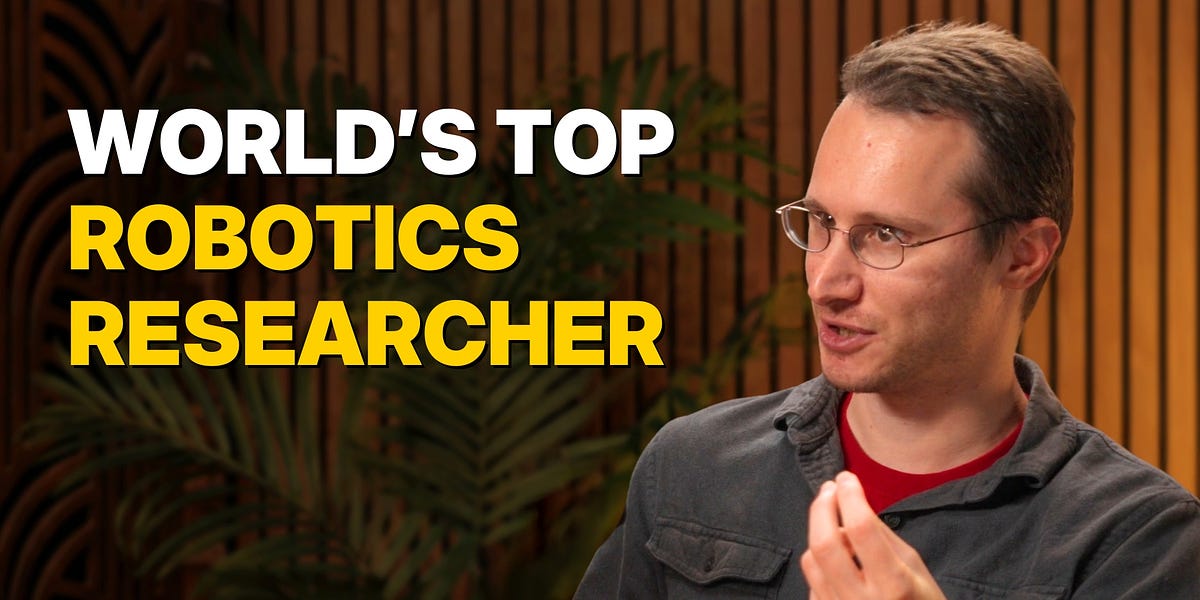
Robotics Has Been Stuck for 70 Years — Deepak Pathak, Skild AI
Source
AI Engineer
Author
AI Engineer
Date
Key takeaways · AI-distilled
Pathak estimates that collecting teleoperation data at one example a minute would take the entire US population more than a century to reach GPT-3 scale, which is why he says robotics has no internet of data.
Skild AI's 'omni-bodied' recipe trains one model for any robot and task: pre-train on scalable data such as simulation and human video, post-train on teleoperation, then improve through a deployment flywheel.
Demos include inserting AirPods with a simple gripper, learning from human video with under an hour of robot data, and cooking omelets on $4,000 arms using only a camera.
Pathak frames adaptation as a safety property: after its other legs are disabled, a robot learns to walk on two legs within three tries.
Terms in this piece · Glossary
pretraining — The first, biggest phase of building a model: training it on enormous amounts of text so it learns language, facts, and reasoning in general.
fine-tuning — Taking a trained model and training it a bit more on your own examples so it gets better at one specific job.
Why it matters
Lays out a concrete architecture and data strategy for one model that transfers across robot bodies and tasks, rather than hand-engineering per-robot controllers, backed by specific demos and data-scale calculations.
 videoWorld Models Need Causality, Not Pretty Pixels — Christopher Manning, Moonlake AI
 videoFrom Ingestion to Agents: How AI Teams Build on Document Intelligence — Adit Abraham, Reducto
 videoYou’re Not Thinking Big Enough: Rebuilding Food Systems with AI Agents — Cody Menefee, Firecrawl
 videoFrom VLM/VLA's to Embodied Agents — Armen Aghajanyan, Perceptron AI