Universal XSS in uBlock Origin from website-driven element picker
- Source
- iter.ca
- Author
- zaik
- Date
A researcher writing at iter.ca disclosed a one-click universal cross-site scripting bug in uBlock Origin on Firefox. In the chain the post describes, a malicious web page first leaks the extension's internal UUID, then drives the element picker iframe that uBlock Origin uses to select page elements, and through it injects filters the extension treats as trusted. A universal XSS is more serious than an ordinary one because the injected script is not confined to the attacker's own site. The author credits GPT-5.6 with finding the issue and says they verified it themselves, and the bug has since been fixed. The report adds to recent cases of models finding real security flaws, after Mozilla's account last week of finding and fixing more Firefox bugs with GPT-6 Cyber, and it shows that kind of auditing reaching widely installed browser extensions, not only browsers and servers.
Context
Until a recent fix, a malicious web page could get the Firefox version of uBlock Origin, the ad-blocking browser extension, to run the page author's JavaScript on any other website, as long as the visitor clicked once on the malicious page. Security researcher Smitty van Bodegom describes the flaw in a post on his blog and calls it a universal cross-site scripting (UXSS) bug. Ordinary cross-site scripting gets an attacker's code into one vulnerable site; a universal one reaches any site, because the weakness sits in something that touches every page, here an extension. The route ran through filters, the rules uBlock Origin uses to decide what to block. Some filters are marked trusted, and trusted filters can inject JavaScript into the pages they match, so a page able to add a trusted filter for another domain could run code inside that site. He says a similar but less serious problem affected uBO Lite, the version built for the newer Manifest V3 extension format, and that the issue is now fixed.
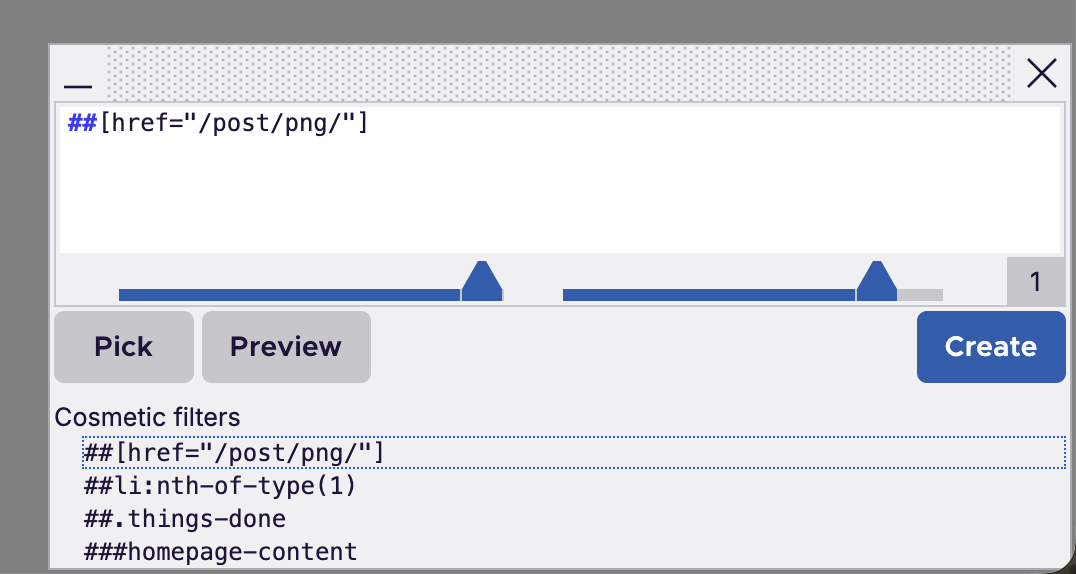
The weak point was the element picker, the tool a user opens by right-clicking a page to block one specific element on it. The picker is an extension page loaded in a frame on top of the website, and it can tell the extension's background process to add filters. The attack loads that page itself. On Firefox, the picker's address contains an identifier that is random for each installation, and van Bodegom found it could leak through one of uBlock Origin's default filters: to neutralize an ad script, that filter swaps the request for a harmless stand-in file served from inside the extension, and a page that intercepts its own outgoing requests can read the extension's address from that swap. He notes this is only one of several ways the identifier can leak. With the address, the malicious page loads the picker in an invisible frame and sends it the messages that normally set up a filter. The picker usually refuses filters that inject scripts, but one field it appends to the filter, meant to name a request type such as image, accepted a line break, so whatever followed became a second, arbitrary filter. Filters created through the picker are treated as trusted, so that second line could inject script into any domain the attacker chose. The last step is getting the user to press the hidden Create button, for example by making the frame invisible or covering it with something the user would click anyway. Van Bodegom describes that step but says he did not build it. Trust in picker-made filters lapses when the user's custom filters are next recompiled, but he points out that an attacker could simply open the target site immediately.
In his account, the core mistake was that the picker accepted instructions from the web page around it at all. One of the fixes ties the picker's opening message to a secret that the genuine picker receives from the extension's content script, the part of the extension that runs inside web pages. The post does not give the version that carries the fix, when it shipped, or a severity rating; for more detail it points to the advisory, which could not be read for this explanation. The post also does not report any use of the flaw beyond his own proof of concept.
AI models did much of the work. Van Bodegom says he suspected that filter injection could lead to this kind of attack, asked GPT-5.6 Sol from OpenAI to look, and it found the issue, which he then checked and verified himself. Claude, from Anthropic, wrote most of the proof-of-concept code, and he says he wrote the post's text himself.


Checking sign-in…
Loading comments…