OpenAI ships GPT-Live-1.1 with standby mode to cut idle costs
- Source
- x.com
- Date

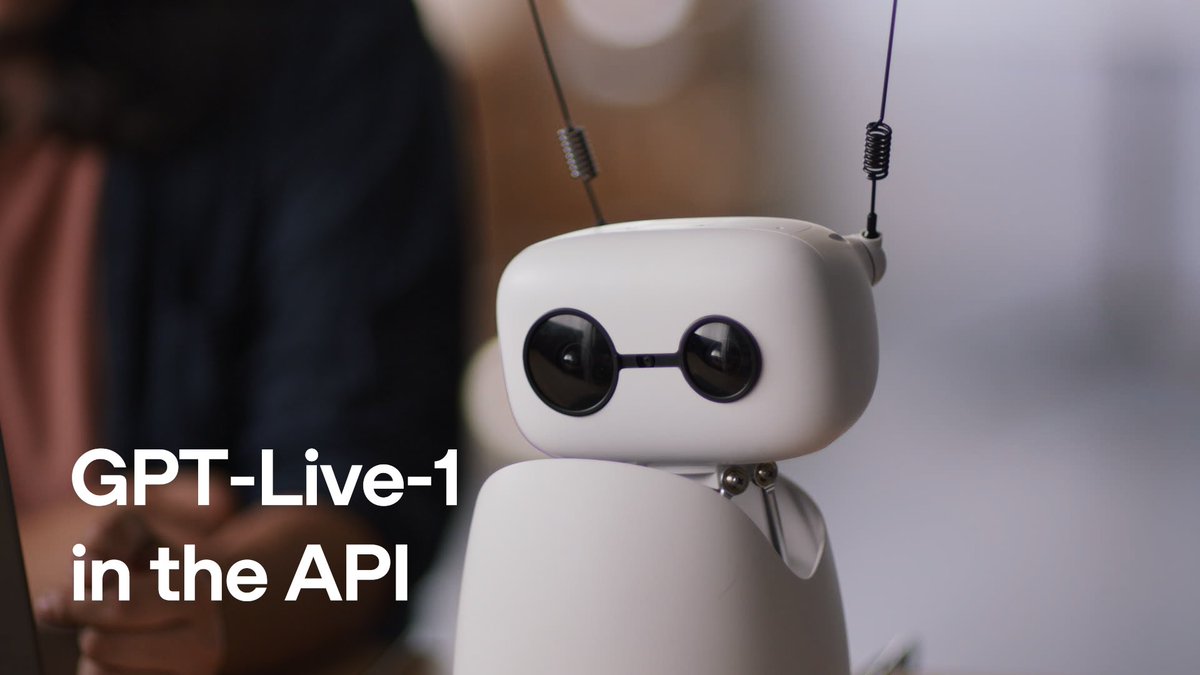
GPT-Live-1.1 is now available in the API. It speaks with more natural and consistent accents across languages, supports lower idle costs with a new standby option, and completes tasks even more reliably.

Context
OpenAI has made GPT-Live-1.1, the newer version of its real-time voice model, available to developers, according to OpenAI's developer account. OpenAI first released the version in its own apps, including ChatGPT, with API access then described as "coming soon". Of the three changes the post names, the cheaper idle time is the one OpenAI attaches numbers to. GPT-Live is charged for the time a voice session stays open, not for what is said, so a session that sits silent while a user reads a screen or steps away keeps costing money. The new standby option lets a session stop running the model during those gaps without disconnecting.
OpenAI's guide to Live conversations describes how it works for WebRTC sessions, the real-time audio connection used by browser and app clients. When creating the session, a developer sets a wake policy so the model waits for speech before it starts, and an idle timeout of 5 to 60 seconds. Once that many seconds pass with no new transcript from either side, pauses and the session goes into standby, while the connection and session ID stay the same. The microphone has to stay live, and when someone speaks the session resumes with its conversation history restored. OpenAI warns that the first reply after standby to a short utterance may take longer. Without a timeout, the model keeps running from the first wake until the session ends.
OpenAI's pricing page lists $0.05 per minute of active time and $0.02 per minute of standby for both GPT-Live-1 and GPT-Live-1.1, metered by the second. Ten minutes spent in standby therefore cost 20 cents instead of the 50 cents they would cost active, by simple arithmetic on those rates. The rate covers only the voice layer: the and tools that GPT-Live hands work to are billed separately, according to the GPT-Live-1.1 model page. Because OpenAI's changelog says standby can be configured for GPT-Live-1 sessions as well, developers can lower idle costs without switching models. For applications with long gaps between interactions, the guide still suggests closing the session and weighing the voice time saved against the cost of starting a new one.
The other two improvements rest on OpenAI's description alone. The model page says GPT-Live-1.1 transcribes speech more accurately and keeps a more consistent accent than GPT-Live-1, and the changelog frames this as better pronunciation and transcription in multilingual conversations. The post also says the model completes tasks more reliably. None of these sources gives a score or other measurement for the accent, transcription or task-completion gains, and the post's video is a staged pronunciation sketch, reviewed here only through an automatic transcript. Until OpenAI or an outside evaluator publishes results, the documented standby rate is the clearest reason to act on this release.
- inference — Running a trained model to get answers — the phase where AI is actually used, as opposed to trained.
- reasoning model — A model trained to think — generating extended internal reasoning before answering — trading time and tokens for accuracy on hard problems.
- benchmark — A standard public test set for comparing AI models — the shared scoreboards behind every "model X beats model Y" claim.



Checking sign-in…
Loading comments…