Mxc: Microsoft Execution Containers version 1.0.0
- Source
- blogs.windows.com
- Publisher
- Microsoft
- Author
- smokel
- Date
Microsoft has shipped version 1.0 of Execution Containers, a policy-driven containment layer for AI agents running locally on Windows. The model is simple: a developer or IT admin defines the files an agent may read and write and the network destinations it may reach, and Windows enforces that boundary while the agent runs. The agent does not get a vote. That matters because most local coding agents today are constrained by their own permission prompts or by instructions in a config file, and both depend on the agent and its harness behaving as intended. An operating system boundary holds even when the agent is confused, prompt-injected or simply wrong about what it is allowed to touch. Microsoft also said Entra agent identity and Agent 365 management for local agents are coming, which would let organizations manage those policies centrally rather than machine by machine. Those pieces are announced, not shipped. For teams running Claude Code, Codex or similar tools on Windows workstations, the practical step is to write a containment policy that matches what each agent actually needs, starting with the repository directory and the package registries it installs from.
Context
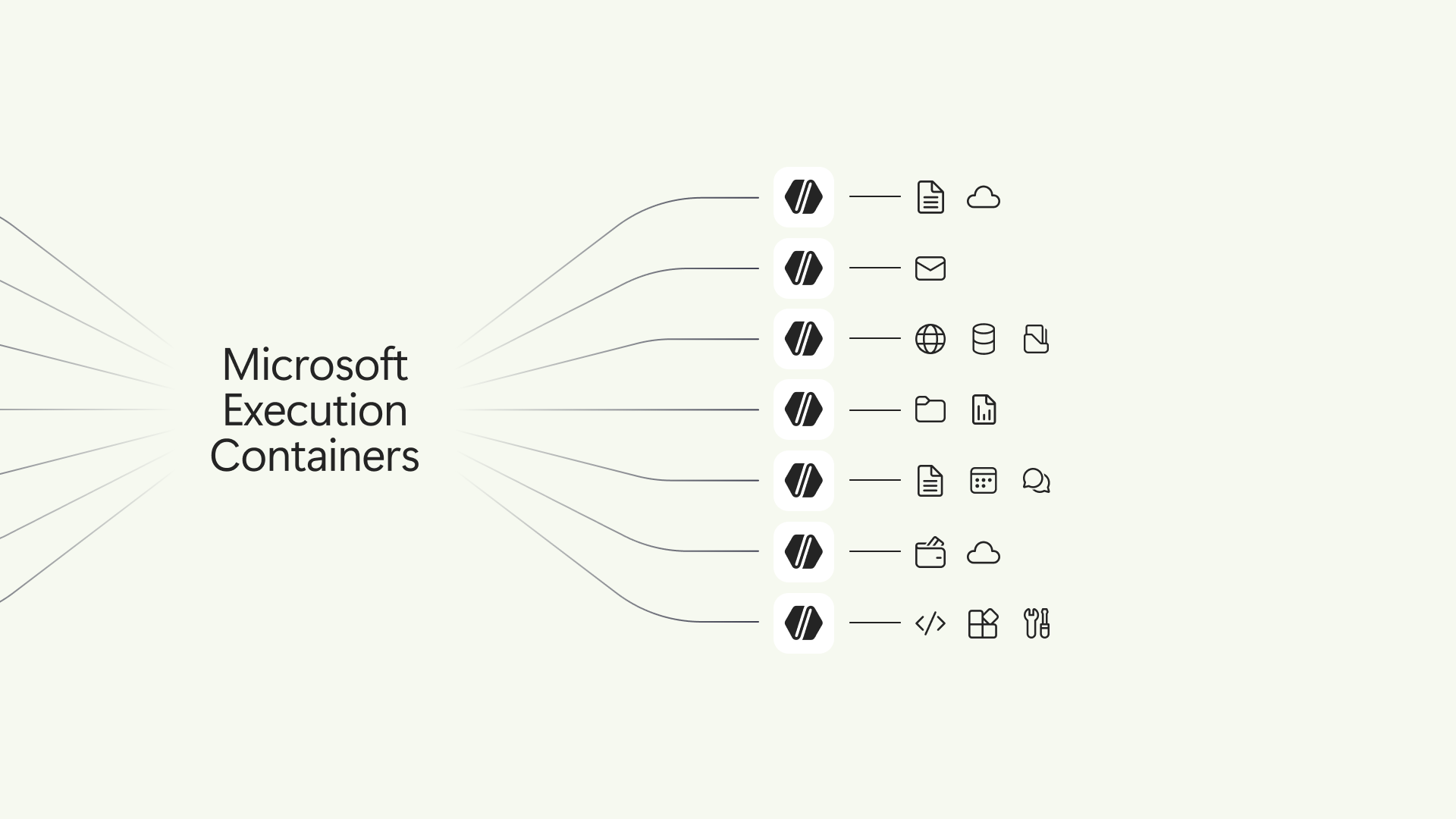
Microsoft Execution Containers, or MXC, is a policy layer that confines AI agents and -generated code. Developers declare what a workload may touch: files, network connections, processes and user-interface access. MXC then maps that policy to a containment backend on the operating system. Because the policy sits outside the workload, Microsoft says an agent cannot grant itself additional access when its plan changes.
The release offers different isolation levels. Lightweight containers run on Windows 11, macOS and Linux; and WSL containers are Windows 11 only, and a microVM backend (a hardware-backed virtual machine) is labeled experimental. Learning mode enforces the while recording blocked operations, and permissive mode allows and records them, which Microsoft intends for writing policy, not for enforcement. Microsoft also notes that each backend has distinct security properties, so a workload still needs its own assessment, and activity reports are limited to Windows process containers.
- Model — A computational system that uses learned patterns to produce an output from information supplied to it.
- Process — A running instance of a program, with its own working memory, open files and identity.
- Session — One conversation or piece of work as a harness keeps it: a record of messages, tool calls and observations that can be saved and resumed.
- Boundary — A point in a program where one part finishes its job and hands its result to another.