Puts Terminal Bench 2.1 scores, per-token pricing, and total vs active parameters for Kimi K3, GLM 5.2, DeepSeek V4 and MiniMax M3 side by side, so you can pick an open-weight coding model on cost and capability.
Key takeaways · AI-distilled
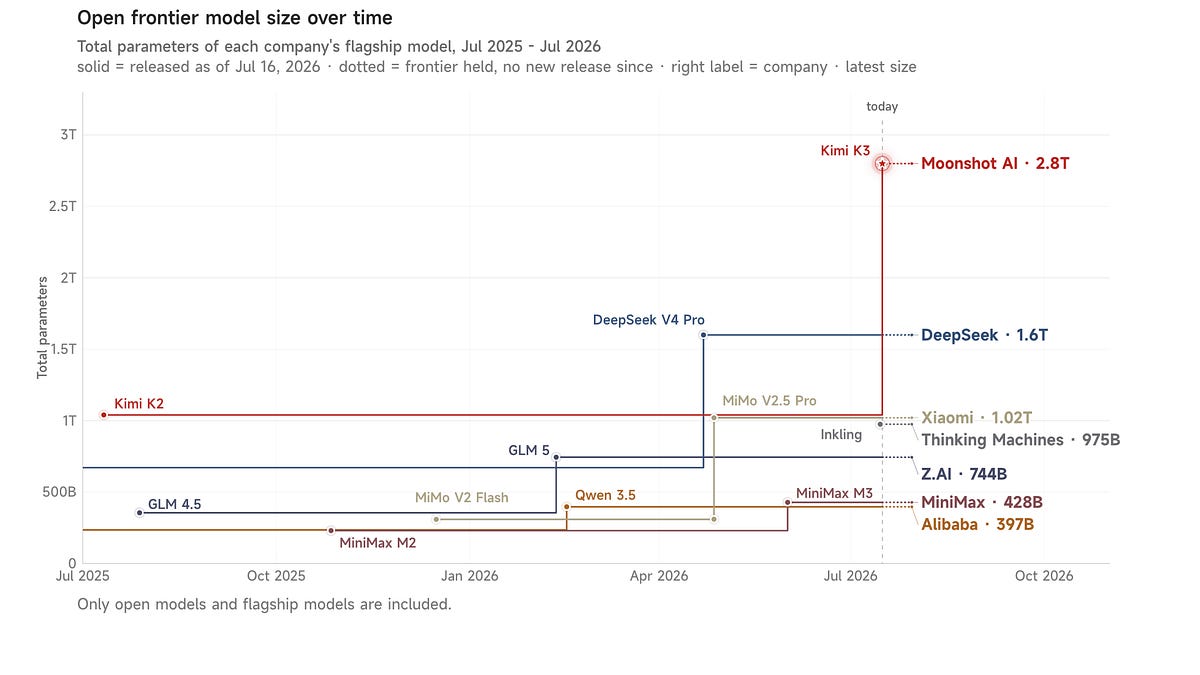
Kimi K3 is a 2.8T-parameter mixture-of-expertsA model built from many specialist sub-networks where only a few activate per token, giving big-model capability at small-model running cost.Full definition → with a 1M context windowThe maximum amount of text a model can consider at once — its working memory for the current conversation or task.Full definition → and native vision; the post notes that despite open weightsA model whose trained parameters are published for anyone to download and run — unlike API-only models you can access but never possess.Full definition → it is too large to run locally, so in practice it is used through hosted access or inference providers.
DeepSeek's July 31 update to V4 Flash kept 284B total and 13B active parameters but, per DeepSeek, raised Terminal-Bench 2.1 from 56.9 in the April preview to 82.7 and added tool calls and Responses API support.
The post argues cache-hit pricing matters for coding agents that make many repeated calls: DeepSeek lists V4 Flash input at $0.14 per 1M tokens on a cache miss but $0.0028 on a hit.
GLM-5.2 from Z.ai has about 744B total and 40B active parameters under an MIT license; Z.ai reports 81.0 on Terminal-Bench 2.1, up from around 63.5 for GLM-5.1.
MiniMax M3 (428B total, about 23B active) takes image and video input alongside code, which the post says suits screenshot, UI, and browser tasks; MiniMax reports 59.0% on SWE-benchThe standard benchmark for AI coding agents: real GitHub issues from real repositories, scored by whether the agent's patch passes the project's own tests.Full definition → Pro.
Terms in this piece · Glossary
open weights — A model whose trained parameters are published for anyone to download and run — unlike API-only models you can access but never possess.
mixture-of-experts — A model built from many specialist sub-networks where only a few activate per token, giving big-model capability at small-model running cost.
context window — The maximum amount of text a model can consider at once — its working memory for the current conversation or task.
SWE-bench — The standard benchmark for AI coding agents: real GitHub issues from real repositories, scored by whether the agent's patch passes the project's own tests.





 articleKimi K3 Achieves 3 In The Artificial Analysis Intelligence Index Comparable To Opus 4 8 And Gpt 5 5Artificial Analysis articles
 articleKimi K3 2.8T-A50B: the largest open model ever released; Opus 4.8-class at Sonnet 5 pricingLatent Space