Gemini Robotics 2.5 accelerates real-world general dexterity
- Source
- deepmind.google
- Date

Context
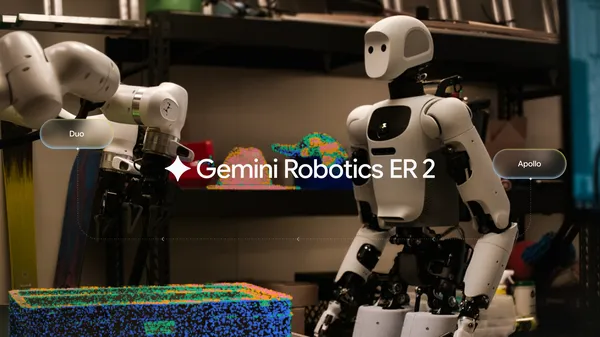
Google DeepMind says Gemini Robotics 2.5 lets robots learn more skills, and learn them faster, than its earlier models (announcement). It is a vision-language-action model: it takes camera images and an instruction and produces the movements of a robot's arms and hands. Google evaluated it on more than 200 distinct tasks, such as serving food with tongs, tying a bow on a gift box and pipetting a liquid, and reports a 30% to 100% higher success rate than previous baselines depending on the type of task, with tasks completed 20% to 30% faster. The model works with different robot bodies, including Apptronik's Apollo 2 humanoid with a five-finger hand and the two-gripper Franka Duo. For now it is rolling out only to Google's robotics partners.
The most concrete evidence is a proof-of-concept on Mercedes-Benz production lines in Kecskemét, Hungary, and Sindelfingen, Germany. Apollo 2 robots did kitting, the repetitive job of picking parts from bulk bins and placing them in trays in the exact order each vehicle needs. As in Gemini Robotics 2, the work was split between two models: Gemini Robotics ER, an embodied-, tracked the workflow, while the 2.5 action model controlled the hands and arms. Google reports a 96% success rate and calls the pilot promising progress toward industrial use. The post does not say how many picks or how long the trial ran, so the figure describes one proof-of-concept pilot rather than sustained factory deployment.
Google credits its general model Gemini 4 Argon for much of the speed-up in development. Argon generated thousands of varied simulated practice runs from a real camera scene, and those runs, combined with real demonstrations, helped the robot generalize to new scenes and objects. On safety, Google says guidance applied while the model is running raised safe task completion by 33% around obstacles and 43% around nearby people. It is also releasing ASIMOV-, an open-source of prompts that disguise unsafe requests to a robot. The 99.5% jailbreak resistance Google reports on it belongs to Gemini 4 Argon, against 82% for Gemini Robotics ER 2, not to the new action model.
- Google DeepMind reports Gemini Robotics 2.5 achieves 30% to 100% higher success rates than previous baselines depending on task type and completes tasks 20% to 30% faster, across 200 evaluated tasks such as pipetting liquid and tying a bow.
- In a proof-of-concept on Mercedes-Benz lines in Hungary and Germany, Apptronik's Apollo 2 humanoid sorted parts from bulk bins into sequencing trays at a 96% success rate, with Gemini Robotics ER tracking the workflow and the 2.5 actions model controlling its arms and hands.
- DeepMind says -time reasoning guidance lets the robot steer around physical hazards in real time, raising safe task completion by 33% around obstacles and by 43% around nearby people in its evaluations.
- DeepMind is releasing ASIMOV-Jailbreak, an open benchmark of hundreds of prompts that disguise unsafe robot requests. Gemini 4 Argon scored 99.5% jailbreak resistance, against 82% for the earlier Gemini Robotics ER 2 baseline.
- Gemini 4 Argon sped up development by generating thousands of varied simulated practice runs and a digital twin from a real camera scene. Combined with real demonstrations, this helped the robot generalize to new scenes and objects, DeepMind says.
- reasoning model — A model trained to think — generating extended internal reasoning before answering — trading time and tokens for accuracy on hard problems.
- jailbreak — A prompt crafted to make a model ignore its own guidelines — usually through roleplay, hypotheticals, or encoding rather than a direct request.
- benchmark — A standard public test set for comparing AI models — the shared scoreboards behind every "model X beats model Y" claim.
- inference — Running a trained model to get answers — the phase where AI is actually used, as opposed to trained.

Checking sign-in…
Loading comments…