An Indic Voice Agent with CUGA
- Source
- huggingface.co
- Date
Context
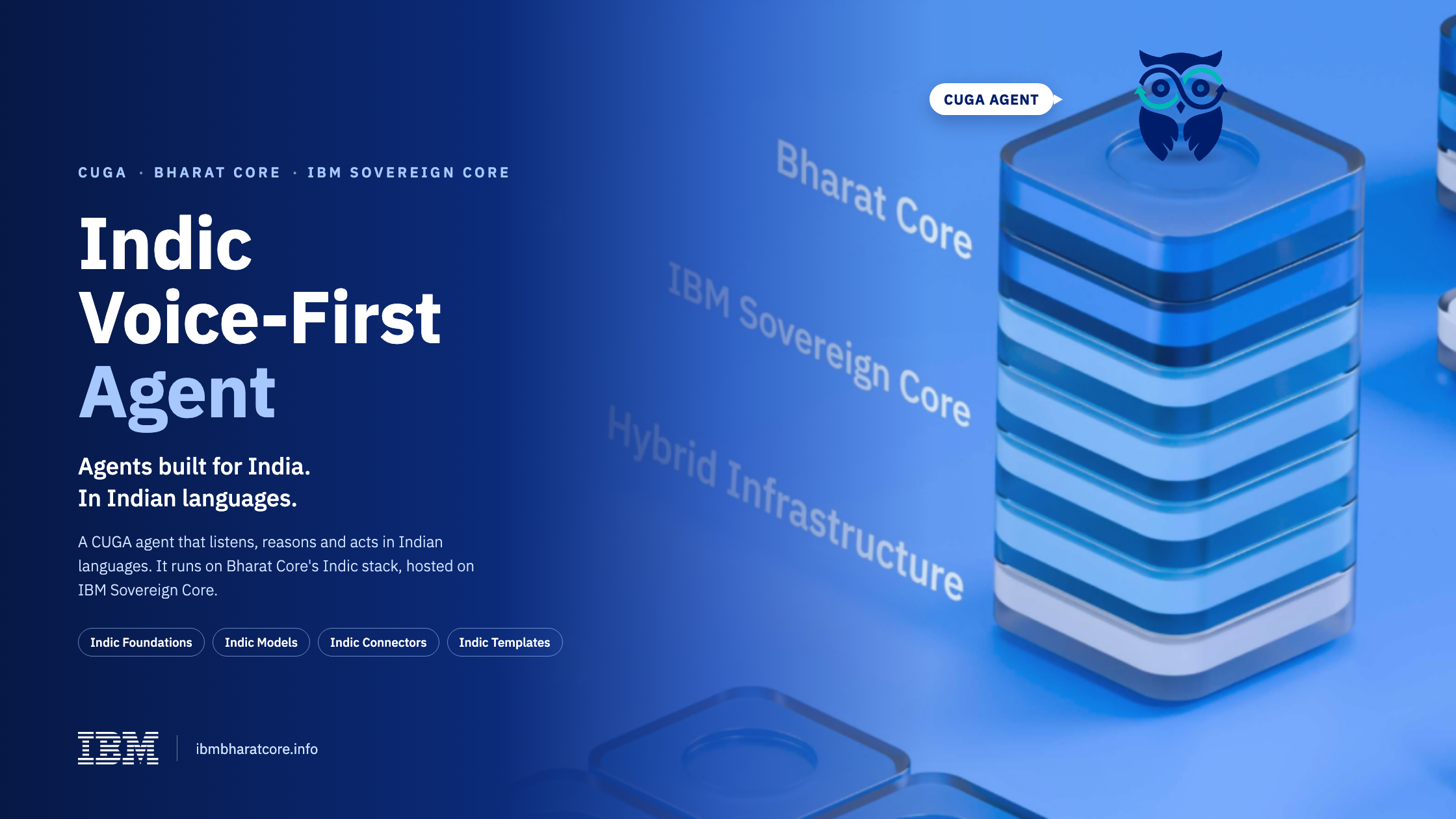
A spoken Hindi question searching an English document can fail without producing a single error message, and that silent failure was the one genuinely hard part of a voice assistant IBM Research describes building for farmers. The app takes a question asked aloud in Hindi, Tamil or another Indian language, searches a 154-page agricultural handbook written in English, and speaks back two to four sentences in the language the question was asked in, using only what the handbook says and showing the pages it came from. The step that decides which passages the model is allowed to use works by turning text into vectors, lists of numbers arranged so that similar meanings land near each other, and returning the ones nearest the question. That conversion is done by an embedding model, and CUGA, the open-source IBM Research harness that runs this app's agent loop, uses an English-only one by default. It turned Hindi into vectors that carry almost no meaning, the team writes, and the search still returned five passages; they were simply the wrong ones. The model, correctly instructed to answer only from what it had been given, then said the handbook did not cover the question. Every layer behaved as designed, so nothing logged a problem.
The fix was to swap in a multilingual embedding model, which puts the same meaning in the same place whatever language expresses it, so one English document serves every language and no translated copies are needed. The team used `intfloat/multilingual-e5-large`, whose model card says it starts from xlm-roberta-large, is continually trained on a mixture of multilingual datasets, and covers the 100 languages xlm-roberta supports, while warning that low-resource languages may see degraded performance. The card does not say which languages those are, so for any particular Indian language that is something to test rather than assume. The post calls the change conceptually simple but says wiring it into CUGA took a small workaround, which it defers to a companion tutorial, so the integration detail is not in the published evidence. The advice the authors draw is a test rather than a technique: before tuning a single prompt, ask the agent one question in a non-English language and check that it finds the right pages.
Everything around that retrieval problem is deliberately plain, which is the second idea worth taking. CUGA handles the model wiring, tool management, state and , so the team wrote tools and a prompt instead of an agent loop, and one setting switches the underlying model between watsonx and OpenAI; how much a harness contributes at all, including IBM's own benchmark comparison of CUGA against two other harnesses running one fixed model, is covered in a separate explanation. The agent itself is text in, text out: audio goes to speech-to-text, then to `agent.knowledge.search()` over a PDF that was parsed, chunked and embedded locally, then to the answer, then to text-to-speech. Because the agent never touches audio, it can be built and tested as plain text first, and the speech layer can be replaced without changing it, which is how the post supports both Sarvam AI's cloud APIs, called straight from the user's browser so the server never sees the user's key, and the open-source SraVaani and Svara models running on your own server. Each question also gets a fresh conversation thread, so one user's language or cannot leak into another's. The team says a few small decisions mattered more than expected: a prompt plus a light formatter keeps Markdown, bullets, citation tags and bracketed translations such as "millet (बाजरा)" out of text that will be read aloud, and simple input checks catch off-topic questions, with anything that slips through prefixed `OFF_TOPIC` by the model so the app can substitute a polite redirect without a second model call.
None of this is measured. The post reports no retrieval accuracy before or after the swap, no evaluation of answer quality, no latency figures and no user study, and it comes from the team that builds the harness, so the silent-failure story is an engineering account of what they hit and what they changed rather than a demonstrated result. The closing section is positioning too: the authors say nothing here is specific to agriculture, since the handbook could be swapped for scheme documents, health advisories or legal guides, and they tie the approach to IBM Bharat Core, which they describe as an optimized AI stack on IBM Sovereign Core for running Indic AI workloads securely on local infrastructure. What a reader can check without taking anyone's word for it is the running demo Space. What transfers is the failure signature: a retrieval stack that cannot cross languages does not crash, it tells the user politely that the document does not cover the question.
- guardrails — The checks around a model that block bad inputs and outputs — filters, validators, and permission rules the model itself can't override.
- grounding — Tying a model's answers to checkable sources — retrieved documents, live data, tool results — instead of letting it answer from memory alone.
- Context and context window — Context is the information available for a generation; the context window is the capacity available to hold it.
- Realtime conversational agent — An agent that processes streaming audio or visual input while a session is live.
Checking sign-in…
Loading comments…