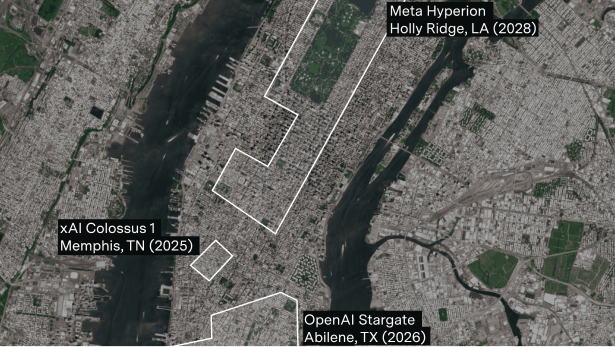
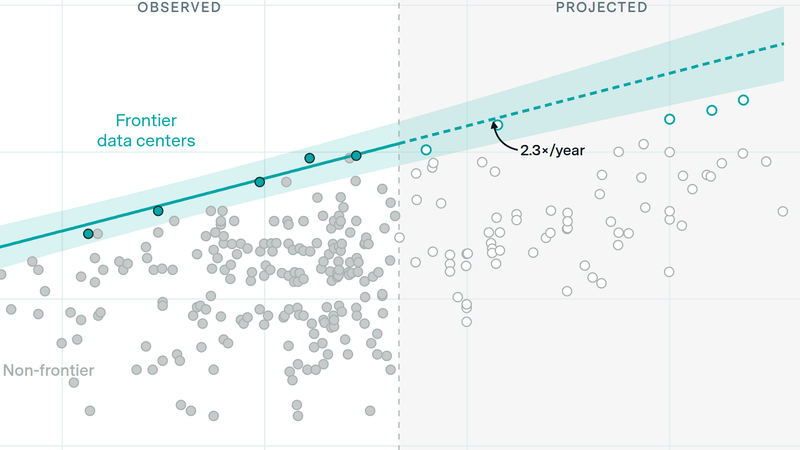
Power is the binding constraint on frontier training clusters. Epoch quantifies it (Stargate Abilene needs city-scale electricity), which helps engineers reason about future model capability, cost, and availability.
Key takeaways · AI-distilled
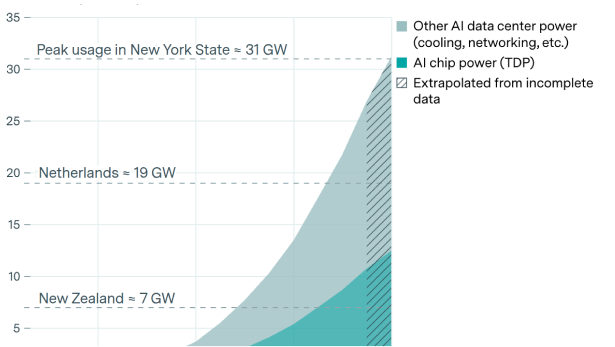
Epoch AI estimates US AI data centers will need 20 to 30 GW by late 2027. That is about 5% of US generation capacity, but 30 GW would be roughly 25% of Japan's, 50% of France's and 90% of the UK's, which favors the US and China for gigawatt-scale sites.
Distance to users barely matters: Epoch calculates Texas-to-New York transfer at about 12.5 ms, while generating a 1,000-word response takes on the order of 10 seconds, so builders pick sites for power, not proximity to cities.
Power density drives the design. An NVL72 GB200 rack draws over 100 kW in about 0.5 square meters, against roughly 10 kW for a typical non-AI rack. That forces liquid cooling, the reason AI data centers are associated with heavy water use.
Epoch judges AI's broad climate effect small so far: AI data centers use about 1% of US power, versus 12% for air conditioning, and all US data centers used 17.4B gallons of water in 2023 against agriculture's 36.5 trillion. It projects 5% of US electricity by 2027.
Gigawatt sites are hard to keep secret: thousands of workers from several organizations build them, and their large outdoor cooling equipment is visible in satellite imagery, which Epoch says weakens the Manhattan Project analogy.