Turning My Obsidian Vault Into a Local AI Engineer — Filip Makraduli, Superlinked
- Source
- youtube.com
- Publisher
- AI Engineer
- Author
- AI Engineer
- Date
Context
A that reads a user's files sees everything in them, so one approach is to route documents through a separate processing tool first. In this workshop, Filip Makraduli of Superlinked connects an Obsidian vault (a of Markdown notes) to a coding agent through , a standard way for agents to call external tools. The tools run small open models on infrastructure the team controls and handle OCR (reading text from scans), extraction, summarization, question answering and redaction. In the demo, a scanned NDA comes back as redacted Markdown, a smaller artifact, instead of every page going to a large model.
The closing discussion questions that privacy boundary. According to the session description, the closing discussion asks what happens if the agent can read the raw file before calling the tool: instructions alone may leave a gap, and questions explore separating file access from processing and checking whether the intended boundary actually holds. The supported lesson is therefore a constraint, not a guarantee. A local pipeline reduces what is sent to a hosted model only if the agent is also kept from reading the originals, and the description does not say how that question was resolved.
- Makraduli's demo turns a scanned NDA into a redacted Markdown document before a coding agent uses it: small open models on team-controlled GPUs do the OCR and redaction, and the agent receives only the smaller processed artifact.
- The setup splits into a host, an MCP server exposing extraction, summarization, question answering and redaction tools, and GPU worker pools; Superlinked's inference layer handles model loading, batching and workloads sharing the cluster.
- He ties these choices to embeddings, and task-specific LoRAs, and to routing work between models already warm on a GPU, so different document jobs can share one private cluster.
- Agent mode — A mode in which one agent can inspect, edit, run commands, and iterate toward an outcome.
- Folder — A named container that holds files and other folders; also called a directory.
- Model Context Protocol (MCP) — A published agreement for an AI application to discover what a separate program offers and ask it to run one of those offerings.
- reranking — A second pass that re-scores retrieved candidates by reading each one against the query, fixing the ordering that fast vector search got approximately right.
 video1,000 Claude Agents Formalized Fermat's Last Theorem — Lance Martin, Anthropic
 videoHow 21 People Built a $100M+ Agent Company — Quinn Slack, Amp
 videoSoftware Factories: Escape from Trash Mountain — Steve Yegge, Gas Town
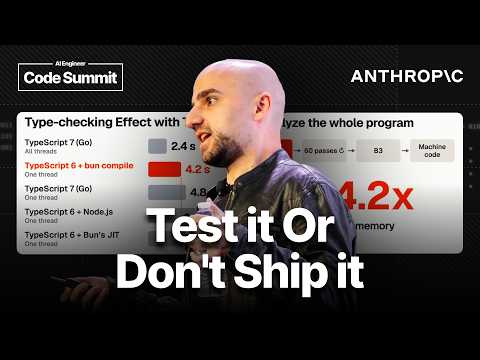 videoHow to Ship Millions of Lines of Agent-Written Code — Jarred Sumner, Anthropic
 videoHow Secrets Leak Through AI Agents (and How to Stop It) — Venice AIAI Engineer
 videoTurn 10,994 Notes Into Memory - Paul Iusztin, Decoding AI & Louis-François Bouchard, Towards AIAI Engineer
 videoFrom Ingestion to Agents: How AI Teams Build on Document Intelligence — Adit Abraham, ReductoAI Engineer