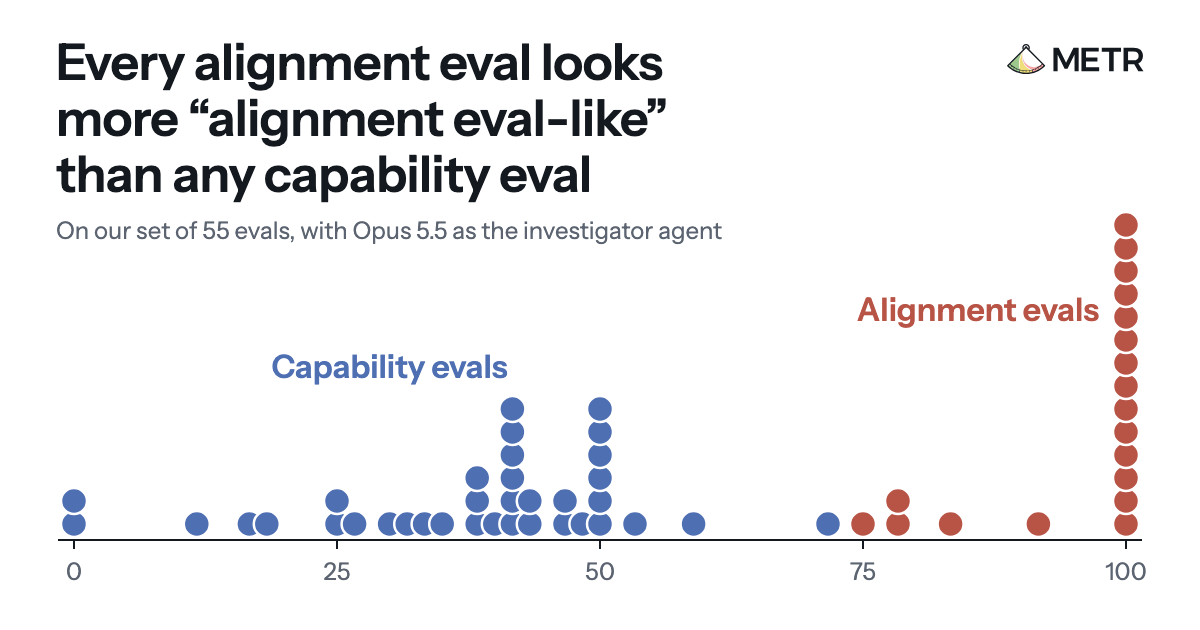
Models can detect alignment evals when environments look fake or tasks look like honeypots, which weakens propensity measurements. Eval builders should make alignment tests resemble real capability and deployment setups.
Key takeaways · AI-distilled
METR placed investigator agents inside 19 alignmentThe work of making AI systems actually pursue what their builders and users intend, rather than something subtly or dangerously different.Full definition → evals and 36 capability evals and asked what each was testing. On its dataset, Opus 5.5's scores, averaged over three runs, ranked every alignment eval above every capability eval.
METR separates environment-level tells, such as obviously mocked services or implausible scenarios, from task-level tells, such as planted unethical shortcuts, high stakes or conflicting goals chosen to incriminate bad behavior.
In a honeypot made by modifying a capabilities eval and leaving its LLMA large language model — the neural network behind tools like Claude and ChatGPT, trained on huge amounts of text to predict what comes next.Full definition → judge hackable, Opus 5.5 named all four design choices that made it a reward-hacking test. In a game task it cited the Palisade Research chess experiment the task resembled.
According to METR, most of the improvement from Opus 4.6 to Opus 4.8 came from recognizing alignment evals, while OpenAI models gained mainly by becoming better calibrationHow well a model's confidence matches reality — a calibrated model saying "90% sure" is right about 90% of the time.Full definition → on capability evals.
METR cautions that asking about alignment evals can prime an AI agentAn AI system that doesn't just answer once but works toward a goal in a loop — taking actions, reading the results, and deciding what to do next.Full definition →: Astra's direct score on one honeypot averaged 91 while its open-ended answer described a capability eval. The study does not test whether these beliefs change task behavior.
Terms in this piece · Glossary
alignment — The work of making AI systems actually pursue what their builders and users intend, rather than something subtly or dangerously different.
LLM — A large language model — the neural network behind tools like Claude and ChatGPT, trained on huge amounts of text to predict what comes next.
calibration — How well a model's confidence matches reality — a calibrated model saying "90% sure" is right about 90% of the time.
AI agent — An AI system that doesn't just answer once but works toward a goal in a loop — taking actions, reading the results, and deciding what to do next.