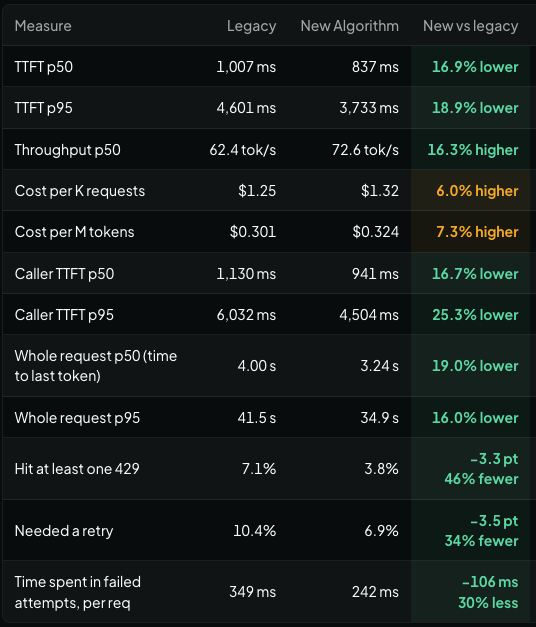
OpenRouter's default routing now scores providers on effective price, throughput, reliability and quality rather than mostly price. Expect faster, more reliable responses at about 6% higher cost unless you pin or sort providers.
Key takeaways · AI-distilled
OpenRouter's old router ranked almost entirely on input tokenThe chunk of text a model reads and writes in — roughly three-quarters of a word — and the unit AI usage is billed in.Full definition → price, so providers could hold traffic by listing a low input price and recouping it on pricey cached or completion tokens. The new one uses effective price from measured traffic, including real cache hit rate.
OpenRouter's Routing Cost prices in retries: if 1 in 5 tries fails, a good answer costs 1.25 tries. Quality counts too, mainly well-formed tool calls, and a provider flagged for broken tool calls or low benchmarkA standard public test set for comparing AI models — the shared scoreboards behind every "model X beats model Y" claim.Full definition → accuracy gets only a trickle of test traffic until cleared.
OpenRouter adds time to first token to the Routing Cost on top of throughput, even though throughput already includes it, because AI agentAn AI system that doesn't just answer once but works toward a goal in a loop — taking actions, reading the results, and deciding what to do next.Full definition → sessions make many tool calls in a row and each one waits on a first token.
OpenRouter says a plain A/B test would mislead, since steering new-router traffic off a struggling provider frees capacity for the control group. It ran a week-long switchback instead: 3-hour blocks alternating routers with a discarded one-hour burn-in, over 24 million requests.
Three guardrailsThe checks around a model that block bad inputs and outputs — filters, validators, and permission rules the model itself can't override.Full definition → sit on OpenRouter's scoring: every provider keeps a trickle of traffic so recovery is noticed, failing providers get backed off, and a learned per-provider load cap spills excess before 429s. In the test, requests needing a retry fell from 10.4% to 6.9%.
Terms in this piece · Glossary
token — The chunk of text a model reads and writes in — roughly three-quarters of a word — and the unit AI usage is billed in.
benchmark — A standard public test set for comparing AI models — the shared scoreboards behind every "model X beats model Y" claim.
AI agent — An AI system that doesn't just answer once but works toward a goal in a loop — taking actions, reading the results, and deciding what to do next.
guardrails — The checks around a model that block bad inputs and outputs — filters, validators, and permission rules the model itself can't override.