Theorizer comes to Asta
- Source
- allenai.org
- Date
Context
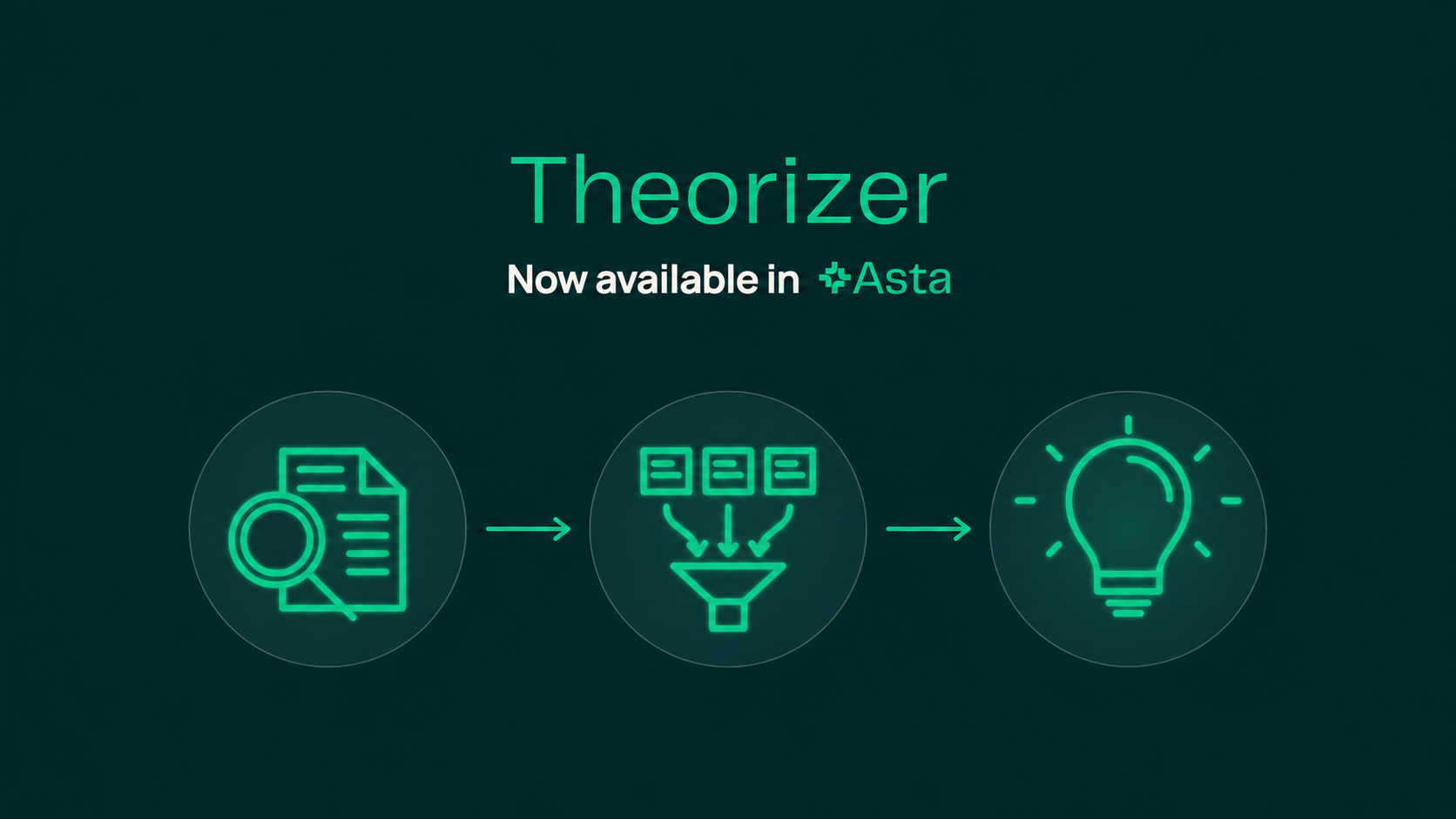
Ai2, the Seattle non-profit research institute, has launched Theorizer in Asta, its platform of AI agents for scientific research, and released the code openly so researchers can inspect how it works. The job Theorizer does is narrow and specific: you give it something you cannot explain, such as a tumor growing without a known cause or an implausible value in a dataset, and it searches the published literature, builds a template for what to extract from each paper it finds, compares those extracted findings, and proposes explanations with each claim linked back to the study behind it. That linking is the point of the design. A researcher can open the cited papers and judge whether the studies examined comparable conditions before deciding whether a proposed theory is worth an experiment.
Ai2's announcement describes four groups who tested it over roughly a year of co-development. Sid Devarakonda, a thoracic oncology director at Providence Swedish Cancer Institute, used it on "driver-negative" lung adenocarcinoma: in roughly 20% to 30% of cases of the most common lung cancer subtype, even full sequencing finds no recognized genetic alteration driving growth. After several rounds, Theorizer helped him state three candidate explanations, and follow-up analysis with AutoDiscovery, an Asta that writes and runs code against datasets, pointed at a mechanism he had not been focused on, then at preliminary evidence that some of these tumors may depend on a cell-division protein called CDK2. Ai2 is explicit that this still requires experimental validation. At the International Potato Center in Peru, Piero Palacios and Henry Juarez got a theory that turned out to be wrong, and said so: it proposed a seasonal humidity rise to explain implausible dew-point values, and testing it ruled it out, but it pushed them to measure the anomaly by distance from weather stations, which is the analysis that traced the values to how the original climate dataset estimated conditions far from any station.
Read together, those accounts describe a tool that changes where a researcher spends rather than one that produces answers. A neuroscientist at the Allen Institute, Jerome Lecoq, got 50 candidate theories about one class of brain cell where he had expected one or two, and the one he singled out restated an idea already in the literature while connecting computational and experimental strands into an account he could weigh against his own view. Ai2 states the limits plainly: a search can miss earlier work, so a claim Theorizer flags as new may already exist elsewhere, and the researcher still has to check. Asta's web interface covers costs up to a limit, and the open library can be run locally, which Ai2 connects to scientists telling them their best evidence sits in internal reports they cannot send to commercial AI labs. That is the same reasoning behind its release of the small open-weight AstaBrief model for writing cited reports on a researcher's own servers.
- Theorizer searches the literature for a question, builds a template of what to extract from each paper, then compares the extracted findings to generate theories with every claim linked to its source papers, so researchers can check support and whether conditions match.
- Ai2 warns Theorizer flags claims it considers new but can miss earlier work and misjudge originality, so a theory that looks novel within the papers it analyzed may already exist elsewhere in the literature.
- For driver-negative lung adenocarcinoma, about 20-30% of cases, Theorizer helped turn a broad question into three hypotheses. Follow-up with AutoDiscovery gave preliminary, not yet validated support that some low-RAS cancers may depend on CDK2.
- At Peru's International Potato Center, a Theorizer explanation for implausible November dew points proved wrong, but testing it led researchers to measure the spike by distance from weather stations, tracing the error to how the PISCO dataset estimated remote conditions.
- Ai2 covers token costs up to a limit for Theorizer in Asta's web interface and open-sourced the library, so researchers can run it on their own machines, paying for tokens, and adapt its methods.
- AI agent — An AI system that doesn't just answer once but works toward a goal in a loop — taking actions, reading the results, and deciding what to do next.
- attention — The mechanism that lets a model weigh which earlier words matter for the word it's currently processing — the core operation of a transformer.
- token — The chunk of text a model reads and writes in — roughly three-quarters of a word — and the unit AI usage is billed in.
- open weights — A model whose trained parameters are published for anyone to download and run — unlike API-only models you can access but never possess.

Checking sign-in…
Loading comments…