An updated Clairic and Clairic-flash are now open-weight, from the new Workers AI Superintelligence team
- Source
- blog.cloudflare.com
- Date

Context
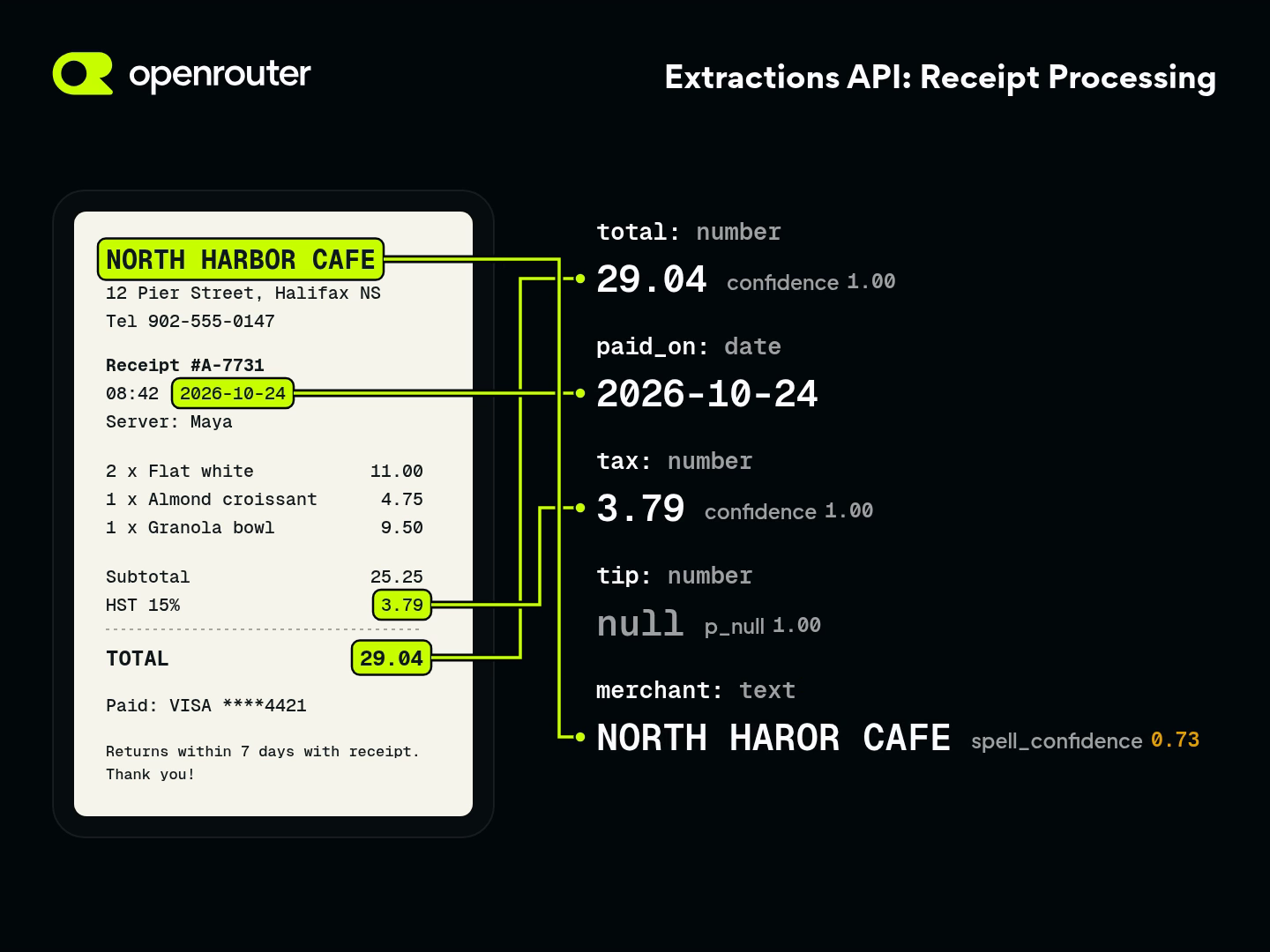
Cloudflare has published the weights of its two Clairic models, which pull specific facts out of documents, and has switched its hosted endpoint to a larger model with a price rise due on December 1. Clairic is an extraction model: a developer sends a document, such as a support ticket, a lease or a photo of a receipt, along with a list of fields to fill, such as the supplier, the line items and the total. It returns typed values with confidence scores and the character positions in the source each answer came from, so an application can check where a value was found. Cloudflare first offered it as a preview in October. According to Cloudflare's announcement, the updated Clairic has 27 billion parameters, the new Clairic-flash has 9 billion, and both are on Hugging Face.
The main change is how the model writes its answers. The preview produced every field in a single pass over the input. The new version writes each text or number field by token, using what it has already written to choose the next token, and all fields are generated side by side until each reaches its own end marker. Separate trained components handle estimates, forecasts, durations, calculated dates and arithmetic. Cloudflare says this costs a little speed and buys accuracy: in its latency tests, median responses ranged from 358 to 691 milliseconds for Clairic and from 155 to 393 milliseconds for Clairic-flash, depending on the workload. The models can now read PDFs as well as images, up to four images or pages per request. On Cloudflare's internal tests, both new models filled all 576 synthetic receipt fields correctly, against 369 for the preview, though no public extraction exists yet, and Cloudflare asks readers to take these self-reported evaluations as "directional guidance."
The practical change is for anyone already calling the preview. The endpoint `@cf/cloudflare/clairic` used to serve the 9 billion parameter model at $0.10 per million input tokens. It now serves the 27 billion parameter model, rolled out in place, and that model will cost $0.24 per million input tokens from December 1. The smaller model moves to `@cf/cloudflare/clairic-flash` and stays at $0.10. Both cost $0.10 until December 1, and Cloudflare charges only for input tokens. Teams that care more about cost than the extra accuracy need to switch endpoints before then. The Hugging Face listing marks the weights as Apache 2.0.
- Cloudflare redesigned Clairic after its preview: text and number fields now use parallel slot autoregressive generation, where each field picks tokens from what it has already written and stops at its own end marker, with all fields advancing together in the serving batch.
- Separate trained heads handle estimates, forecasts, durations, calculated dates and arithmetic, and every response still returns confidence scores, character spans and probabilities, according to Cloudflare.
- On Cloudflare's own , which it calls directional and self-reported, Clairic scored 335/336 on fresh text fields versus 295/336 for the preview, and image-reading errors fell from 207 to 0 on its internal benchmark.
- Cloudflare measured sub-second full HTTP responses from a self-hosted server: Clairic's p50 ranged from 358 to 691 ms and the 9B Clairic-flash's from 155 to 393 ms across its eval sets.
- Pricing charges input tokens only: $0.24 per million for the 27B Clairic and $0.10 for the 9B Clairic-flash, with Clairic discounted to $0.10 until December 1, 2026. Apps on the preview endpoint get the new model in place.
- open weights — A model whose trained parameters are published for anyone to download and run — unlike API-only models you can access but never possess.
- token — The chunk of text a model reads and writes in — roughly three-quarters of a word — and the unit AI usage is billed in.
- benchmark — A standard public test set for comparing AI models — the shared scoreboards behind every "model X beats model Y" claim.
- eval — A repeatable test for AI quality — a set of tasks plus scoring — used the way software teams use test suites, because model output is too variable to judge by eyeballing.


Checking sign-in…
Loading comments…